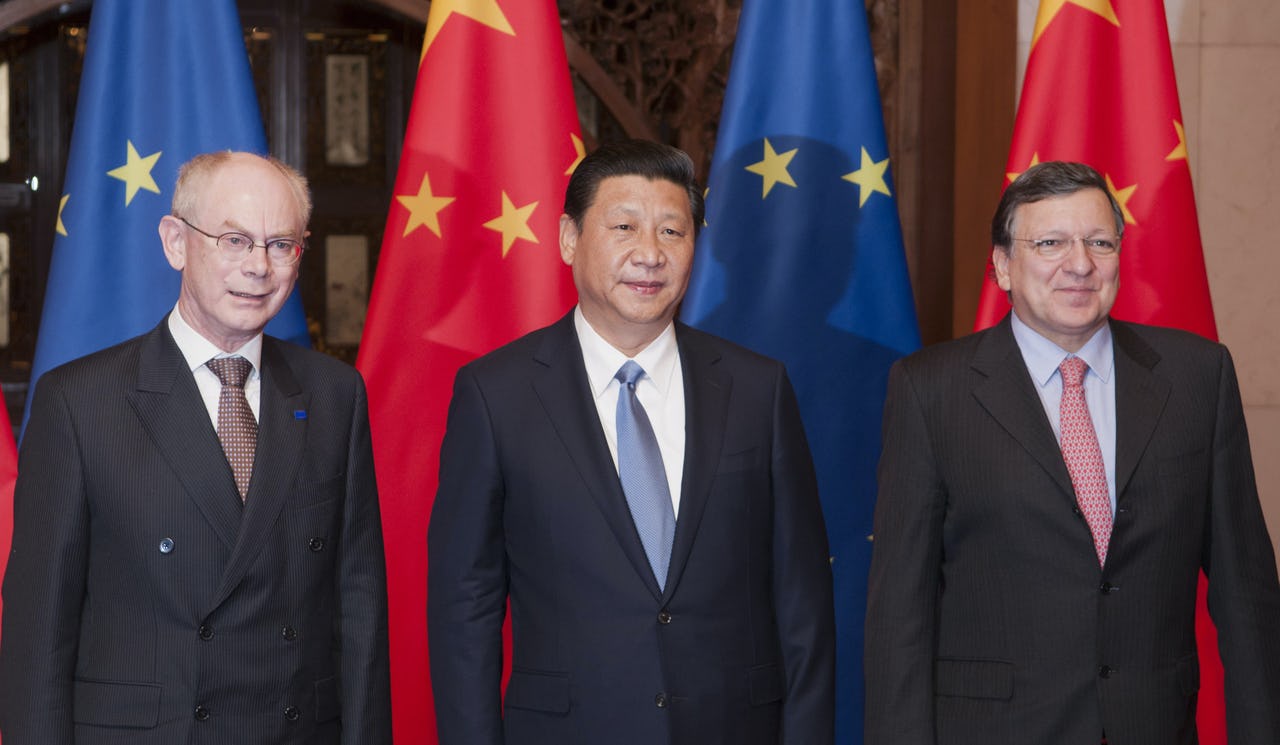
Herman van Rompuy, Former President of the European Council (the left) and José Manuel Barroso, Former President of the European Commission (the right) met with Xi Jinping, President of the People’s Republic of China (the middle) on 21 November 2013, during the 16th Sino-EU Summit. Both China and the EU agreed that they would strengthen the communication of Arctic affairs, including joint research programmes. Photo: EC – Audiovisual Service
With rapid Arctic changes, non-Arctic actors, particularly China and the European Union (EU), have been showing a growing interest in and have been playing a more active role in Arctic affairs. Non-Arctic actors’ specific interests and motivations in the Arctic have already been well-explored in literature.1)See Airoldi A (2014) The European Union and the Arctic: Developments and Perspectives 2010-2014. Copenhagen: Nordic Council of Ministers. Kopra S (2013) China’s Arctic Interests. Arctic Yearbook 2: 1-16. Schulze V G (2017) Arctic Strategies Round-up 2017. Working paper. German Arctic Office. Scholars such as De Mestral2)Mestral A (2012) The EU as an Arctic Power: Analysis of the Competence of the EU in the Arctic by Policy Areas. Dalhousie Law Journal 35(2): 329-356., Nielsson & Magnússon3)Nielsson E T & Magnússon B M (2019) China’s Arctic Policy White Paper and Its Influence on the Future of Arctic Legal Developments. In Shibata A, Zou L, Sellheim N & Scopelliti M (Eds.) Emerging Legal Orders in the Arctic: The Role of Non- Arctic Actors (pp.49-65). London| New York: Routledge. and Wegge4)Wegge N (2014) China in the Arctic: Interests, Actions and Challenges. Nordlit 32: 83-98. have also made some comments on the justification of non-Arctic actors’ interest-motivated Arctic participation, but they only engage with this fleetingly. Most of these discussions are based on secondary sources such as non-official media reports; some do not even specify the data sources they rely on at all. Admittedly, there are a few studies that include scattered primary data on Arctic policy, but most of them have no systematic methodology. The existing research mostly ignores the systematic examination of whether non-Arctic actors actually justify their Arctic participation in line with those academic views on justification.
In order to systematically explore how non-Arctic actors justify their participation in the Arctic, primary data, namely, about actors’ official Arctic policies, needs to be collected comprehensively and analysed in context. These policies are mainly reflected by actors’ relevant policy documents, official press releases, and leaders’ speeches and statements, which can be analysed as discourse.5)See Ball S (1990) Politics and Policy Making in Education: Explorations in Policy Sociology. London: Routledge. Ball S (1993) What is Policy? Texts, Trajectories and Toolboxes. Discourse: Studies in the Cultural Politics of Education 13(2): 10-17. Goodwin N (1996) Governmentality in the Queensland Department of Education: Policies and the Management of Schools. Discourse 17(1): 65-74. Watts R (1993) Government and Modernity: An essay in Thinking Governmentality. Arena Journal 2(2): 103-157. However, systematic discourse analysis is lacking in existing research. When observing actors’ official Arctic discourses, their official attitudes/stances towards the Arctic are sometimes mentioned but very superficially.6)See Liu H, Dong Y & Chen Y (2012) China and the Arctic: The Path of Science Research, Law and Policy. Polar Oceans Governance 26(1): 361-380. Moisio S (2003) Back to Baltoscandia? European Union and Geo-Conceptual Remarking of the European North. Geopolitics 8 (1): 72-100. Considering the influence that attitudes can have on behaviours,7)See Ajzen I & Fishbein M (2005) The Influence of Attitudes on Behavior. In Albarracin D, Johnson B T & Zanna M P (Eds.) The Handbook of Attitudes (pp.173-221). Mahwah, NJ: Lawrence Erlbaum Associates. Ajzen I (2011) The Theory of Planned Behavior: Reactions and Reflections. Psychology & Health 26(9): 1113-1127. actors’ official attitudes/stances towards the Arctic play a crucial role in their actual participation in Arctic affairs. Hence, a comprehensive discourse analysis with systematic methodology is needed to explore non-Arctic actors’ official attitudes/stances towards the Arctic and how they justify their Arctic participation given their official attitudes/stances.
Considering that Arctic environmental change has wide-ranging influences on Arctic affairs, and almost all the participants frequently make reference to the Arctic environment in their official political discourse, this article plans to focus on the environmental discourse of non-Arctic actors in Arctic affairs (‘Arctic environmental discourse’). Arctic environmental discourse refers to the official political discursive elements8)According to Mühlhäusler and Peace (2006), the vital addressers/producers of environmental discourse would be governments, transnational bodies and powerful organisations, and speakers would be media and persons who represent the producers of environmental discourses (Mühlhäusler P & Peace A (2006) Environmental Discourses. Annual Review of Anthropology 35: 460). In this sense, ‘Arctic environmental discourse’ is a kind of official political discourse. employed to articulate Arctic environment-related topics such as Arctic climate change, the relationship between humans and the Arctic environment, and the future of the Arctic environment.9)More specifically, these articulations are basically reflected in the various linguistic forms employed in various contexts. These articulations centre on the influences of Arctic environmental issues, including possible negative domestic and international impacts, the possible opportunities that environmental changes could bring, and actors’ official assessments, policies, and actions related to it.
As key non-Arctic actors, both China and the EU have manifested increasing interest in and taken active participation in Arctic affairs, particularly after August 2007.10)Since Russia planted a titanium national flag on the North Pole seabed in August 2007, the Arctic has attracted increasing attention from the international community, including Arctic states and non-Arctic actors such as China and the EU. Moreover, both frequently emphasise the importance of environmental protection and seem to adopt some similar strategies to exert their power to have a say in Arctic affairs. For example, both have highlighted their strong concern about Arctic climate change and their rising contributions to climate change mitigation and adaptation. Despite these similarities, the EU and China operate within different contexts. For instance, the EU has some direct connections with the Arctic.11)Three Member States (Finland, Sweden, and the Kingdom of Denmark) and two other members of European Economic Area (EEA) (Norway and Iceland) are Arctic states and members of the Arctic Council. Due to the geographical link, the EU is also more vulnerable to Arctic climate change than other non-Arctic actors such as China. Their different situations in the Arctic could lead to diversified ways of participation. Therefore, it is significant to compare the official use of the Arctic environmental discourses of China and the EU. This can lead to a better understanding of non-Arctic actors’ participation in the context of Arctic environmental changes.
Methodology and Analytical Framework
The non-numeric data is mainly collected from primary sources from August 2007 to November 2019 (the beginning of this research). It includes both actors’ Arctic policy papers and other official documents associated with Arctic affairs,12)For example, China’s Arctic policy papers and other relevant official documents include China’s Arctic Policy (the State Council Information Office, January 2018), Vision of Maritime Cooperation in Building the “Belt and Road Initiative” (the National Development and Reform Commission & the State Oceanic Administration, June 2017), National “Eleventh Five-Year” Marine Science and Technology Development Plan Outline (Ministry of Natural Resources, September 2009) and so on. The EU’s examples include The European Union and the Arctic Region (Commission of the European Communities, November 2008), Developing a European Union Policy towards the Arctic Region: Progress since 2008 and Next Steps (European Commission & High Representative of the European Union for Foreign Affairs and Security Policy, June 2012), An Integrated European Union Policy for the Arctic (European Commission & High Representative of the European Union for Foreign Affairs and Security Policy, April 2016), and so on. relevant official press releases and press briefings,13)For example, the EU’s relevant press releases include Knowledge, Responsibility, Engagement: the EU Outlines its Policy for the Arctic (European Commission, July 2012), EU in Talks to Prevent Unregulated Fisheries in the Arctic High Seas (European Commission, March 2017), Central Arctic: EU to Enter Agreement against Unregulated Fishing (Council of the EU, March 2019), and so on. and key leaders’ speeches and statements.14)For example, relevant speeches and statements made by Chinese leaders and senior officers include Statement by H.E. Ambassador Lan Lijun at the Meeting between the Swedish Chairmanship of the Arctic Council and Observers (then Chinese Ambassador to Sweden Lan Lijun, November 2011), Pioneering and Enterprising: From a Polar Major-country to a Polar Great Power — Retrospect and Prospect of 30-year Chinese Polar Expedition (Secretary of the Leading Party Group and Director of the State Oceanic Administration Liu Cigui, November 2014), Keynote Speech of Mr. Gao Feng at the Opening Ceremony of the 5th China- Nordic Arctic Cooperation Symposium (China’s Special Representative for Arctic Affairs Gao Feng, May 2017), and so on. Relevant speeches and statements made by EU leaders and senior officers include The European Union and the Arctic Region (European Commissioner for Maritime Affairs and Fisheries Maria Damanaki, October 2012), Vice-President Katainen’s Speech at the Arctic Conference (the European Commission’s Vice-President Jyrki Tapani Katainen, June 2019), Speech by Commissioner Vella at the EU Arctic Forum (European Commissioner, Karmenu Vella, October 2019), and so on. In addition, authoritative media reports are selected as a secondary data source for China to supplement the lack of Arctic policy papers and press releases. This is because China has only released one white paper on Arctic policy up until now.15)These supplementary media reports are selected from China’s official media, which is fairly consistent with the Chinese official discourse. Selected China’s official media in this article mainly include China Daily, Xinhua News Agency, People’s Daily, China Ocean News, and China Internet Information Office. Open access to the research data is provided at the moment.
Based on the collected official data, systematic discourse analysis is adopted to analyse the official use of both actors’ Arctic environmental discourses. This discourse analysis is conducted from the perspectives of attitudinal resources and justification resources, which highlights the functions of discourse: ‘to be expressive of’16)See Kinneavy J E (1969) The Basic Aims of Discourse. College Composition and Communication 20(5): 297-304. and ‘to persuade’17)See Aydin-Düzgit S & Rumelili B (2019) Discourse Analysis: Strengths and Shortcomings. All Azimuth 8(2): 285-305. Poppleton C A (1998) An Activity for Teaching the Purposes of Discourse. The Internet TESL Journal 4(5).. In this article, I use ‘attitudinal resources’ to refer to the discursive elements conveying the official attitudes/stances towards Arctic affairs relevant to environmental changes in Arctic environmental discourses. For example, in EU Arctic environmental discourses, “The EU can play an important role in contributing to the reduction of hazardous pollution in the Arctic”, especially “an important role”,18)Council of the European Union (2009) Council Conclusion on Arctic Issues. 8 December, https://ec.europa.eu/maritimeaffairs/sites/maritimeaffairs/files/docs/body/arctic_council_conclusions_09_en.pdf. Accessed on 29 January 2020 and “The EU edge in technologies for sustainable exploitation of resources in polar conditions”19)Commission of the European Communities (2008) The European Union and the Arctic Region. 20 November, http://eeas.europa.eu/archives/docs/arctic_region/docs/com_08_763_en.pdf. Accessed on 29 January 2020 show positive self-judgements.20)These examples take the monogloss dialogistic position and explicitly convey a positive self-judgement of the EU itself with a high capacity in the Arctic pollution reduction and sustainable exploration of resources within the context of Arctic environmental changes. I also use ‘justification resources’ to refer to the discursive elements that discourse initiators use to justify their Arctic participation in Arctic environmental discourses. For instance, in China’s Arctic environmental discourses, “Arctic climate change… has had a direct and profound impact on China’s weather, climate, ecological system, agriculture production… The melting of Arctic glaciers causes the global sea-level rise, which affects the economic and social development of China’s coastal areas”21)Shu J (2018) 专访极地办:中国愿同国际一道维护北极和平 [Interview with the Chinese Arctic and Antarctic Administration:China is Willing to Make Contributions to Arctic Peace with the International Community]. 中国网[China Internet Information Centre], 31 January, http://ocean.china.com.cn/2018-01/31/content_50365457.htm. Accessed on 24 November 2019 clearly highlights that China has been affected negatively by Arctic climate change, as a resource to justify the necessity of China’s Arctic participation as a stakeholder.
Content analysis is conducted to supplement and enhance discourse analysis by identifying the extent to which the official attitudes/stances and justification themes are employed in Arctic environmental discourses and the chronological changes. Such mixed methods can explore the “multiplicity, variety, instability, and historical contingency” of the discursive construction “within specific sociohistorical contexts.”22)Feltham-King T & Macleod C (2016) How Content Analysis May Complement and Extend the Insights of Discourse Analysis. International Journal of Qualitative Methods: 5-7.
The specific analytical framework of attitudinal resources is proposed by adjusting and further developing the Appraisal Theory,23)Martin J R (2000) Beyond Exchange: APPRAISAL Systems in English. In Hunston S & Thompson G (Eds.) Evaluation in Text: Authorial Stance and the Construction of Discourse (pp.142-175). Oxford: Oxford University Press. Martin J R & Rose D (2003) Working with Discourse: Meaning beyond the Clause. London| New York: Continuum. Martin J R & White P R R (2005) The Language of Evaluation: Appraisal in English. Hampshire| New York: Palgrave Macmillan. which offers significant methodological guidance for the type of discourse analysis in this article. Appraisal Theory focuses on all evaluative uses of language and can help researchers capture the attitudes, value positions, and discourse initiators’ opinions by evaluating discourse. Besides, this theory highlights ‘interpretive’ and ‘explanatory’ analysis, centring on the semantic essence hidden behind the superficial layer of language, namely, semantic meanings, contexts, and ideological positionings.24)Wang Z H (2001) 评价系统及其运作:系统功能语言学的新发展[APPRAISAL Systems and Their Operations: A New Development in the Systemic Functional Linguistics]. 外国语[Journal of Foreign Languages] 6: 13-20. According to Martin & White (2005), there are two broad attitudinal tendencies – positive attitudes/stances and negative attitudes/stances.25)Martin J R & White P R R (2005) The Language of Evaluation: Appraisal in English. Hampshire| New York: Palgrave Macmillan. In this research, six attitudes/stances under either positive or negative attitudinal tendency are formulated: ‘desiderative feeling’, ‘feeling of security’, ‘evaluation of impacts’, ‘self-judgement’, ‘judgement by others’ and ‘judgement of others.’
The analytical framework of justification is proposed by combining deductive and inductive approaches, which includes four categories: ‘necessity’, ‘importance’, ‘legitimacy’, and ‘reasonability’. Specifically, the ‘necessity’ of Arctic participation focuses on ‘urgency of participation as a stakeholder’ and ‘responsibility’; the ‘importance’ of participation highlights the ‘contribution’ and ‘worthiness’; and the ‘reasonability’ includes three foci – ‘trans-regional and global nature of the Arctic environment and relevant Arctic affairs’, ‘reliability’, and ‘bilateral and multilateral participation’.
Comparison of the Attitudinal Resources
When employing the Arctic environmental discourses, both China and the EU pay attention to conveying their official attitudes/stances towards the matters relevant to the Arctic environment and climate change. According to the rigorous data analysis, it seems that a series of common features are shared in their attitudinal resources. In general, both actors hold optimistic attitudes/stances towards Arctic affairs within the context of Arctic environmental changes. For example, both actors pay close attention to the prospects of the development of Arctic trade, shipping, energy and mineral resources, fishing, and tourism within the context of Arctic climate change; and China attaches importance to the Arctic shipping opportunities in particular. Both actors also display a strong willingness to actively participate in various Arctic affairs triggered by Arctic climate change.
Judgement resources are the dominant attitudinal resources for both actors, and they particularly focus on positively judging themselves in the Arctic. Also, it seems that both actors intend to objectively and critically evaluate the impacts of Arctic climate change. In addition, both actors rarely convey the ‘feeling of security’ in their Arctic environmental discourses. Although it seems that the changes in the Arctic do not directly affect the security of non-Arctic actors such as China and the EU, the prospects of the exploration and exploitation of the Arctic natural resources are indeed more or less related to China and the EU’s energy security,26)See Hossain K (2010) EU Energy Policy and the Arctic Region: A Balancing Interest between Environmental Responsibility and Resource Dependence. European Energy and Environmental Law Review 19(6): 295-305. Peimani H (Ed.) (2013) Energy Security and Geopolitics in the Arctic: Challenges and Opportunities in the 21st Century. Singapore: World Scientific. and Arctic climate change does have repercussions for their climate security.27)See Pan M & Zhou Y D (2010) 论北极环境变化对中国非传统安全的影响[Arctic Environmental Change on China’s Non-Traditional Security]. 极地研究[Chinese Journal of Polar Research] 22(4): 415-422. Manicom J & Lackenbauer P (2013) East Asian States, the Arctic Council and International Relations in the Arctic. Waterloo: Center for International Governance Innovation. Xia L P (2014) 规范性力量理论视阈下的欧盟北极政策 [On the Arctic Policy of European Union from the Perspective of Theory of Normative Power]. 社会科学[ Social Science] 1: 14-22. A possible reason for lacking such attitudes/stances could be that both China and the EU, being non-Arctic actors, intend to decrease any doubt and resistance to their Arctic participation from the international community, especially Arctic states, by avoiding mentioning security concerns in their Arctic participation. This is because security concerns are in the realm of ‘high politics’ in general,28)The traditional security issues refer to the threats against the territorial integrity, political sovereignty, and the core value of the state, which are naturally considered high politics issues, see Baldwin D A (1997) The Concept of Security. Review of International Studies 23:5-13. Attinà F (2016) Traditional Security Issues. In Wang J & Song W (Eds.) China, the European Union, and the International Politics of Global Governance. New York: Palgrave Macmillan. The concept of security has already gone beyond the traditional understanding, and non-traditional security issues focus on the political and socio-economic challenges to “the survival and well-being of peoples and states”, such as “climate change, resource scarcity, infectious diseases, natural disasters…transnational crime”. (Caballero-Anthony M (2016) An Introduction to Non-Traditional Security Studies – A Transnational Approach. London: Sage.) However, security concerns are still generally assumed as high politics issues. which are more sensitive to and attract greater attention from states,29)This is because high politics is assumed “more vital to the state’s continued existence” and to have a priority in the state’s political agenda, see Youde J (2016) High Politics, Low Politics, and Global Health. Journal of Global Security Studies 1(2):157-170. in mainstream international politics. In this sense, frequent mentioning of security concerns in their Arctic discourses could lead to misunderstanding and even overreaction from Arctic states. Such logic seems to also be at work when looking at their justification resources.
Besides the aforementioned similarities, there are also some differences in China and the EU’s attitudinal resources. First of all, their attitudes/stances have different chronological features. The frequency of attitudinal resources in China’s Arctic environmental discourses has been continuously rising in general, especially from 2016, reaching a peak in 2018 when China issued its first white paper on Arctic policy. It reflects that China has an increasing interest in the Arctic and that Arctic climate change and associated Arctic affairs are gradually entering China’s political agenda, particularly since 2016. Compared to China, the distribution of the EU’s attitudinal resources is more balanced despite periodic fluctuations following the updating of its Arctic policy in 2012 and 2016. This reveals that the EU has formulated its own attitudes/stances since its 2008 Arctic policy and has kept developing its attitudes/stances regularly. In this sense, it could be argued that the EU has more mature attitudes/stances towards the Arctic, which could better guide its current and upcoming Arctic participation.
Second, the EU pays more attention to making positive self-judgements in its Arctic environmental discourses. In some cases, the EU prefers to position itself as a ‘leader’, especially in the Arctic climate change governance and Arctic research, while China never makes similar judgements in its Arctic environmental discourses. One reason could be that the EU, as a normative power, is generally assumed to be a leader in international climate change governance,30)See Bernauer T, Gampfer R & Kach A (2014) European Unilateralism and Involuntary Burden-Sharing in Global Climate Politics: A Public Opinion Perspective from Other Side. European Union Politics 15(1): 132-151. although such leadership has been weakened to some extent since the Copenhagen Climate Change Conference in 2009. Thus, despite being a non-Arctic actor, the EU might believe that its leadership can also be applied to Arctic climate change governance. Comparatively, China seems to be keeping a circumspect stance toward international politics, at least in its official discourses. Since most of the main players in the Arctic are Western countries and the members of North Atlantic Treaty Organization (NATO), China, being a non-Arctic actor and an emerging non-Western world power, has to be careful in navigating its Arctic participation.
Third, there is a difference in how the judgement by other actors is used as an attitudinal resource. This kind of judgement plays a role in China’s attitudinal resources, while it is rarely witnessed in EU attitudes/stances. One possible reason could be their different discursive styles. In Chinese official discourses, it is common to cite Chinese ancient classical texts31)Such as Confucian thoughts and poetry of the Tang and Song Dynasties and to quote other international actors’ official discourse as well as their mainstream media reports, including the judgements on China they made. In its Arctic environmental discourses, China often cites the Arctic states’ recognition of and support for its participation in the Arctic, such as “a vital participant in Arctic affairs”32)Zhou C (2017) 林山青会见中国-北欧北极合作研讨会的冰岛、挪威、芬兰代表 [Lin Shanqing Meets with Representatives of Iceland, Norway and Finland at the China-Nordic Arctic Cooperation Symposium]. 中国海洋报[China Ocean News], 26 May, http://www.mnr.gov.cn/zt/hy/xysjd/hhgz/201705/t20170526_2101980.html. Accessed on 23 November 2019 made by the Former President of Iceland Ólafur Ragnar Grímsson, “a precious partner for Finland and other Nordic states”33)Li J & Zhang X (2016) 中国与北欧国家北极合作稳步推进[Steadily Promoting the Arctic Cooperation between China and Nordic States]. 新华社[Xinhua News Agency], 14 June, http://www.xinhuanet.com/world/2016-06/14/c_1119042615.htm. Accessed on 24 November 2019 made by the Former Speaker of the Parliament of Finland Maria Lohela, and “an active and constructive contributor to the Arctic”34)Xinhua News Agency (2018) “冰上丝绸之路”构筑人类新梦想[“Polar Silk Road” Builds a New Dream for Mankind]. 新华社[Xinhua News Agency], 27 March 2018, http://www.xinhuanet.com/silkroad/2018-03/27/c_1122597251.htm. Accessed on 23 December 2019 made by the Deputy Director of Communication to the Minister of Foreign Affairs of Canada Adam Austen. This seems to be adopted as a strategy to support its positive attitudes/stances towards relevant Arctic affairs.
Lastly, compared to China, the proportion of ‘desiderative feeling’ in the attitudinal resources is much higher for the EU. It indicates that the EU prefers to clearly reiterate its participation willingness in its Arctic environmental discourses. Some of the EU’s Arctic participation plans appear more ambitious. For example, the EU is eager to pursue the highest safety and environment standards in the Arctic and has been trying to call on all Arctic stakeholders to carry them out, which may again be motivated by its role as a normative power in the international community.
Comparison of the Justification
When justifying their Arctic participation in Arctic environmental discourses, both China and the EU focus on articulating the high ‘reliability’ and the key ‘contribution’ of their participation. This corresponds to the emphasis on the positive self-judgement in their attitudinal resources: China and the EU, as non-Arctic actors, are trying to establish a similar positive self-image in the Arctic, namely, as a reliable actor contributing to the protection and development of the Arctic. It also seems that both actors desire to dispel doubts from the Arctic states about the real intentions of their Arctic participation and want their participation to be welcomed.
In order to prove their ‘reliability’, on the one hand, China and the EU frequently reiterate the priority of Arctic environmental protection and Arctic climate change mitigation, the respect for Arctic states and other stakeholders, the willingness to cooperate with these actors, the contribution they have made/are making/can make, and the importance of promoting sustainable development. On the other hand, both have different preferences to articulate their reliability. China pays more attention to underlining its non-interventional position, its full respect for the jurisdiction, sovereign rights and interest-seeking of Arctic states, and the pursuit of common interests and win-win results with Arctic states. Such a cautious strategy might be partly the result of its anxiety towards the possible surfacing of the ‘China threat’ narratives in this context.35)The ‘China threat’ narratives represent a “realist informed approach” to China’s increasing global influence, which is mainly advocated by some American diplomats and scholars, see Shih C & Yin J (2013) Between Core National Interest and a Harmonious World: Reconciling Self-role Conceptions in Chinese Foreign Policy. Chinese Journal of International Politics 6(1): 59-60. Ross R (2005) Assessing the China Threat. The National Interest 81: 81-87. Wegge N (2014) China in the Arctic: Interests, Actions and Challenges. Nordlit 32: 83-84.) China is portrayed as the rival of the US and a “danger” to the military, economic, political, ideological aspects of the liberal Western-dominant world, see Lanteigne M (2019) Chinese Foreign Policy: An Introduction. Oxon| New York: Routledge. Yang Y E & Liu X (2012) The ‘China Threat’ through the Lens of US Print Media: 1992-2006. Journal of Contemporary China 21(76): 697.) In the Arctic context, China’s strengthened position is considered to be at the cost of other Arctic stakeholders and as a sign that China is “trying to re-shape the rules governing the Arctic”, see Wegge N (2014) China in the Arctic: Interests, Actions and Challenges. Nordlit 32: 91. According to Sun Yun and Jacquelyn Andrea Chorush, US leaders insist that China’s increasing interest in the Arctic is a military threat.
Unlike China, it seems that the EU prefers to highlight its respect for and contribution to the Arctic Indigenous peoples and communities. One reason could be that there are Arctic Indigenous people residing within the EU.36)Sami people are the only Arctic indigenous people within the EU. According to the International Work Group for Indigenous Affairs (IWGIA), most of the Sami people live in the European Arctic region, including two EU Member States (Sweden and Finland) and one EEA member (Norway), see Mamo D (2020) The Indigenous World 2020. Copenhagen: The International Work Group for Indigenous Affairs (IWGIA), 527.) More importantly, its emphasis on the rights of Indigenous communities represents one of its core norms – ‘respect for human rights and fundamental freedoms’ – based on the norms identified from the laws and policies of the EU.37)Manners I (2002) Normative Power Europe: A Contradiction in Terms? Journal of Common Market Studies 40(2): 235-258.
Concerning their ‘contribution’, both actors highlight their efforts and contributions to the protection and sustainable development of the Arctic. The Arctic research contribution is commonly reiterated, but the specific foci are different. The EU focuses on the vast amount of funding it has offered to Arctic research, while China underlines the significance of its ongoing Arctic research without revealing the actual amount of funding it invests in Arctic research.38)It might be partly due to China’s common transparency problem of financial data in international affairs. Another difference is that the EU highlights its leading role in certain Arctic affairs while China does not. The possible reason could be their distinct roles and situations in the international community, which is similar to the reason for some differences in the self-judgement of attitudinal resources, see ‘comparison of attitudinal resources’ above).
Moreover, the legitimacy of participation plays an indispensable role in justifying Arctic participation for both actors, and the participation rights endowed by relevant international law and international treaties are commonly highlighted. However, China and the EU have more distinct foci when trying to establish the legitimacy of their Arctic participation. China frequently mentions its observer status in the main Arctic governance regime – the Arctic Council (AC), while the EU seldom mentions its status in the AC. The decision concerning the EU’s observer status was deferred at the Kiruna Ministerial Meeting in 2013, even though the AC “receive[d] the application of the EU for Observer status affirmatively” and the EU “may observe Council proceedings” before a final decision.39)The Arctic Council (n.d.) About – Observers. https://arctic-council.org/en/about/observers/. Accessed on 10 January 2020 This is also why the EU often highlights its eagerness to become a formal observer in the AC in its attitudinal resources. Nonetheless, the EU has three Arctic Member States, which means that the EU can participate in certain Arctic affairs on behalf of its Arctic Member States, by means of the exclusive Union competences and the shared Union competences.40)According to the Treaty of Lisbon, some Arctic affairs can be categorised into the exclusive Union competences, such as the conservation of marine biological resources and fisheries, or the shared Union competences with the Member States, such as maritime shipping, and environmental affairs, see European Union (2016) Division of Competences within the European Union. 26 January, https://eur-lex.europa.eu/legal-content/EN/TXT/?uri=LEGISSUM%3Aai0020. Accessed on 10 February 2020 This fact is frequently mentioned by the EU to justify its legitimacy. In addition, both actors have different preferences for other categories of justification. China emphasises the transregional and global nature of the Arctic environment and relevant Arctic affairs to support the reasonability of its participation, and the urgency of participation as a stakeholder. Specifically, China sometimes pinpoints that its domestic climate, ecological system, and even its agriculture are being negatively affected by Arctic climate change because it is a “Near Arctic actor”.41)See State Council Information Office of the People’s Republic of China, 2018, White Paper on China’s Arctic Policy. 26 January, http://english.scio.gov.cn/2018-01/26/content_50313403.htm. Accessed on 25 November 2019 The EU takes into account the global nature and the urgency of participation as well, but it does not pay as much attention as China. In contrast, the EU highlights its responsibility to participate in Arctic environmental affairs from time to time by admitting the environmental footprint it has left in the Arctic.
Conclusion
Overall, this article argues that China and the EU share a series of similarities and differences in the attitudinal and justification resources of their Arctic environmental discourses. On the one hand, the identified similarities generally depend on shared identities. For example, both China and the EU seldom express the feeling of security while they often speak highly of multiple governance regimes and highlight their respect for the role and the rights of Arctic states. This may be influenced by their collective identity, being key non-Arctic actors, which requires them to make efforts to decrease potential resistance to their Arctic participation from Arctic states. Both actors also have a strong need to justify their Arctic participation comprehensively, including the necessity of participation that is hardly present in Arctic states’ discourses.
On the other hand, the identified differences reflect their own distinct features. For instance, China particularly emphasises its full respect for the rights of Arctic states in order to justify its reliability and to some extent relies on the recognition from the international community to support its positive self-image. It reflects the circumspect position of China as a rising non-Western and non-Arctic country, as well as China’s cultural and diplomatic tradition. Unlike China, the EU assumes itself as a normative power and tries to occupy the moral and normative high ground in international affairs. The EU particularly highlights its willingness and efforts to pursue its proposed highest environmental standards in the Arctic, in order to occupy a vital or even leading role in Arctic climate governance and justify the importance of its Arctic participation. To some extent, it could be argued that the underlying purpose of the various official use of actors’ Arctic environmental discourses is to serve their own domestic interests in the Arctic.
This article has both academic and policy relevance. This comparison can contribute to an in-depth understanding of the Arctic participation of China and the EU by focusing on their Arctic environmental discourses. Understanding China and the EU’s official attitudes/stances towards the Arctic environment and relevant affairs may help other stakeholders to develop their own Arctic policies, especially to identify the cooperation space with these two key non-Arctic actors in Arctic affairs. Furthermore, the similarities in justification might guide other or future Arctic stakeholders who share the same identities to justify their own Arctic participation.
Yue Wang graduated cum laude with a MA degree in International Relations in 2020 from the University of Groningen in the Netherlands, and is currently applying for a suitable PhD position in the field of Arctic International Relations and Arctic Governance.
"discourse" - Google News
September 15, 2020 at 10:15PM
https://ift.tt/3mwJCGX
A Comparative Study of the Official Use of Arctic Environmental Discourses of China and the EU - The Arctic Institute
"discourse" - Google News
https://ift.tt/2KZL2bm
https://ift.tt/2z7DUH4


No comments:
Post a Comment