Rechercher dans ce blog

Showing posts with label discourse. Show all posts

Thursday, November 17, 2022

Purdue symposium during 'MitchFest' will focus on free speech for advancing healthy civil discourse on university campuses - Purdue University

israelob.blogspot.com

WEST LAFAYETTE, Ind. — Tolerance and free speech are messages taken very seriously at Purdue University. As a national leader on this topic, Purdue will host a Dec. 5 symposium, focusing on the vital role that open debate and civil discourse play in advancing a healthy campus culture of learning and engagement.

The panel discussion, titled “Freedom of Inquiry and the Advancement of Knowledge,” will be moderated by Steven Schultz, Purdue’s general counsel. Free and open to the public, the symposium is at 6 p.m. Monday, Dec. 5, in Stewart Center’s Fowler Hall and is part of “MitchFest,” a series of public events celebrating the legacy of retiring Purdue President Mitch Daniels. 

Through President Mitch Daniels’ leadership, Purdue placed an emphasis on free speech in 2015. That year, Purdue became the first public university to adopt the Chicago Principles, a landmark declaration of the importance of freedom of expression in any university community.

“At Purdue, we affirm and protect free speech not only because our First Amendment obligations as a public institution require us to do so, but because this commitment should be at the heart of every university’s mission,” Shultz said. “If some topics are considered closed for free inquiry and debate, that mission is undermined. But when we allow the free expression of opinions, even those with which many might disagree, we facilitate the process of truth-seeking that’s vital to the accumulation and dissemination of knowledge — the very essence of a university community.”

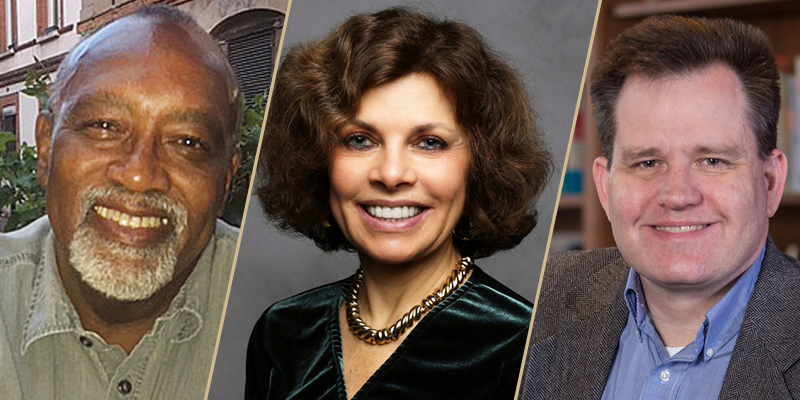
Scheduled to join Schultz on stage are leading free speech experts:

  • Glenn C. Loury is the Merton P. Stoltz Professor of Economics at Brown University. He holds a bachelor’s degree in mathematics from Northwestern University and a PhD in economics from Massachusetts Institute of Technology. As an economic theorist, he has published widely and lectured throughout the world on his research. He also is among America’s leading critics on racial inequality. He has been elected as a distinguished fellow of the American Economics Association, as a member of the American Philosophical Society and the U.S. Council on Foreign Relations, and as a fellow of the Econometric Society and the American Academy of Arts and Sciences. His 1995 book “One by One, From the Inside Out: Essays and Reviews on Race and Responsibility in America,” won the American Book Award and the Christianity Today Book Award.
  • Nadine Strossen is the John Marshall Harlan II Professor of Law, Emerita at the New York Law School and former president of the American Civil Liberties Union (1991-2008), who spoke at Purdue in February 2016. She is a senior fellow with the Foundation for Individual Rights and Expression (FIRE ) and a leading expert and frequent speaker and commentator on constitutional law and civil liberties who has testified before Congress. She serves on the advisory boards of the ACLU, Academic Freedom Alliance, Heterodox Academy and the National Coalition Against Censorship. The National Law Journal has named Strossen one of America’s “100 Most Influential Lawyers.” Her 2018 book “HATE: Why We Should Resist It With Free Speech, Not Censorship” has been selected as the common read by Washington University in St. Louis in 2019 and Washburn University in 2022.
  • Keith E. Whittington is the William Nelson Cromwell Professor of Politics at Princeton University, chair of the Academic Freedom Alliance and a visiting fellow at the Hoover Institution. He works on U.S. constitutional history, politics and law, and on American political thought. Whittington is the author of “Repugnant Laws: Judicial Review of Acts of Congress From the Founding to the Present” and “Speak Freely: Why Universities Must Defend Free Speech,” among other works. He has been a visiting professor at Harvard Law School, Georgetown University Law Center and the University of Texas School of Law, and he is a member of the American Academy of Arts and Sciences. He served on the Presidential Commission on the U.S. Supreme Court. He completed his undergraduate work at the University of Texas at Austin and PhD in political science at Yale University.

Purdue placed an emphasis on free speech in 2015, when it became the first public university to adopt the Chicago Principles, a landmark declaration of the importance of freedom of expression in any university community. Purdue reinforced its commitment in 2016 by incorporating a dedicated module on freedom of expression during Boiler Gold Rush, its weeklong student orientation program.

Purdue’s pledge continues to gain national attention. The latest recognition: a No. 3 ranking in 2022 for campus free speech from the College Pulse/FIRE survey. Purdue climbed three spots from 2021 and highlights its ongoing emphasis on the importance of the topic as vital to its mission as a land-grant institution. In the latest College Pulse/FIRE ranking, Purdue trailed only the University of Chicago, which developed the Chicago Principles, and Kansas State University. Mississippi State and Oklahoma State universities rounded out the top five.

Moreover, Purdue and the University of Chicago are the only Association of American Universities members in the top 10. Purdue remains the highest-ranking member of the Big Ten (next is the University of Maryland at No. 20) and leads all Indiana-based schools (the University of Notre Dame is next at No. 31 on the overall listing).

As Purdue’s chief legal officer, Schultz advises the board of trustees, the president and senior administrators on issues of law, governance and risk management and oversees representation of the university in all legal matters. In addition to developing and leading its internal legal operation since joining Purdue in 2013, Schultz was one of the architects of the Boiler Gold Rush free speech orientation module, which he still moderates each year.

Before coming to Purdue, he practiced as a corporate attorney and served as general counsel for several firms in the private sector. Schultz was chief counsel for Daniels when he was governor of Indiana. An Indianapolis native, Schultz received an undergraduate degree in history and political science from Butler University and law degrees from Yale and Cambridge (Trinity Hall) universities.

About Purdue University

Purdue University is a top public research institution developing practical solutions to today’s toughest challenges. Ranked in each of the last five years as one of the 10 Most Innovative universities in the United States by U.S. News & World Report, Purdue delivers world-changing research and out-of-this-world discovery. Committed to hands-on and online, real-world learning, Purdue offers a transformative education to all. Committed to affordability and accessibility, Purdue has frozen tuition and most fees at 2012-13 levels, enabling more students than ever to graduate debt-free. See how Purdue never stops in the persistent pursuit of the next giant leap at https://purdue.edu/.

Writer and Media Contact: Phillip Fiorini, pfiorini@purdue.edu, 765-430-6189

Adblock test (Why?)


"discourse" - Google News
November 18, 2022 at 02:11AM
https://ift.tt/j7dNoBM

Purdue symposium during 'MitchFest' will focus on free speech for advancing healthy civil discourse on university campuses - Purdue University
"discourse" - Google News
https://ift.tt/wpoMPYr
https://ift.tt/yG7kSHA

Monday, November 14, 2022

Knesset swearing in heralds political stability, though discourse unlikely to soften - The Times of Israel

israelob.blogspot.com

The 120 members of Israel’s 25th Knesset will be sworn in on Tuesday, ushering in a right-wing, religious majority that has vowed to pursue a radical agenda, while providing Israel with long-sought domestic political stability after a cycle of five elections in less than four years.

Despite prime minister-designate Benjamin Netanyahu’s vigorous efforts, Israel’s 37th government will not be sworn in alongside its lawmakers, as contested ministerial portfolios and disputed policy goals have yet to be reconciled in coalition agreements.

While the talks between Netanyahu and his far-right partner Bezalel Smotrich have come to a head over the assignment of senior ministry posts, the parties are expected to come to terms well before the December 11 deadline for forming a government. Comprising Netanyahu’s right-wing Likud, two ultra-Orthodox parties and the far-right Religious Zionism alliance, the coalition would be the most hawkish government in Israel’s 74-year history.

The Netanyahu-led bloc won a decisive 64 Knesset seats in the November 1 election — the first since 2015 that handed a majority to a bloc of closely aligned parties. However, it only narrowly won the popular vote, and nearly half the electorate bitterly opposes its right, far-right and ultra-Orthodox components. In accepting the task of forming a coalition on Sunday, Netanyahu acknowledged the national divides, and promised to govern for all Israelis — “those who voted for me and those who did not.”

The past 19 months have been especially politically turbulent, marked by mutual venom spewed between Yesh Atid chair Yair Lapid and Yamina leader Naftali Bennett’s short-lived government and the Netanyahu-led opposition, which climaxed during a heated four-month-long election campaign.

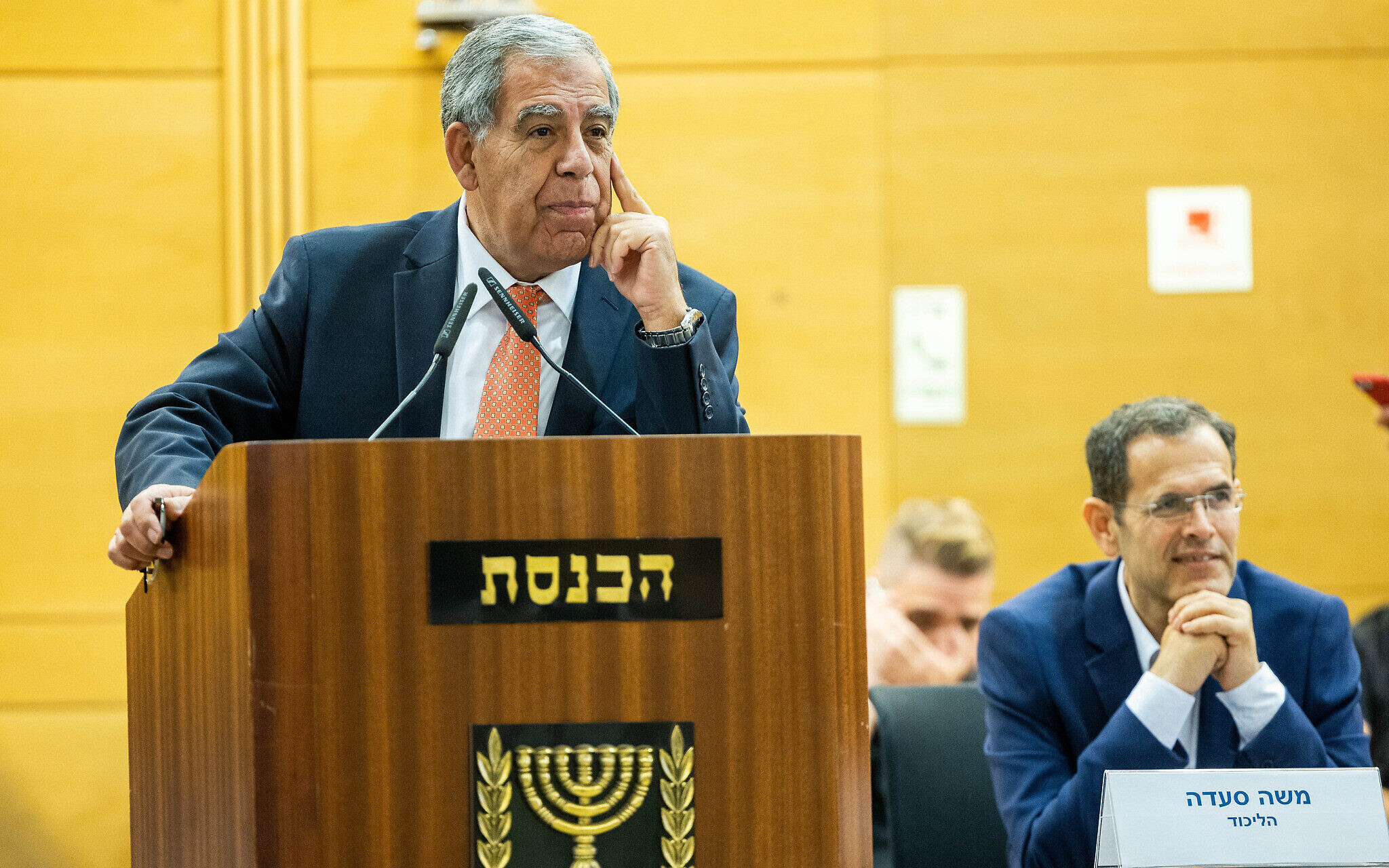
Ahead of Tuesday’s swearing-in ceremony, Knesset Speaker Mickey Levy said that his hope is “that the 25th Knesset will be a positive turning point in the discourse and in the way Knesset members conduct their debates.”

Knesset Speaker Mickey Levy speaks to freshman Knesset members a day before the 25th Knesset opens, November 14, 2022. (Yonatan Sindel/Flash90)

Earlier on Monday, Levy told the crop of 23 freshman MKs that the outgoing Knesset was “a bad example of the way in which discourse is conducted in a democratic society.”

“There are difficult arguments here, but I recommend that you speak to the merits of the matter and not make ad hominum comments while conducting a respectful conversation,” Levy said.

However, the 25th Knesset is already shaping up to carry some of the mutual nastiness forward.

On Sunday, prospective public security minister and far-right Otzma Yehudit leader Itamar Ben Gvir taunted Hadash-Ta’al MK Ahmad Tibi, tweeting that he should be sent to Syria after the veteran Arab lawmaker expressed his support for the late Palestinian leader Yasser Arafat.

“What are you waiting for?” Tibi tweeted back. “Deport me. You’re in power. Go ahead and deport me/us to Syria.”

Religious Zionism MK Itamar Ben Gvir (right) shouts at Joint List MK Ahmad Tibi (left) during clashes in the East Jerusalem neighborhood of Sheikh Jarrah, February 13, 2022. (Olivier Fitoussi/Flash90/File)

Ben Gvir campaigned on a tough-on-terror platform and advocates deporting “disloyal” Arab citizens along with those who carry out terror attacks. He has routinely called Tibi a terrorist, and been evicted from the Knesset plenum for doing so.

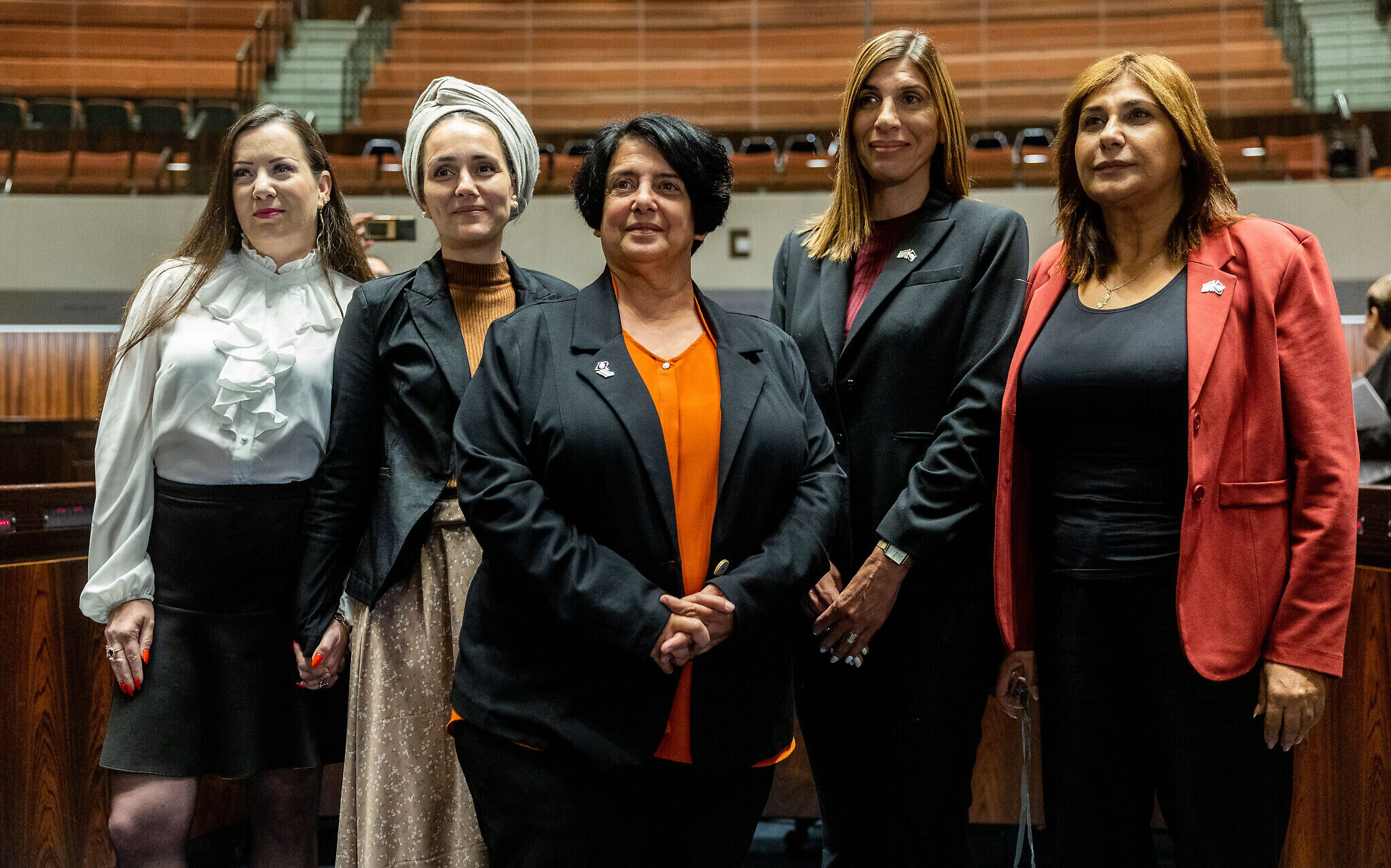
Tibi is a former adviser to Arafat and one of nine Muslim lawmakers in the incoming Knesset. The new parliament also only has one Druze lawmaker, 29 women, and three openly gay lawmakers, spread across 10 parties. Within the expected coalition, demographic variation drops precipitously to nine women, one openly gay lawmaker, and zero Arab parliamentarians.

Concerns raised by commentators about the lack of diversity are not ameliorated by some of the policies members of the incoming coalition say they will pursue. Among their most fiery are proposals to ban gay pride parades, reinstitute conversion therapy, roll back religious reforms, and revoke state recognition of non-Orthodox conversion to Judaism.

On the security front, in addition to Ben Gvir’s deportation proposals, the would-be police minister wants to relax open-fire rules against Palestinian protesters and stone-throwers.

All parties in the expected incoming government also support sweeping judicial reform that would place the judiciary under much more stringent political check. In particular, the parties want to advance an override clause by which the Knesset can reinstitute laws invalidated by the Supreme Court, as well as place the judicial appointments process under political control.

Religious Zionism has also proposed canceling the main corruption charges for which Netanyahu is standing trial. Ben Gvir has gone further and said he would pass a law that would retroactively grant Netanyahu and sitting prime ministers immunity from indictment.

President Isaac Herzog will preside over Tuesday’s swearing-in ceremony, his first since becoming head of state in 2021. Staged as a festive affair, the ceremony is expected to include a Knesset honor guard, a military orchestra and a cavalry convoy.

Alongside Herzog will be Speaker Levy and Knesset Secretary Dan Marzouk.

New members of the Knesset at the Knesset’s introductory session, a day before opening session of the 25th Knesset, November 14, 2022. (Yonatan Sindel/Flash90)

A Yesh Atid MK, Levy is expected to soon be replaced as speaker by an MK from the incoming coalition, although this post, too, has yet to be finalized.

Marzouk has the distinction of leading the 120 incoming lawmakers in their swearing-in by roll call.

The standard oath of office for lawmakers states: “I commit to be faithful to the State of Israel and to fulfill with devotion my cause in the Knesset,” to which incoming lawmakers are expected to respond: “I commit.”

A minor outcry occurred in April 2021, when several Joint List MKs changed the wording of their oaths to commit to fighting “occupation” and “racists.” They were later re-sworn into parliament without the extra wordage.

The 23 freshmen MKs participated in a day-long introductory course on Monday during which they met with Knesset management, toured the labyrinthian building and received an overview of the complicated and various parliamentary tools at the lawmakers’ disposal.

Marzouk, who taught incoming legislators how to use various tools to influence the parliamentary and public agendas, told the new MKs that although some days may slog into a bureaucratic routine, they are “acting in the service of great ideas.”

“Remember that at the end of the day, the goal is to build a better state and society, each according to his own method and view,” the Knesset secretary said.

Adblock test (Why?)


"discourse" - Google News
November 15, 2022 at 01:00PM
https://ift.tt/eAwtFSi

Knesset swearing in heralds political stability, though discourse unlikely to soften - The Times of Israel
"discourse" - Google News
https://ift.tt/oNgLfD5
https://ift.tt/fhLSpFl

Saturday, November 12, 2022

The Discourse : Stick to reliable SOURCES - The Star Online

israelob.blogspot.com

[unable to retrieve full-text content]

The Discourse : Stick to reliable SOURCES  The Star Online

"discourse" - Google News
November 13, 2022 at 08:00AM
https://ift.tt/rvhLyk9

The Discourse : Stick to reliable SOURCES - The Star Online
"discourse" - Google News
https://ift.tt/abfjYw4
https://ift.tt/Hm19SWg

Thursday, November 10, 2022

'Civil Discourse' is Theme of Community Learning Forum | Rapid City South Dakota - City of Rapid City

israelob.blogspot.com

‘CIVIL DISCOURSE’ IS THEME

OF COMMUNITY LEARNING FORUM

CITY’S HUMAN RELATIONS COMMISSION HOSTING

NOVEMBER 14 EVENT

RAPID CITY, SD—‘Civil Discourse’ is the theme of an upcoming community forum hosted by the Rapid City Human Relations Commission (HRC).  The forum will be held Monday, Nov. 14 from 5:30-7:30 p.m. at Western Dakota Tech.

          The event is part of a series of periodic Community Learning Forums hosted by the City’s Human Relations Commission.  The forum will feature a round table discussion format.

          “The goal of the conversation is to probe for solutions and to enhance our community’s understanding of civil discourse,” said LaFawn Janis, the City’s HRC coordinator. “It’s an opportunity to come together to determine if there’s a path towards taking positive civil discourse.”

           Janis said forum participants are asked to share experiences and stories of personal or public exchanges of civil discourse.

           Heavy snacks and refreshments will be served.  For more information, contact Janis at 605-718-2420 or This email address is being protected from spambots. You need JavaScript enabled to view it. .

Adblock test (Why?)


"discourse" - Google News
November 11, 2022 at 06:01AM
https://ift.tt/lEjQFZH

'Civil Discourse' is Theme of Community Learning Forum | Rapid City South Dakota - City of Rapid City
"discourse" - Google News
https://ift.tt/9a5UvIj
https://ift.tt/4ATgxX1

Monday, November 7, 2022

Why I hate the Twitter-fication of political discourse - CMU The Tartan Online

israelob.blogspot.com

Editorials featured in the Forum section are solely the opinions of their individual authors.

In the interest of honesty and journalistic transparency, I will admit that I have a Twitter account. No, I will not give it to you. I follow an assortment of various funny internet lefties, most of whom I found through YouTube, plus a smattering of funny apolitical accounts. I have a love-hate relationship with the platform. Since deleting the app from my phone, I've been trimming down my time on Twitter, but somehow, I still gravitate back to my feed at the end of every day. Like how one might unwind by smoking a cigarette or watching trashy reality TV, I retreat into my internet hole every night to reduce my cognitive activity to a warm steady hum. It's dessert for my brain. I know I shouldn't, yet I do. My point is, I understand the impulse to gravitate towards political echo chambers.

It's the same impulse that leads one to click on a compilation of Ben Shapiro dunking on blue-haired feminists at Swarthmore University, or watch a late-night host make stale jokes about Trump being orange — not that those groups are equivalent, of course. I'm not gonna "both sides" feminists and Donald Trump, and hopefully you've caught enough of my political tendencies to understand why. The reason I draw the comparison is that both forms of media thrive on people's desire to watch talented public speakers make a fool out of those you dislike.

Now, I did just point out two examples of unhelpful political discourse that are not from Twitter, so you might be asking, "Isn't this working against your point?" Once again, I want to emphasize that it's not your turn to speak, so please don't interrupt me. Obviously, echo-chamber discourse based around lazy superficial clapbacks can happen everywhere (except, of course, the fine publication in your hands). But I think Twitter is unique among media platforms because of how strongly it encourages and relies on such discourse. The character limit disincentives nuance, and the culture that has formed around the site's mechanics is frustrating and toxic. As fun as it is to see your favorite internet microcelebrity ratio some goon from PragerU, the only purpose of that content is to give you a small hit of dopamine so you continue to keep your eyes glued to the site.

If you'll allow me (not that I need your permission) to make this article even more meandering, I'll concede that maybe a quippy clapback can, in some cases, be useful. Recently, Canadian twitch-streamer and trans activist Keffals (Clara Sorrenti) was catapulted into nuclear-hot Twitter stardom, and used her fame to ratio some pretty big names, including J.K. Rowling, Ben Shapiro, Jair Bolsonaro, and even current head Twit Elon Musk. For the uninitiated, a ratio refers to a reply or quote tweet that gets more likes than the original tweet — the "ratio" of likes is in your favor. For trans youth, a lot of whom have no places to safely express their identity in real life, online communities may be their only haven. So, perhaps seeing a famous trans streamer knock some transphobes down a few pegs makes them feel a little less alone, or gives them hope that things could get better. But, I still believe the vast majority of clap-back content is derivative, uninspired garbage that serves no utility other than filling the echo chamber.

Now let's talk about John Fetterman. In the interest of journalistic integrity and transparency, I will tell you I fully intend to vote for him. I agree with many of his policies, although he's far from ideal. His pro-fracking position doesn't sit well with me, nor does his 2013 shotgun incident, in which he held Chris Miyares, a Black man, at gunpoint on false suspicion of being involved in a shooting. In recent months, he's become somewhat of a Twitter celebrity after many of his anti-Oz tweets went viral.

I am not a fan of this.

Twitter elevates spiteful and reductive commentary because it gives people the emotional satisfaction of seeing their opponent humiliated without deepening your understanding of anything. Nearly all of Fetterman's most viral tweets are superficial dunks on Oz, but fail to engage with the substance of Oz's platform or his fitness for office. There is so much to hate about Oz; I wrote a whole damned article about that if you're curious. And there's definitely an argument to be made that Dr. Oz is a carpetbagger. But, I don't know how many memes about Oz being from New Jersey I can read and still find it to be a fresh take. There is also something quite, how do you say — cringe — about a 53-year-old man posting a TikTok that features an audio mashup of "Glimpse of Us" by Joji and "All-Star" by Smash Mouth. There is absolutely no shot John has heard of either of those artists. Some 17-year-old intern probably found that meme, and the tweet proceeded to get two million views.

Nevertheless, we are stuck with the wasp's nest that is Twitter in the vehicle-careening-off-a-precipice that is our body politic. Social media has become an inalienable facet of our lives now, and I guess I'd rather that Fetterman be good at using it than Oz. Sucks to suck.

Adblock test (Why?)


"discourse" - Google News
November 08, 2022 at 07:38AM
https://ift.tt/3r6ckWw

Why I hate the Twitter-fication of political discourse - CMU The Tartan Online
"discourse" - Google News
https://ift.tt/oArQFni
https://ift.tt/YKFDHI9

Monday, October 31, 2022

Letter to the Editor: In the interest of Civil Discourse - Hypotheses VS Theories - by Community Contributor - The Ark Valley Voice

israelob.blogspot.com
Print Friendly, PDF & Email

Dear Editor,

In high school science class, we learn the difference between a hypothesis and theory. A hypothesis is an idea subject to investigation. In science, if a hypothesis is not validated by data, it is discarded or modified, and additional data is collected and so on until a verifiable hypothesis is revealed.  A theory is a hypothesis that has been subjected to examination and validated with facts.

This distinction makes all the “Just askin’….” questions about election integrity just hypotheses. The next step, not taken by the “Just askin’…” folks, is for them to propose a hypothesis and actually test and prove it with facts.

“Just askin’…”  questions over election integrity and the integrity of election officials are now getting some pushback from both political sides. One notable example is Pam Anderson, GOP candidate for Secretary of State. Anderson is featured on the cover of Time magazine under the headline, “Conspiracy Theorists Want to Run America’s Elections. These Are the Candidates Standing in Their Way.” Further, Anderson is quoted in the Associated Press, after her victory in the GOP primary, “I will continue my fight for restoring the confidence of Colorado voters against lies and the politicians or interest groups that seek to weaponize elections administration for political advantage.”  Both articles are posted on Anderson’s website.

At the county level, County Commissioners and Clerk Mitchell received a letter from Alan Seeling (available by CORA request).

At the time of his writing, Seeling was Chairman of the Chaffee GOP and past leadership within the Chaffee Patriots. Alan Seeling wrote in January 2022, “First, I want to commend you, Lori, for your immediate follow-up concerning the past years videos. I think that what you did was very commendable. In addition, I think that your organization of the counting of ballots in the county is something you should be proud of.” Seeling continues, “As chair of the county GOP I am very happy to support your continued presence as County Clerk. I can’t say anything about anyone trying to run against you but I want you to know the GOP is not putting anyone up to waste your time running against you.”  Seeling concludes with, “Again, thank you for all your efforts on all of our behalves in Chaffee County, I think you are doing a good job.”

Back to high school science class, “You can’t prove what doesn’t exist, you can only prove what does exist.” Can we please see a testable hypothesis from the “Just askin’s….” that can be examined and either verified or discarded? After all, we have the paper ballots and they can be examined and audited. This is one of the many things that make Colorado’s elections secure and transparent. A fact, not a hypothesis. Until then, for mercy’s sake, can we do as Alan Seeling says and not “… waste your time (Clerk Mitchell)?”

JoAnne Allen

Nathrop

Adblock test (Why?)


"discourse" - Google News
November 01, 2022 at 05:08AM
https://ift.tt/DlrP1yC

Letter to the Editor: In the interest of Civil Discourse - Hypotheses VS Theories - by Community Contributor - The Ark Valley Voice
"discourse" - Google News
https://ift.tt/QSw4Az6
https://ift.tt/SIzxAtE

'Blonde' and the internet discourse machine - Miami Student

israelob.blogspot.com

In 2000, American author Joyce Carol Oates released her novel “Blonde,” a fictionalized account of the life and struggles of Norma Jeane Mortenson, a.k.a. Marilyn Monroe. The book was well-received in its time, viewed not as a biography of Monroe’s life but a manifestation of the way people saw her as both a personality and an object.

Two decades later, its adaptation has not been given the same leeway.

“Blonde” (the film), released by Netflix and directed by Andrew Dominik, is in many ways the definitive showcase for the transformation of media discourse in the age of social media.

Courting controversy for seemingly every aspect of its production, from its rating to its director to its story and imagery, the film has experienced a prolonged discussion cycle over topics ranging from its depiction of Monroe to the ethics of including scenes of sexual assault.

Of course, “Blonde” isn’t the first film to be treated this way. But with the prominence of its discourse, it brings the conversation around how social media has changed the ways people engage with media to the forefront — especially when that media contains elements often considered taboo.

In order for a subject to go viral, there needs to be a spark, said Jacob Lassin, a visiting assistant professor who teaches social media cultures (COM 325) in Miami University’s Department of Media, Journalism and Film.

“These things often snowball,” Lassin said. “The way the algorithms work are, when somebody starts getting a little bit of attention, it starts to get a little bit more attention. And that can grow and grow and grow from there.”

With “Blonde,” that spark came in the form of its trailer and the announcement that the film would be rated NC-17.

In the 2010s, only eight films were assigned the rating, which is the highest that can be given by the Motion Picture Association (MPA). Filmmakers are usually told by studios to avoid content that would garner an NC-17, due to both a public stigma against it and the fact that many major theatrical distributors refuse to show films with the rating.

“Blonde” was assigned NC-17 for “some sexual content,” a vague descriptor that mainfests in the finished film as several topless and a few full-frontal scenes of Monroe (played by Ana de Armas) and three scenes involving abuse and rape.

Dominik defended the film in interviews leading up to its release, while also offering his own interpretation for the film’s rating.

“That’s just the ratings board being political,” Dominik said in an interview with Screen Daily. “If I look at an episode of ‘Euphoria’, it’s far more graphic than anything going on in ‘Blonde’.”

Enjoy what you're reading?
Signup for our newsletter

These statements didn’t help things — in fact, they only made it worse.

“If certain groups or individuals want a story told a certain way, they’re able to kind of get that initial momentum going,” Lassin said. “They can really steer the way that people view things because there isn’t really the kind of oversight that you see from more traditional media outlets.”

Discussion over the film’s content continued to spread, with speculation over what could have caused the film to be given an NC-17 rating. Even with Dominik’s attempts to clarify, people across social media didn’t hesitate to call the film exploitative, disgusting and an affront to Monroe — all without having seen a single scene.

Lassin said this kind of sensationalizing happens often with trending topics on social media.

“It’s really now a system based off of, are you able to generate sensation and outreach in a lot of cases,” Lassin said. “And so even if there’s no real content there, it’s really about what you were able to get people arguing about whatever you said.”

The Venice Film Festival gave people the chance to actually see “Blonde,” garnering mixed reactions.

Sitting at a 42% on Rotten Tomatoes and earning a critic score of 50 on Metacritic, reviewers were universally favorable toward technical aspects of the film, such as the score and de Armas’s performance, but found the film’s treatment of Monroe much harder to stomach.

Reviewing the film for Arizona Republic, entertainment journalist Bill Goodykoontz summed up the critical consensus.

“It’s exceptionally well made, daring and experimental, with a powerful performance from Ana de Armas at its center. At its everything, really — she dominates the film, as well she should,” Goodykoontz said. “But the film is also too long, too self-indulgent, just too much. It is a marathon of misery.”

At the same time, a narrative began developing that it was morally wrong to like, or even watch, “Blonde.” Supporting the film meant supporting the continuing abuse of Monroe’s legacy, and by extension, the exploitation of all women in film.

People took to user review sites like Rotten Tomatoes and Letterboxd to review bomb the film — a phenomenon in which media is given a disproportionate amount of low user scores with the intent of showing their disapproval with something about it.

While sites like this have some moderation features that can curtail this from happening, it still colors people’s impressions and may keep them from watching a film for themselves.

By the time “Blonde” was released on Netflix on Wednesday, Sept. 28, the controversy had reached a fever pitch. But with the film out and nothing new to gain from discussions about it, it quickly faded away as users moved onto the next trending topic.

So … where does this leave “Blonde?”

Given the current cultural climate, it’s unlikely the film could possibly win everyone over. Even if it had been pulled off with perfect finesse — which it certainly was not — there would still be people who found it at best morally questionable and at worst reprehensible.

That said, as an avid media consumer, it’s disheartening to see people so quick to disengage from a film and refuse to even try and watch it for themselves.

“Blonde” and its discourse is the perfect representation of the current social media landscape: one more interested in delivering “hot takes” and feeling morally superior than actually engaging in legitimate conversation.

@HollowCentral

hollowrr@miamioh.edu

Adblock test (Why?)


"discourse" - Google News
October 29, 2022 at 10:00PM
https://ift.tt/xC8svom

'Blonde' and the internet discourse machine - Miami Student
"discourse" - Google News
https://ift.tt/QSw4Az6
https://ift.tt/SIzxAtE

Sunday, October 30, 2022

Bare-Bones Religious Freedom - Public Discourse

israelob.blogspot.com

Notre Dame professor Phillip Muñoz’s “natural rights” account of religious freedom generates prescriptions that will be satisfying to nobody—not even, it seems, to himself. The minimalist First Amendment defended in Muñoz’s Religious Liberty and the American Founding (2022), would forbid governments to act like or delegate power to churches or to interfere with “worship as such.” No meddling with the Mass “as such.” Beyond those strictures, governments would be constitutionally free to fund and favor religion, or to restrict and discriminate against religion. The Christian baker who objects to celebrating a same-sex wedding would find no protection in Muñoz’s First Amendment. Indeed, the Constitution would not even protect the Catholic Church from liability under a general antidiscrimination law for its male-only priesthood.

Hardly anyone will find these outcomes attractive, and Muñoz himself seems not especially happy with them either. Muñoz is not at all hostile to religion or religious freedom, and his interpretation allows legislatures to provide broader protections. He embraces the constitutional prescriptions because he believes a faithful interpretation of the Constitution compels them. Muñoz’s central premise is that the Constitution should be interpreted according to the “natural rights” logic that was prevalent in the Founding period; and he tries to follow this logic to its conclusions, come hell or high water. His unappealing prescriptions reflect a kind of courageous integrity.

I admire that integrity, but I also think it is profoundly misguided. In a short review, there is no way to do justice to the scope and intricacy of Muñoz’s account, so I will try only to explain in simplified terms where I think the central error lies. Before undertaking this mostly critical discussion, though, I must acknowledge (too summarily, alas) the book’s considerable virtues. Muñoz’s account exhibits impressive scholarship; it provides a lucid explanation of the Founders’ natural rights thinking; and the examination of constitutional texts is methodical and informative. The analysis of the legislative history of the Establishment Clause is as meticulous as any I have seen.

These are notable accomplishments. And yet . . .

Religious Freedom As a (Narrow) Natural Right

Suppose a scholar were to show that the authors of an ancient legal document were deeply committed to, say, astrology. That would be an interesting historical fact, and it conceivably might shed light on the document, even if we now regard astrology as nonsense. But we may be skeptical if the scholar proceeds to argue that those authors misunderstood their own document in places because they misapplied astrological principles. And we will be more skeptical still if the scholar goes on to argue that we should resolve current controversies under the still authoritative document by extending the authors’ (spurious) astrological reasoning to the present, including to questions that they never considered.

This is basically what Muñoz does in this book, invoking not astrology but rather “natural rights.” He argues, for example, that although the Founding generation saw no constitutional problem in legislative prayer, they were mistaken; unbeknownst to them, their own natural rights logic condemns the practice. And he spends the last third of the book explaining what “the natural rights construction” would dictate with respect to a host of current constitutional controversies: this is where he reaches the counterintuitive prescriptions noted above.

To some readers, of course, my analogy will seem unfair, even absurd. Astrology and “natural rights” are hardly comparable.

Or are they?

As Muñoz explains, “natural rights” were thought to be derived from—or, rather, reserved in—social compacts whereby individuals agreed to exchange the unregulated but vulnerable freedom of the pre-political “state of nature” for civil society and government. A right to religious freedom was among these reserved “natural rights.” Muñoz laments that hardly anyone today thinks in “natural rights” terms; that is because, he suggests, we have lost confidence in the power of reason to lead us to sound conclusions in matters of governance and justice. Well, that may be one reason why “natural rights” thinking has gone out of fashion. But another is that such reasoning seems to lack cogency. It is like trying to answer practical legal questions by interpreting a fairy tale.

Just as a matter of history, after all, the story of a pre-political state of nature culminating in universally agreed on social compacts seems to be a flagrant fiction. And although fictions have their uses, they are also inherently squishy. The social contract is a made-up thing; consequently, I can make up a social contract that contains or excludes whatever terms I want, and so can you. So could Thomas Hobbes, and John Locke, and Jean-Jacques Rousseau—and Thomas Jefferson.

Muñoz himself emphasizes that although natural rights thinking was pervasive in the Founding generation, thinkers of the period differed radically in their understandings of what religious freedom entailed. Given the fictional nature and the consequent malleability of the social contract, this is just what you would expect. So why would anyone suppose that any genuine disagreement about law or government could be persuasively settled by hypothesizing such a contract? And why would anyone feel compelled to hold to a profoundly unattractive version of religious freedom just because that is what some rendering of the fictional social contract dictates? Why not just imagine a more friendly or sensible contract?

“Natural Rights” (Il)logic

Muñoz believes, however, that there is a kind of natural-rights logic that leads to his minimalist version of religious freedom. Here is the logic, as I understand it: Some rights that would exist in a state of nature are inherently inalienable, because it would simply be impossible for contracting parties to relinquish them. So any social contract would necessarily recognize these particular, impossible-to-relinquish rights. And religious freedom—albeit in an exceedingly narrow conception—is, or was, or would be, one such inalienable right.

And why would it be impossible for hypothetical contracting parties to relinquish this right of religious freedom? Citing seminal statements by Jefferson and Madison, Muñoz suggests that all of us necessarily believe, and cannot help believing, whatever the evidence seems to us to support. Even if you wanted to, therefore, you could not transfer power over your beliefs to government. In that sense, your aboriginal right to believe whatever you actually do believe is literally inalienable. Because this right could not be ceded away in any government-creating social contract, government accordingly can have no jurisdiction in the realm of religious belief a realm that Muñoz quietly extends to worship.

Conversely, according to Muñoz, you could grant to government the power to regulate conduct even religiously-motivated conduct. In a pre-political situation you might enjoy a right to conduct yourself according to your religious convictions, but that right is not inalienable. So the natural-rights logic of religious freedom provides no basis for concluding that hypothetical contractors would reserve a free exercise right covering religious conduct.

There is much that might be said about this argument. But even within the artificial confines of a social-contract thought experiment, the argument, if I have understood it correctly, seems doubly infirm. It does not support even Muñoz’s narrow categorical right covering “worship as such.” Suppose we stipulate that people have no control over their religious beliefs (a contestable point, actually), and hence could not relinquish a right to believe as they see fit. The right would cover beliefs, but it is not clear why this right would extend to worship. Governments cannot dictate what people believe in their minds and hearts, let us say; but governments surely can regulate—and often have regulated—how people worship.

On the other hand, even if a broader religious freedom right extending to conduct would not meet the impossibility-of-relinquishment requirement for inalienability, contracting parties who placed great value on religion might nonetheless choose to protect their ability not just to worship but also to live in accordance with their religious beliefs—even if such protection could not be absolute. This is not merely an abstract possibility: Muñoz explains that proponents of an “expansive liberalism” version of natural rights (including Madison) did hold that “religion itself, not just religious worship, lies beyond the legitimate jurisdiction of government.” Given the fictional nature of the social contract, who can say they were wrong?

Natural Rights and Constitutional Interpretation

In sum, the logic of natural rights need not leave us with only Muñoz’s freedom to worship. For argument’s sake, though, let us stipulate that Muñoz is right: a natural rights approach would support a narrow categorical right covering only religious worship. Even so, and even if we agree on a strict “original meaning” approach to constitutional interpretation, what is the warrant for imposing this narrow conception on the Constitution? Why couldn’t the Framers have constitutionalized more than, or less than, this meager right?

Muñoz addresses the question by trying to show that the original public meaning of the Free Exercise Clause tracked his natural rights interpretation. In doing so, he vigorously criticizes scholars like Michael McConnell and jurists like Justice Samuel Alito who have interpreted the provision more broadly to support “free exercise exemptions” or accommodations. Muñoz’s discussion is detailed and illuminating. But does he show that the broader accommodationist interpretation is mistaken? I don’t think so.

In a short review, once again, I cannot address the finer points of Muñoz’s argumentation. But consider three main sites of skirmish. First, state constitutions. McConnell and Muñoz agree that state constitutions are a valuable source for understanding Founding-era thinking. And McConnell (and Justice Alito) note that several state constitutions contained “public peace” provisions declaring that the practice of religion could be restricted only if “repugnant to the peace or safety of the State” (as the Georgia constitution put it). Such qualifications would seem to be limitations on otherwise protected religious conduct, not mere worship. Muñoz responds that several state constitutions did not contain any such qualifications. The language of these constitutions looks more categorical, and since categorical protection for religious conduct would obviously be impractical, Muñoz infers that the right must have been narrower in scope.

But this inference seems frail. Muñoz’s response does not really account for the state constitutions that did explicitly contain “public peace” limitations. And he himself repeatedly insists that the Founding generation understood that rights inherently contain their own limitations. So even for the constitutions with more categorical-looking language, it is equally plausible to suppose that these constitutions simply took the “public peace” limitation for granted and thus left it implicit.

Second, consider the legislative history of the Free Exercise Clause itself. Some of the earlier versions or proposals expressly used the term “worship,” as did Madison’s own initial version. But the final version—the one that was actually forwarded to the states, ratified, and placed in the Constitution—dropped the term “worship” and referred instead to “the free exercise thereof”—i.e., of religion. The “exercise” of religion, it would seem, is not limited to worship. In persuasively arguing against “no preference” interpretations of the Establishment Clause, Muñoz notes that some earlier versions were worded in “no preference” terms but that the final version deleted this language; and he infers that the Framers considered but rejected the “no preference” idea. The same logic would seem to apply to his own claim that the Free Exercise Clause covered only worship, not conduct or “exercise.” In other words, why is the “no preference” excision indicative of the Framers’ intent, but not the preference for the more expansive “exercise” over the more minimalist “worship”?

Third, Muñoz makes much of the fact that in drafting what became the Second Amendment, the framers considered including a specific provision exempting religious pacifists from military service: such an exemption was approved in the House of Representatives but deleted in the Senate. Muñoz thinks that Congress’s deliberation of this pacifist exemption means that the Framers didn’t build free exercise exemptions into the First Amendment. If the First Amendment already contemplated free exercise exemptions, Muñoz argues, such a provision would have been superfluous. Moreover, nobody in Congress even noted a connection between the Second Amendment’s proposed exemption for religious pacifists and the Free Exercise Clause.

But it is difficult to draw any strong inferences from these facts. For one thing, we don’t know whether anyone in Congress noticed a possible connection between the amendments; the pacifist exemption was deleted in the Senate, where debates were not recorded. So who knows? The Senate might have deleted the provision because the senators thought it superfluous.

Less speculatively, the Religion Clauses, like the Bill of Rights in general, were framed and advanced by people (like Madison), as Muñoz explains, who believed them unnecessary but were trying to appease critics and fend off calls for a second constitutional convention. So discussion of the ostensibly unnecessary provisions was mostly complacent and exceedingly brief; few legislators bothered to speak at all. Consequently, very little can be inferred from what was said or, a fortiori, from what was not said.

Given congressional complacency and the paucity of direct evidence, it may be that the historical record does not conclusively support an interpretation mandating free exercise exemptions; indeed, McConnell never claimed otherwise. But in contending that the record establishes the opposite conclusion—namely, that the framers rejected such a right—Muñoz goes beyond what the evidence warrants.

The Framers’ Achievement

Nothing in the preceding discussion should be taken as disparaging the Framers and their achievement, or even their natural rights vocabulary. Every generation needs to address issues of governance and law, and hence will look for some framework or vocabulary for thinking about such matters. By the late eighteenth century, the more Aristotelian and Thomistic approaches of earlier centuries had been discarded as unduly “scholastic”; and the purely Christian or biblical approach had become unacceptably “sectarian” in Enlightened circles. A “natural rights” approach may have seemed like an eligible replacement. Its very malleability made it useful for expressing conclusions defensible on less fictional grounds.

Moreover, although the Founders thought in “natural rights” terms, that approach hardly exhausted their intellectual repertoire. Madison’s argument for religious freedom in his seminal Memorial and Remonstrance, for example, contained explicit social contract language, to be sure; but it also contained much else that was not dependent on the fictions of a state of nature and a social contract. If the Father of the Constitution did not restrict himself to a social contract approach, why should we?

The enduring implication of calling religious freedom a “natural right,” as Muñoz explains, was that religious freedom is an inherent human right that is not merely a concession of government. We can surely applaud that conclusion without embracing, or confining ourselves to, the specific “state of nature/social contract” thinking that the Founders sometimes used to express that idea.
Adblock test (Why?)


"discourse" - Google News
October 31, 2022 at 07:00AM
https://ift.tt/tJ65Tln

Bare-Bones Religious Freedom - Public Discourse
"discourse" - Google News
https://ift.tt/k48tiHI
https://ift.tt/L86x3nj

Friday, October 28, 2022

The response to John Fetterman’s debate performance reveals the stigma employees with disabilities still face. Here’s why the discourse needs to change - Fortune

israelob.blogspot.com

Happy Friday.

A lot of you agreed with me that Kanye “Ye” West’s slow descent into bigotry and problematic speech was a long-missed opportunity to curb the harm that kind of power can perpetuate. “You so perfectly stated the issues around supporting Kanye West all these years and the deep issues surrounding his behavior. Although his antisemitic rants were the straw that broke the camel’s back, as a society we are all responsible for letting it get to this point,” wrote one reader. And plenty thought that major brands should have weighed in much, much earlier. His anti-Blackness wasn’t bad for business, so they let that slide, was the general theme.

But issues around disability were once again front and center in the raceAhead ecosystem after a televised debate, between Pennsylvania U.S. Senate hopefuls John Fetterman—the state’s lieutenant governor—and television celebrity Dr. Mehmet Oz, revived ableist talking points about Fetterman’s performance.

Fetterman is still recovering from a stroke he suffered five months ago. His halting speech—worsened in part by the unusual format of debates—became a flash point for politicians, media figures, and online chatter. It was a “rocky debate performance,” declared the AP, echoing a mainstream consensus. 

Online commenters, reading from an outdated playbook, piled on in similarly cringe-inducing ways.

“There is no amount of empathy for and understanding about Fetterman’s health and recovery that changes the fact that this is absolutely painful to watch,” tweeted one prominent commentator, who was quickly buried by counter-sentiments in response.

People with disabilities are underrepresented in political life but not completely absent. But it is an issue, says Andrew Pulrang, co-founder of CripTheVote, a campaign to encourage people with disabilities to engage in policy and politics. “Disability and disability accommodations are a question mark for a lot of people — they raise questions, they raise suspicion,” he told the Washington Post, talking about the stigma disabled candidates continue to face.

But the lingering rhetoric around Fetterman’s performance is symptomatic of the insidious way we still think and talk about people with disabilities, which leaves it to business to help reshape an exclusionary narrative.

Disability is the only segment of underrepresented talent that anyone can join, often quite suddenly, at any time. That’s part of what made the new “realization” during COVID that anyone could work from anywhere such a breakthrough for disabled talent.

That breakthrough is about to be put to the test.

Currently, some 1 in 4 Americans live with a disability, and at least 70% of disabilities are not readily apparent. But by late 2020, the CDC declared COVID a disabling event, with more than one million newly disabled workers attempting to navigate their new reality.

Expect those numbers to grow.

While a new study from the University of New Hampshire’s Institute on Disability and the Kessler Foundation finds that employers are responding—some 78% of 3,800 supervisors surveyed said their workplace established or changed the way they provide accommodations because of the COVID pandemic—big questions remain about whether leaders are going to be nimble enough to both welcome talent with existing disabilities and retain employees with new ones.

“Our community is growing exponentially from long COVID,” Jill King, a disability rights advocate who is disabled, told NPR. “More people are needing [accommodations] as well as asking for them.” That means that employers are in the hot seat to make sure they feel safe enough to do so. “[Workers], as well as all other nondisabled employees, deserve to feel safe to bring their whole selves to work. And this means being unafraid to disclose a disability and seek any support they may need in the workplace,” said Julie Sowash, executive director of the nonprofit consultancy Disability Solutions, in an interview with the Society for Human Resource Management (SHRM).

One big bright spot in the news this week has been how members of the public were increasingly able to make the distinction between Fetterman’s recovery and his ability to think, lead, and continue his work in public service. The public’s response, in some regards, has put the pundits to shame.

“To see someone who is in recovery, using these tools that were fairly new to him, and doing so in a public debate where the stakes are so high, and all eyes are on him – it’s pretty incredible,” Maria Town, the president of the DC-based American Association of People with Disabilities told the Guardian. “I have a lot of respect for what he was doing.”

Next week, I’ll be digging more deeply into how systemic racism has sidelined voices of people of color in the disability rights movement.

More interesting stuff below.

Wishing you an incredible weekend.

Ellen McGirt
@ellmcgirt
Ellen.McGirt

This edition of raceAhead was edited by Ashley Sylla.

On point

A Thai media “tycoon” and transgender advocate has bought the Miss Universe pageant. And I am here for it. The pageant, previously owned by former U.S. president Donald Trump, was purchased by Anne Jakkaphong Jakrajutatip, the CEO of JKN Global Group PCL, a Thailand-based media company. Jakrajutatip has been outspoken about her experiences as a transgender woman and has been a longtime advocate for LGBTQ+ issues in Thailand. She’s also famous for her appearances on Thai versions of reality shows, like Project Runway, evidently. She paid $20 million for the property, and I'm already picking out my viewing party outfit.
CNN

Mostly good news in the latest Hollywood diversity report. As part of its newly structured Entertainment and Media Research Initiative, the now annual Hollywood Diversity Report from UCLA shows a meaningful increase in diversity since the 2019/2020 season. But researchers warn that those changes may not be permanent, particularly in leadership roles in writer’s rooms and beyond. “The next few years may be a true test of whether Hollywood is truly committed to the changes they promised during the nation’s reckoning on race following the murder of George Floyd,” Ana-Christina RamĂłn, co-author of the report, told the Hollywood Reporter. Social media engagement is higher when shows have truly diverse casts; despite clear consumer interest in entertainment with majority-minority casts, actors of color were still underrepresented in lead roles on broadcast TV, though in better shape on cable and in film.
Hollywood Reporter

Wharton gets it  The Wharton School of the University of Pennsylvania is planning to offer students a new program of study in diversity, equity, and inclusion, beginning in the 2023-2024 academic year, reports my colleague Paolo Confino in the must-read newsletter CHRO Daily. It will combine courses already within the Wharton curriculum that, when taken together, provide essential skills to deliver both the “ethical promise” of DEI with the necessary financial returns. "Our students have challenged us to do more to prepare them for the new realities of leadership, which involve creating and sustaining diverse, equitable, and inclusive organizations,” says Stephanie Creary, a Wharton professor of management. Sign up for CHRO Daily here.
Fortune

On background

Missing summer fun? Head to Crip Camp. In this poignant essay, Maysoon Zaid, an actor, comedian, and activist with cerebral palsy (and a raceAhead favorite) reviews Crip Camp, a 2020 Netflix documentary that won or was nominated for a slew of awards. She begins by sharing her experience as the only disabled kid at a traditional summer camp. “As I dragged myself up the Appalachian Trail, I could never have imagined that decades earlier a camp existed for kids like me. Crip Camp tells the story of that fantastical place I never knew existed that changed the course of disabled history in America,” she says. The story follows a teenaged Jim Lebrecht, now a disability rights activist, but then a kid in a wheelchair whose life was about to be changed by the hippies who ran Camp Jened in Hunter, New York. Crip Camp was produced by Higher Ground, the production company founded by Barack and Michelle Obama.
Refinery 29

For journalists with disabilities, obstacles abound but so do solutions. Michelle Hackman now covers immigration policy for the Wall Street Journal, but in this first-person account, finding a job was never guaranteed. “Those who make it in the field are the standout go-getters who seek out work-arounds to lessen the burden of their disabilities on employers,” she explains. They become their own IT experts, often hacking together solutions that help them do their work without drawing attention to perceived limitations. “And they are the ones willing to tolerate relentless, if latent, prejudice from sources and editors alike who often have trouble squaring disability with competence.”
Nieman

Parting words

"My advice to other disabled people would be, concentrate on things your disability doesn't prevent you doing well, and don't regret the things it interferes with. Don't be disabled in spirit, as well as physically.”

Stephen Hawking

Adblock test (Why?)


"discourse" - Google News
October 29, 2022 at 03:43AM
https://ift.tt/oxid4hk

The response to John Fetterman’s debate performance reveals the stigma employees with disabilities still face. Here’s why the discourse needs to change - Fortune
"discourse" - Google News
https://ift.tt/kqyU3hB
https://ift.tt/1tZN7Vd

Discourse, Disagreement Central to Truly Liberal Thought – The Oberlin Review - The Oberlin Review

israelob.blogspot.com

Two weekends ago, I took a short trip to Cincinnati to visit my grandmother. While driving through the rural farmlands and small towns of suburban Ohio, I came to the realization that I, a person born and raised in Seattle, was studying at a college with sensibilities that effectively mirrored that of my hometown and that these farmlands and small towns were far more reflective of Ohio than anything I would witness in Oberlin. Oberlin, the isolated, liberal bubble in the middle of Ohio, is not a good representation of the larger community itself.

One of the main reasons I chose to attend Oberlin was its distance from my home state. Although I knew that Oberlin had a fairly large liberal demographic, I made the assumption that the farther I was from my home, the more politically diverse my community would be. And yet somehow, I ended up right back in Seattle.

But is Oberlin truly a liberal space? I believe so. Liberalism has a funny way of preaching inclusion but remaining extraordinarily exclusionary to other categories of political thought. I do believe the Oberlin community could benefit from an opening of minds and a broadening of theoretical political horizons. I am not suggesting that Oberlin needs to start accepting more conservative students, nor am I promoting conservatism on campus. I am merely suggesting that Oberlin offer more opportunities for students to broaden their intellectual horizons through offering a large range of lectures, dialogues, and courses. It is my opinion that in order to be a true liberal, one must understand other families of political thought on a deep level.

Oberlin College was founded as a Christian college, but its political origins are distinctly liberal. It was the first American institute of higher learning to make racial colorblindness a written aspect of College policy, and thus was the first to admit Black students in 1835. It was also the first college to offer bachelor’s degree programs to women beginning in 1837. Since then, Oberlin has prided itself on its diversity, equity, and inclusion programs, social justice-oriented campus life, and commitment to environmental justice. 

However, with the recent intensification of political discourse, particularly its rapid diffusion on social media, the very definitions of and ways of practicing liberalism have been changing. Today, it’s common to read a short blurb or graphic on social media and repost it, contributing to a phenomenon known as “social media activism.” It’s an opportunity for information to become easily accessible and widely dispersed but also a way for people to become complacent with inequality under the guise of reposting and sharing media.

This contemporary form of liberalism is especially prevalent for young people, and I’ve noticed this at Oberlin. Students feel more comfortable regurgitating information they’ve already heard than critically analyzing social issues and forming their own opinions. While this isn’t necessarily an issue, and rather a form of privilege, it does become a problem when people claim to be “activists” or “allies.” Activism and allyship involve much more than reiterating information. They involve active engagement, critical thought, and sacrifice.

While I believe Oberlin does provide opportunities for students to understand forms of non-liberal political thought to a certain degree,  there’s still work to be done. At the start of the year, I remember being told that making mistakes was a part of Oberlin culture. It’s important to take risks and be unafraid to say things that may be “incorrect,” because making mistakes is an integral part of learning. However, since orientation, I have yet to see a single person “make a mistake” in class, during casual conversations, or online. And while this could be chalked up to first-year nervousness about participating in class, I also think the rigidity of liberal values at this school, along with the intense pressure that students may feel to conform to the majority, may discourage students from speaking candidly and without fear of making a mistake.

I’ll be the first to admit that, like most people, I take a sort of subconscious comfort in knowing that everyone around me shares my values. Yet I know that this structure is not conducive to a functioning and ultimately progressive society. The competition of different political ideologies is what inspires our democratic process — the basis for our country’s political system. It’s important that we not only amplify all voices but also work to critically analyze and understand other perspectives. 

While I have spent most of my life in Seattle, I’ve also spent a lot of time among both conservative Americans and Indians in my family. Though it’s difficult to have conversations about politics with people who have completely opposite views as you, I have learned to find merit in open, respectful dialogue. Understanding where other people are coming from, what motivates their political beliefs, and what they like or dislike about conservatism, liberalism, and other groups of thought can be eye-opening.

Typically, liberals want to remain in liberal spaces, and conservatives want to remain in conservative spaces. It’s an innate human inclination to be with people who are similar and like-minded. However, closing yourself off to new people means closing yourself off to a host of experiences. Higher education is an opportunity to not only meet new people but also gain the tools for understanding and engaging with advanced political thought. My advice is not necessarily to move to a conservative area or forcefully seek out conversations and interactions with conservatives. I am merely suggesting that research and critical thinking can go a long way. It can rip you from the binds of homogeneous liberal theory and force you to be your own person with your own values.

Adblock test (Why?)


"discourse" - Google News
October 29, 2022 at 04:03AM
https://ift.tt/SyVkczP

Discourse, Disagreement Central to Truly Liberal Thought – The Oberlin Review - The Oberlin Review
"discourse" - Google News
https://ift.tt/kqyU3hB
https://ift.tt/1tZN7Vd

Thursday, October 27, 2022

Riham Isaac seduces the stage with Another Lover's Discourse - The New Arab

israelob.blogspot.com

The New Arab caught up with one of Palestine's most exciting contemporary artists, Riham Isaac, to find out more about her one-woman show on love, a performance that has since been met with critical acclaim.

This autumn Riham Isaac brings her first solo theatre show, created and performed solely by her, to the Belfast International Arts Festival. The multimedia performance, titled Another Lover’s Discourse, explores the complexity of love and relationships.

Four years ago, Isaac embarked on a journey to explore what it meant to love; what ideas we have about it and what was holding her back from it. This inventive new multimedia performance invites the audience to think differently about love.

“It’s been a long journey for me,” Riham explains. “I started working on the show in 2018, researching and developing work around the theme of love. I was trying to understand how we fall in love and what our ideas around it are, especially as an Arab woman.

"Encouraging a more open conversation about how we understand romantic relationships, her [Riham's] unique show mashes up interviews video, music, performance and original film to explore the complexity of love and relationships"

"The idea was to do a personal investigation into the theme of love. I wanted to express it in its complexity because love can be very complex, it can be very simple. Sharing your personal experience with the audience – it’s a healing process.”

What perhaps sets Riham’s performance apart is the intimate aspect of it, with candid interviews and discussions taking place around the subject of love: “I think one of the key moments in my performance is my interview with my mother, more of an intimate conversation that I wished I had when I was a kid. I do believe that revolution doesn’t happen just by going out in the street; I think revolution starts from within.” 

In March 2020 Riham was invited to showcase snippets of the performance at the AWAN festival. “I had this amazing opportunity to collaborate with other artists and get a sense of how I wanted the show to be,” she explains.

“We put the show together in three weeks and caught the eye of Belfast Arts Festival, who commissioned us to do the full show.”

However, luck wasn’t on Riham's side and, shortly after, Covid forced the world into lockdown, delaying her debut. 

When describing what viewers of Another Lover’s Discourse can expect from her performance, Riham’s eyes light up. “Love is very complex and there are so many emotions – you expect to have a journey with yourself when observing me.”

Encouraging a more open conversation about how we understand romantic relationships, her unique show mashes up interviews, videos, music, performance and original film to explore the complexity of love and relationships.

“It’s multidisciplinary; there’s music and a video installation. I filmed myself in the style of old classical Egyptian films. There are humour aspects to it, with me acting and singing on stage and some intimate moments where I share interviews I’ve done with family, friends and even my mother.”

Riham's practice is interdisciplinary in its art form, exploring both theatrical and cinematic genres. With video installations and integrated live performances – including striking video design by Welsh artist Simon Clode – audiences will be intrigued, curious, and excited by the way Riham communicates and tells stories.

With live music composed by Palestinian musician and composer Faris Ishaq, Riham also sings songs inspired by classical black and white Egyptian films, in which men's and women’s roles were always fixed and linear. 

By representing a nonstereotypical and nuanced take on love, desire and romance as an Arab woman, she aims to challenge heteronormative gender roles and romantic relationships with humour, truth and empathy. 

Following on from Belfast, Another Lover’s Discourse will be performed at PalArt Festival at London’s Rich Mix. Partnering with Amnesty International UK, this one-of-a-kind theatre and arts festival will present art from across Palestine from October 28-31, that covers media such as theatre, spoken word, poetry, music and visual art. 

The festival hopes to welcome all Palestinian artists, anyone who is interested in meeting like-minded artists, and those looking for an alternative experience of arts and culture. 

Riham will also be hosting workshops and community work with young people alongside the performances, including events at Barbican Plymouth, Theatre Royal Bath and Belfast International Arts Festival, as well as a schools’ project in Hounslow linked with the Bethlehem Cultural Festival. 

Sami Rahman is a freelance lifestyle writer based in London. 

Follow her on Twitter: @bysamirahman   

Adblock test (Why?)


"discourse" - Google News
October 28, 2022 at 03:18AM
https://ift.tt/QYsp0t9

Riham Isaac seduces the stage with Another Lover's Discourse - The New Arab
"discourse" - Google News
https://ift.tt/b45ExOo
https://ift.tt/doOcxbH

In Focus 10/27/22 – Inst. for Civic Discourse & Beach Museum of Art, Pawnee Mental Health - News Radio KMAN

israelob.blogspot.com

Segment 1 – 00:00
Segment 2 – 14:41
Segment 3 – 24:17
Segment 4 – 34:55

Thursday’s edition of In Focus featured guests from K-State’s Institute for Civic Discourse and Democracy, the Marianna Kistler Beach Museum of Art, and Pawnee Mental Health Services.

The first half of the program welcomed ICDD Director Dr. Colene Lind as well as Beach Museum Curator Aileen June Wang. The two discussed the ‘Do You See What I See’ exhibit on display at the museum, intended to challenge viewers to reconsider their perspective on a representation through considering how others may view it in a safe setting. Wang and Lind also highlighted a facilitated panel discussion led by Museum Specialist Nate McCLendon about the exhibit coming up on Nov. 3, as well as the ICDD and Beach Museum’s blossoming relationship of collaboration.

The second half of the program, we were joined via phone by Pawnee Executive Director Robbin Cole from Topeka. She was awaiting her scheduled testimony before the Kansas Legislature’s special committee on mental health beds, and shared a preview of her testimony about challenges facing the mental health workforce as well as discussed the state of mental health in Kansas in light of low national rankings.

Adblock test (Why?)


"discourse" - Google News
October 27, 2022 at 10:41PM
https://ift.tt/FdcYfzL

In Focus 10/27/22 – Inst. for Civic Discourse & Beach Museum of Art, Pawnee Mental Health - News Radio KMAN
"discourse" - Google News
https://ift.tt/b45ExOo
https://ift.tt/doOcxbH

Wednesday, October 26, 2022

What's on the Table conversation series promotes open discourse on campus - N.C. State University Technician Online

israelob.blogspot.com

[unable to retrieve full-text content]

What's on the Table conversation series promotes open discourse on campus  N.C. State University Technician Online

"discourse" - Google News
October 27, 2022 at 06:50AM
https://ift.tt/UvbMkGr

What's on the Table conversation series promotes open discourse on campus - N.C. State University Technician Online
"discourse" - Google News
https://ift.tt/QEmqNRF
https://ift.tt/8nN0XtV

Local Jewish community stresses solidarity amid national discourse about anti-Semitism | Carolina News and Reporter - Carolina News and Reporter |

israelob.blogspot.com

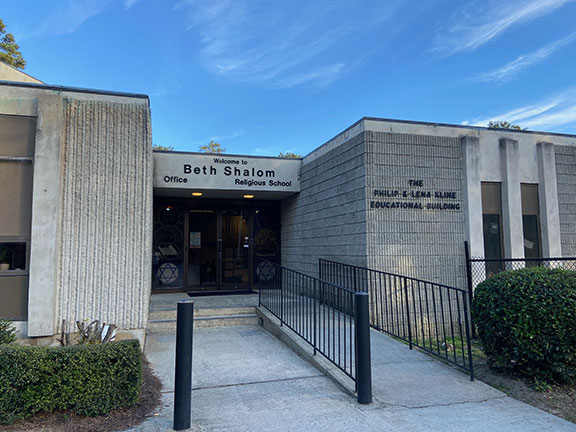
The House of Peace Synagogue at Beth Shalom in Forest Acres (Photo by Caleb Bozard)

Kanye West’s recent anti-Semetic comments have prompted nationwide discussions about discrimination and bigotry against Jewish people. 

In Columbia, members of the Jewish community say there are many ways non-Jewish people can stand in solidarity with them. 

“You would hope … There would just be a general sense of respect and dignity and benefit of the doubt,” said Rabbi Sruly Epstein of Rohr Chabad at the University of South Carolina. 

West, who refers to himself as Ye, was suspended from Instagram and Twitter earlier this month after making several comments on his accounts and in interviews that perpetuated stereotypes of Jewish people. 

The artist’s accounts were restored, with the posts removed, as of Oct. 26. But Adidias and GAP, Vogue magazine and Ye’s booking agency have dropped the artist following the comments.

Brands and celebrities have jumped to respond to his comments and support the Jewish community. Students at Chabad House are concerned by West’s comments, Epstein said. 

“It’s kind of hard not to (hear about West’s comments) at this point — it seems like it’s kind of all over the place,” he said. 

There hasn’t been much violence against the Jewish community in Columbia since he moved here eight years ago, Epstein said. 

“We’ve been very fortunate here,” he said. “Things have seemed to be relatively quiet in that regard. … But at the same time, when something like this does get national headlines, … it can still be very stressful.”

But around the globe, drawing hate isn’t new to the Jewish community — anti-Semitism has been around as long as Jewish people have, Epstein said. 

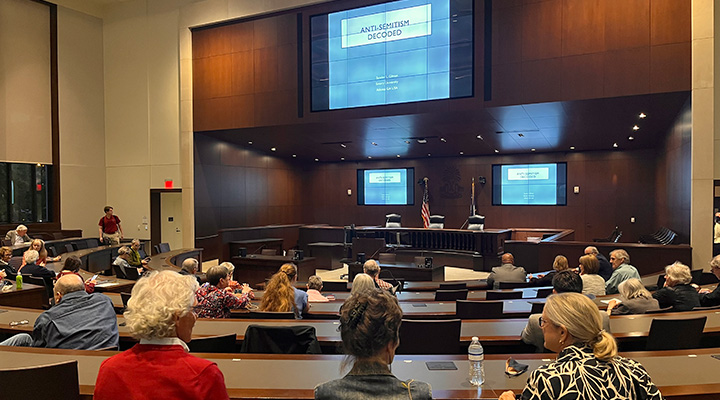
USC hosted a lecture about anti-Semitism on Oct. 25. Sander L. Gilman, a widely respected intellect and professor at Emory University, lectured a crowd of more than 100 attendees in the School of Law. 

“It is clear to us that fear of ‘the other’ often translates into violence, as well as systemic racism,” professor Saskia Coenen Snyder, interim director of the Jewish Studies Program at USC, said while introducing Gilman. 

Anti-Semitism in the United States has been historically tied to other forms of racism, including anti-Black racism, according to Rabbi Meir Muller, an associate professor at USC. 

“As soon as we start saying ‘all Jews’ or ‘all Black people,’ we’ve entered into racism,” Muller said.

Muller, who teaches a course called “African and Jewish American Convergence and Divergence” at USC, said discimination against both Jewish and Black people is often rooted in conspiracy theories and stereotypes. 

Stereotypes and bigotry are introduced when people start believing groups of individuals are all the same, Gilman said at the lecture. 

“Each is different from everybody else,” Gilman said. “In the eyes of (anti-Semites), all Jews are alike in their essence. And that’s what Kanye West said.” 

Jewish congregations in Columbia are racially diverse, said Risa Strauss, director of education at Beth Shalom Synagogue in Forest Acres. The synagogue has participated in studies on how to be aware of color racism within being Jewish, she said. 

“American Jews need to be treated just like all other minorities in this country – fairly and equally, with love and not hate,” Strauss said.

The leader of the Chabad movement, which is a global outreach movement that has been doing Jewish outreach for hundreds of years, said people should respond to hate by spreading kindness, Epstein said. 

“The more darkness we see in the world, the more light we have a responsibility to shine,” Epstein said. “Our response has always been to strengthen our positivity, and not to let it get us down, but to use it as a springboard to do more random acts of goodness and kindness — and to bring more joy and light to the world as a direct response and a direct way of countering the darkness.” 

Epstein said the light bulb gets turned on anytime Jewish people come together to celebrate their identity or heritage. 

But non-Jewish people also can respond to anti-Semetic comments. And West’s comments and the surrounding discourse emphasize the importance of non-Jewish people speaking out, Muller said.

“Silence can send a message that we’re in agreement,”  he said.

Mueller said beyond reaching out to friends, people should consider sensitivity training in workplaces.

Strauss encouraged people to visit synagogues either for services or otherwise to learn about the culture and to hold others accountable when they make jokes or say stereotypical things about Jewish people.

“This is a problem, and I feel like this time in our country has become really divisive and it’s scary,” Strauss said. “Anything you could do to alleviate other people’s fears is great.”

The Beth Shalom Synagogue has a religious school where young students and adults take courses on Hebrew, history and contemporary issues and prepare for bar mitzvahs and bat mitzvahs. (Photo by Caleb Bozard)

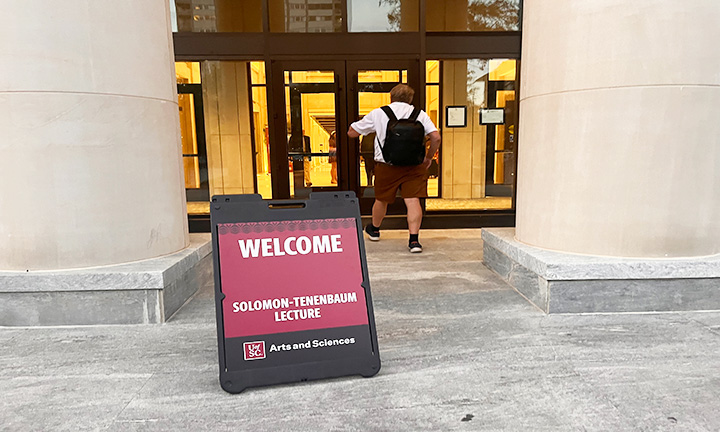
A person enters a University of South Carolina law school classroom before the Oct. 25 Solomon-Tenenbaum lecture. The year’s lecture focused on anti-Semitism. (Photo by Kailey Cota)

Attendees wait at the University of South Carolina’s law school for the Oct. 25 Solomon-Tenenbaum lecture to begin. (Photo by Kailey Cota)

ABOUT THE JOURNALISTS

Caleb Board

Caleb Board

Bozard is a senior journalism student at the University of South Carolina and is a news editor at the student-run Daily Gamecock. He has covered topics such as university politics and social issues. He investigated anti-Asian and Asian American racism on campus during the COVID-19 pandemic and covered leaked, racially charged and homphobic student government communications. He recently interned for the Orangeburg Times and Democrat and is a first generation college student from Barnwell, S.C.

Kailey Cota

Kailey Cota

Cota is a senior journalism student at the University of South Carolina. She is the 2021 S.C. Collegiate Journalist of the Year and the editor-in-chief of USC’s student newspaper, The Daily Gamecock. She spent the summer reporting on the Murdaugh saga, crime and business at The Post and Courier in Charleston, S.C., and hopes to continue reporting about economics.

Adblock test (Why?)


"discourse" - Google News
October 27, 2022 at 04:00AM
https://ift.tt/zsXRhpT

Local Jewish community stresses solidarity amid national discourse about anti-Semitism | Carolina News and Reporter - Carolina News and Reporter |
"discourse" - Google News
https://ift.tt/QEmqNRF
https://ift.tt/8nN0XtV

Search

Featured Post

I just paid $9.99 for a carton of 18 eggs. Will prices ever drop? | Opinion - Sacramento Bee

[unable to retrieve full-text content] I just paid $9.99 for a carton of 18 eggs. Will prices ever drop? | Opinion    Sacramento Bee ...

Postingan Populer