Rechercher dans ce blog

Wednesday, December 2, 2020

Deconstructing the Political and Legal Discourses on Western Sahara - Morocco World News

israelob.blogspot.com

Spread the love

Rabat – The independence discourse on Western Sahara remains one of the most problematic rhetorical undertakings in post-colonial times.

Full of epistemological and political cul-de-sacs, this discourse embodies the tensions at the heart of the nationalist agendas of proto-liberation tendencies.

The lack of political coherence in the discourse of independence proponents comes from the romantic celebration of an unrealistic nationalism, one that is not grounded in history or in a reinvented cultural politics.

Supporters of this approach need to subvert these unsettling assumptions, not for intellectual reasons, but because they are the basis of actions on the ground, actions that have been so far unsuccessful and incoherent.

A solution to the ongoing conflict can only be possible if both sides advance well-thought-out historical narratives that will provide the basis for a mutually agreed upon plan, which is not yet the case.

In the meantime, fantasies continue to be built around competing nationalisms, one grounded somehow (albeit awkwardly) in history, and the other in an imagined destiny that is at odds with both historical facts and cultural practices.

The result is a political cul-de-sac that mirrors the rhetorical contradictions of the discourse that informs political actions and advocacy efforts. And of course, the prolongation of a pseudo-conflict that never should have existed in the first place, with the sufferings that go with it on the ground, especially in the refugee camps. 

Deconstructing political and legal discourses

Most of the writings and informed political or legal decisions on the history and politics of Western Sahara are built on assumptions that are either historically shaky or theoretically unfounded.

The romanticism of post-colonial positions has blinded militants and some scholars to the fact that the historical and sociological reality is at odds with meta-concepts imposed from other historical realities and metanarratives, especially Western discourse on liberation, statehood, and the nation state. 

ICJ Ruling

The watershed decision that triggered the series of events that marked the territory’s history over the last 40 years was the International Court of Justice’s (ICJ) October 16, 1975 advisory opinion regarding two questions (1):

1. Was the territory terra nullius when Spain colonized it in 1888? 2. Were there any historical ties between the Sahrawi populations and Morocco? The terra nullius argument was the basis of Spain’s response to Morocco’s nationalist claims—in an attempt by Spain to keep the territory under its control. On the other hand, Morocco’s claims to the territory were historical, based on its human, commercial, cultural and religious interaction with the territory since the 10th century. They were also legal, based on the allegiance Sahrawis paid to Moroccan Kings since the Middle Ages.

The opinion of the ICJ was forcedly balanced, unduly interpretive and pseudo-political (rather than purely judiciary). To the first question, the court decided that Western Sahara was not terra nullius when the Spanish colonized it at the end of the 19th century. None of the parties questioned the meaning of terra nullius. Everybody (Spain, Morocco, Mauritania, the UN and the ICJ) understood the concept to mean uninhabited territory. But the notion of terra nullius applies only when there is a link between the people and the territory. Will it apply to nomadic, semi-nomadic and transhumant tribes roaming northern Mauritania, southwestern Algeria and southeastern Morocco looking for grazing opportunities for their camel and goat herds? 

Terra Nullius

The existence or non-existence of terra nullius depends on a sociological paradigm that was absent in Western Sahara up until the mid-20th century with the sedentarisation of the nomadic tribes of the Sahara (2).

The ICJ ruling was right in saying that the territory was no terra nullius (a few settlements and roaming nomads prior to colonization speak to that). However, it is possible that the constant nomadism of Saharan tribes had made the territory a temporary terra nullius at times of drought or when the herding tribes would move east to present-day Algeria, deep south to modern-day Mauritania or flee the Siba wars (3) to Benguerir, Sidi Kacem, Guelmim or Taroudant (in Morocco) (4).

Read Also: Western Sahara: How Morocco Outmaneuvered Algeria with Africa, UN

Had the court ruling been more nuanced in saying that the “territory was no terra nullius, but the few settlements and the pastoralist and nomadic ways of life in no way denoted a property right of the people to the land. That property should be looked for in who ruled over the territory by virtue of international conventions and the allegiance of the local powers (judges, caids and notables) to those very rulers”, much political and legal wrangling would have been avoided. 

Quite a few activists and scholars took the terra nullius argument (which was a winning card for the Moroccan government against Franco’s position) to mean “whoevepr lives in the territory owns it” and decides on its fate (5).

But as we have seen, the nomadic Saharan tribes did not live in the territory in a sedentary fashion in such a way as to own it. Moreover, owning a piece of land or pasture individually or collectively does not amount to sovereignty over the territory; sovereignty over a territory is a supra-tribal concept that supersedes the concerns of pasture, water, and nomadic communal life (6).

Thirdly, sovereignty over a land is not always based on property rights; if that were true, then Russia would have been right in claiming Crimea back (given that the majority of its inhabitants speak Russian or are of Russian origin). And France would have had no right to sell Louisiana to the US in the mid-19th century because of its dominant French culture and demography. Culture and demography could inform legal decisions regarding sovereignty (national property) but it is not a standard rule, especially in some non-Western contexts. 

Allegiance, but…

The ICJ’s answer to the second question was that there were legal allegiance ties between Morocco and the Saharan tribes; however, those ties should not constitute a basis for the ownership of or sovereignty over the territory. And to add: these legal ties also did not mean “self-determination” which can only be achieved “through the free and genuine expression of the will of the peoples of the Territory.” (7) This part of the ruling, out of concern for balance, came out full of contradictions. How can the legal ties between the people of a territory and an entity not constitute a basis for property or sovereignty? Why is allegiance not the basis of sovereignty? 

If the judges and legal scholars after them consider allegiance to be at odds with modern day constitutionalism and democratic institutions, then they should have thought twice. The pledge of allegiance to the flag and the undivided nation is the basis of American federalism: “I pledge allegiance to the flag of the United States of America, and to the republic for which it stands, one nation under God, indivisible, with liberty and justice for all.” (8) The controversy around the oath of allegiance is more about its use for patriotic reasons than for its conceptual content.  The British oath of allegiance, since the Magna Carta in 1215 up until the modern wording under Queen Victoria and currently under Elizabeth II, involves “faith” and “true allegiance” to the monarch and “her heirs and successors, according to law.” (9) The current debate about nationality in French politics is at depth a debate on allegiance to the values of the republic, which means that belonging to the nation implies an act of allegiance. (10)

Populations and territory

The ICJ not only discarded allegiance as the basis for sovereignty but assumed that a legal relation with the populations implied a legal relation with the territory.

How is that possible with nomadic tribes with only a few settlements at water points or sacred sites? Why did the court discard the various accords Morocco had signed with the English, the French, the Russians, the Portuguese, the Dutch, etc. to allow for safe navigation along the Western Sahara shores (11)? The Spanish even advanced as one of their conditions for the ceasefire after the Tetouan War against Morocco in 1859-60 the “permission” to build a settlement along the coast of Western Sahara (12). Why did the ICJ not decide that sovereignty over the territory could only be Moroccan, both de facto and de jure, by virtue of the accords signed between Morocco and European nations regarding Western Sahara (13)?

In addition, the territory as such is a creation of French and Spanish colonialism. If we want to be ecologically and culturally “pure”, the space where Saharan tribes with similar sociological and cultural traits exist in a nomadic and transhumant form extends from the Erg Chebbi dunes and the Noun and Draa Rivers up north (Morocco), to Adrar and Reggane (Algeria), to Kiffa and Néma (Mauritania). That is more or less where people meet the territory. As such the Western sense of territorial nationalism, on which the ICJ condition was built, does not apply. 

In fact, by adding the interpretation that allegiance is not a basis for sovereignty, the ICJ answered a question it was not asked. It is a question that should not be asked in the first place: it is up to the parties to discuss what it means to have allegiance ties between the local populations and the Moroccan polity.

The ICJ’s interpretive addendum not only created a contradiction. It also decided for the parties what they should do with its ruling and undermined the position of those who want to use allegiance as a basis for Moroccan sovereignty! In its attempt to craft balance, the ICJ created a significant contradiction with dire military and political consequences for the conflict.

Saharan Kings

Moreover, allegiance in the Morocco-Saharan context is, historically, not a straightforward notion; it is not a one-way street. Allegiance was not from southern tribes to northern Kings; those very Kings since the Almoravids came, for the most part, from the very Sahara that is supposed to pay allegiance to allegedly “foreign” Kings (14).

The Almoravids were born of the Saharan nomadic tribes in the Mauritanian Adrar. They roamed the Saharan West between Morocco and Senegal around the 1040s under the spiritual leadership of the Malekite Abduallah Ibn Yassine before conquering Awdaghost, Awlil and Sijilmasa and setting capital in Aghmat in the High Atlas (15).

Here is a Saharan dynasty, of nomadic Lemtouni origins, to which both Saharan and non-Saharan tribes paid allegiance, and which unified northern parts of Mauritania, southwestern parts of Algeria, and all of Morocco and Andalusia under one flag in the 11th and 12th centuries (16): is its allegiance system at odds with the ICJ assumption that allegiance is only a one-way street between Saharan tribes and non-Saharan Kings? The Saadian and Alawite dynasties originated in the Sahara as well as the other Berber dynasties that ruled Morocco between the 10th and 17th centuries, which almost all moved from the South to the North (17).

Morocco has always been Saharan in the same way as parts of the Sahara were Moroccan, especially under the Almoravid, the Wattasid, the Saadi and the Alawites (up until the colonial period). 

Ibn Khaldun’s theory of the rise and falls of empires (18) was based on the historical movement from an ascetic Saharan environment to more “decadent” urban centers in Fez, Marrakech, Tlemcen and Taroudant.

Power comes from the austere, frugal and strict South and decays up North when it meets with the “hedonistic” values of urban life. Allegiance of urban centers to southern warriors writ victorious through solidarity and alliance networks is well-documented in history books (19). 

Therefore, I always toy with the idea of rewriting the ICJ ruling. I imagine it as follows: “There were allegiance ties between Saharan populations and Moroccan Kings. However, some of these Kings were themselves Saharan and therefore allegiance was also from non-Saharan groups to Saharan Kings who ruled over all of Morocco.

The interconnectedness between things Saharan and the Moroccan polity was so strong and complex that it is difficult to speak of Morocco without the Sahara or of the Sahara without Morocco.

Whether this is the basis for Moroccan sovereignty over Western Sahara is something to be negotiated among the stakeholders under the supervision of the UN.” This nuanced ruling would have opened different possibilities for the parties to find common ground and a mutually agreed upon solution. 

Polisario, Moroccan at first…

This is so much so that the foundation of the Polisario Front in Rabat in the early seventies was aimed at liberating Western Sahara from Spain and integrating it into Morocco (20). Independence became an option when the Moroccan authorities and political parties failed to listen to the young Polisario leadership and even suppressed a peaceful demonstration in Tan Tan in 1972, which was organized to ask for the reintegration of a decolonized Western Sahara into Morocco (21).

Gaddafi adopted the group in 1973 and convinced it to turn into a revolutionary movement and fight for independence, as a way of creating nuisances for (and ultimately toppling) the then allegedly “reactionary” regime of Hassan II.

What is important here is that Polisario’s founders were aware at the beginning that Western Sahara could be at odds with history, culture and ecology if it were to renege on its historical role as a source of renewal in Moroccan dynastic politics. Unfortunately, that glimmer of hope was lost due to Moroccan government short-sightedness and the emergent adventurism and primitive nationalism of Gaddafi-sponsored Polisario. 

“Peopleness” and nationhood

What could have been avoided was the painstaking effort to foreground a Saharan people and national identity despite the stubbornness of historical truth.

How can you bestow the notion of “people” on nomadic tribes that roamed spaces without any consideration for colonial and post-colonial borders? What is the basis of “peopleness“? Even the notion of a “nation” would be an aberration in the absence of founding myths, unifying folklore that praises the deeds of heroes and foundational moments! The nation is a construction (22).

Saharan tribes were not interested in this exercise because they belonged to a loose entity called the Saharifian kingdom to which they paid allegiance, sometimes taxes, and sometimes aspired to conquer when they became strong, in which they took refuge fleeing Siba wars or had their learned sons serve as judges or local lords for its different dynasties, in whose cities they traded camels.

The closest they came to a national aspiration was as subjects of the sultan, who may have happened to come from amongst them, as was the case with the Almoravids. 

It is therefore safe to say that the sociological nature of Saharan tribal structure makes the territory only accessory to the pastoral needs of the population.

The territory changes from Draa, to Noun, to Adrar, and other vast Saharan spaces depending on the availability of grazing pastures, water and safety of passage. Western Sahara was a colonial construct, reinforced by proto-nationalist desires, fueled by Cold War designs and geostrategic considerations. As such, it reflects neither the cultural ecology of the Saharans nor their complex history as one of the groups that indelibly marked the demographic, cultural and political fabric of Greater Morocco. 

The referendum

The highly controversial referendum is a conceptual and a political oddity. The will of the population is not transferable to the status of the territory. The population may choose to stay under Moroccan sovereignty or choose another form of governance.

However, the territory itself has another legal status which depends on who ruled over it before Spanish colonialism (by virtue of the accords signed with maritime powers in the 18th and 19th centuries) (23), and who initiated the process of decolonization starting with Tarfaya in 1958, the resistance to the French-Spanish Ecouvillon Operation against the Liberation Army in 1958, the registration of the Moroccan demand with the UN Fourth Commission in 1964 (24), the retrocession of Sidi Ifni in 1969, the Green March in 1975 and the Madrid Accords in 1976. 

Post-colonial politics

These acts of post-coloniality are ignored by some scholars, independence and human rights militants because they are adamant on setting up another post-coloniality narrative based on an imaginary construct of an “oppressed people and a colonized nation.”

In the absence of sociological evidence to warrant “peopleness” and historical evidence to warrant “nationhood”, the promoters of this post-post-coloniality never explained how they would reconcile the sociology of nomadism and its malleable ecological spaces with the historical jurisdiction over the Western Sahara (and parts of the Eastern Sahara) territory.

The result has been a nationalist rhetoric, sometimes advancing the post-colonial argument, sometimes the human rights agenda and, a third time, the natural wealth of the territory. This rhetoric sometimes mixes them all, without any attempt to build a historico-sociological narrative that withstands critique, especially from the standpoint of post-colonial, cultural studies and deconstruction theories.

Human rights

The argument against human right abuses in Western Sahara tries desperately to link HR cases to the suppression of national aspirations; the HR proponents state that Saharans are oppressed because they are struggling for self-determination.

However, when you look at most of the documented cases you will find that they are not different from what happens in Oujda, Tangier, Zagora or Fez. It is a problem of governance and human rights culture at the level of the security apparatus that does not have anything to do with ethnicity or political views. The desperate link between human rights and independence views shows the limits of post-post-colonial discourse.

Equally desperate is the link between Moroccan control of the territory and the exploitation of natural resources. This link does not stand the Moroccan rebuttal that it has been spending tens times more on the territory’s development than it has received from the exploitation of its resources (25). 

Read Also: Western Sahara: Over 100 Italian Intellectuals Voice Support for Morocco

These epistemological and political cul-de-sacs are at the heart of the contradictions and the imagined assumptions of Western Sahara legal and political discourse. 

The lack of political coherence in the discourse of independence proponents comes from the romantic celebration of an unrealistic nationalism, one that is not grounded in history or in a reinvented cultural politics. Supporters of this approach need to subvert these unsettling assumptions, not for intellectual reasons, but because they are the basis of actions on the ground, actions that have been so far unsuccessful and incoherent.

A solution to the ongoing conflict can only be possible if both sides advance well-thought-out historical narratives that will provide the basis for a mutually agreed upon plan. 

Footnotes

1. International Court of Justice , Western Sahara: Advisory Opinion of October 16th, 1975, 12.

2. Olivier Vergniot, « De la distance en histoire. Maroc – Sahara occidental : les captifs du hasard (XVIIe-XXe siècles) » Revue des mondes musulmans et de la Méditerranée Année (1988 48-49 : pp. 96-125).

3. Bled-Siba : Land of dissidence or the area of the Kingdom of Morocco whose tribes or inhabitants refused to pay taxes or accept government-appointed caids. Nonetheless, these tribes rarely rejected the authority of the Sultan.

4. Grigori Lazarev, « Les mouvances de population dans les provinces sahariennes. De l’histoire à aujourd’hui”, Critique économique (33, 2015): 25-37.

5. Abdeslam Maghraoui, “Ambiguities of Sovereignty: Morocco, the Hague and the Western Sahara Dispute”, Mediterranean Politics, (08 Dec: 2010): 113-126 & Samuel J. Spector, “Western Sahara and the Self-Determination Debate”, Middle East Quarterly, (2009: Vol. 16, number: 3). 

6. James A. Caporaso, “Changes in the Westphalian Order: Territory, Public Authority, and Sovereignty,” International Studies Review Vol. 2, No. 2, Co Order (Summer, 2000), pp. 1-28. 

7. ICJ Reports (1975) p. 68, para. 162

8. US Department of Veterans Affairs, Washington, D.C. 20420

9. UK Oath of Allegiance and Pledge of Loyalty, https://ift.tt/3lGc1Zv 

10. Liav Orgad, “Liberalism, Allegiance, and Obedience: The Inappropriateness of Loyalty Oaths in a Liberal Democracy” Canadian Journal of Law & Jurisprudence (2014: Vol 27, Issue 1): 99-122.

11. Charles-André Julien, Le Maroc face aux impérialismes, 1415-1956. In: Annales. Économies, Sociétés, Civilisations. 35ᵉ année, N. 3-4, 1980. pp. 822-823.

12. José Carlos Lopez-Pozas Lanuza, « Africà Occidental Espanola : la Cuestion de la Sobrenià y la Retirada del Sahara » Tesis Doctoral, Instituto Universitario General Gutierez Mellado, 2015.

13. Abdelkhaleq Berramdane, Le Maroc et l’occident (Revue française de sciences politiques, 1988)

14. H. T. Norris, Saharan Myth and Saga (Calrendon Press, 1972).

15. Frank Trout, Morocco’s Saharan Frontiers (Geneva: Droz, 169).

16. Vincent Lagardère,  Les Almoravides jusqu’au règne de Yusuf b. Tasfin (1039-1106), (Peyronnet Georges : 1993)

17. Abdarrahmane Ibn Khaldun, L’histoire des berbères et des dynasties musulmanes de l’afrique septentrionale, traduit de l’arabe par  le Baron de Slane (Alger : 1854)

18. Muhsin Mahdi, Ibn Khaldun’s philosophy of history A study in the philosophic foundation of the science of culture (George Allen & Unwin, 1957) & Elisabeth Mérad-Bouchouareb, « Ibn-Khaldoun : Origine et décadence des Etats » Revue historique de droit français et étranger, Vol. 71, No. 4 (octobre-décembre 1993), pp. 585-594.

19. Stephen Cory, “Breaking the Khaldunian Cycle? The Rise of Sharifianism as the Basis for Political Legitimacy in Early Modern Morocco”,  Cleveland State University History Department Publications, 2008; Anderson E.N., Chase-Dunn C. “The Rise and Fall of Great Powers” in Chase-Dunn C., Anderson E.N. (eds) The Historical Evolution of World-Systems. The Evolutionary Processes in World Politics Series, (Palgrave Macmillan: 2005). 

20. The POLISARIO Front, a liberation group founded in Morocco, on May 10, 1973 by Mustapha Sayed El Ouali, aimed to “opt for revolutionary violence and armed struggle as the means by which the Saharawi population can recover its total liberty and foil the maneuvers of Spanish colonialism.’’ (16) However, the movement completely changed its course of action, delivering an ambiguous statement in favor of full independence of Western Sahara during its Second Congress in August 1974. The Congress also proclaimed the creation of the Sahrawi Arab Democratic Republic (SADR) as a government-in-exile to be based in Algeria. The POLISARIO received support first from Libya and then has up until now enjoyed political, military and diplomatic backing from Algeria. See Mohammed El Yazghi, Assahra Hawiyatouna, book-interview with Youssef Al Jalili, (2018.) 

21. Tony Hodges, Historical Dictionary of Western Sahara. (The Scarecrow Press, INC.: 1982) pp. 113-117.

22. Benedict Anderson, Imagined Communities: Reflections on the Origin and Spread of Nationalism (Verso, 1991) & Homi Bhabha, Nation and Narration (Routledge: 1990). 

23. Erik Jensen, Western Sahara: Anatomy of a Stalemate (Boulder: Lynne Rienner Publishers, 2005).

24. In  1964, at the request of Morocco, the Western Sahara issue was included in the Agenda of the Special Committee of Decolonization of the United Nations. In 1965, the UN General Assembly adopted resolution 2072, urging Spain to take immediate action and negotiate with Morocco the retrocession of the occupied territories of Sidi Ifni and the Sahara. 

25. Emmanuel de Casterlé, Rapport sur le développement humain dans les provinces du sud du Royaume : Acquis et perspectives (PNUD, 2008).

Let's block ads! (Why?)


"discourse" - Google News
December 03, 2020 at 02:49AM
https://ift.tt/39H2JKp

Deconstructing the Political and Legal Discourses on Western Sahara - Morocco World News
"discourse" - Google News
https://ift.tt/2KZL2bm
https://ift.tt/2z7DUH4

Opinion: With Biden, America Is Back — But Not At The Head Of The Table - NPR

President-elect Joe Biden introduces key foreign policy and national security nominees and appointments last week in Wilmington, Del. Mark Makela/Getty Images

Mark Makela/Getty Images

Aaron David Miller (@aarondmiller2), a senior fellow at the Carnegie Endowment for International Peace, served for more than two decades as a State Department Middle East analyst, adviser and negotiator in Republican and Democratic administrations. He's the author of The End of Greatness: Why America Can't Have (and Doesn't Want) Another Great President.

Richard Sokolsky, a nonresident senior fellow at the Carnegie Endowment for International Peace, worked in the State Department for six different administrations and was a member of the secretary of state's Office of Policy Planning from 2005 to 2015.


Joe Biden has assembled one of the most experienced and talented national security and foreign policy teams in decades. They grasp that the world has changed and that they can't hit the rewind button to 2016. Most important, they understand that the primary challenge their boss confronts is fixing America's broken house — the key to the success, or failure, of his presidency. If the administration wants to succeed, it will have to establish a more cooperative and less imperial style of leadership, choose its battles wisely for promoting democracy and human rights, and not automatically discard the few things that President Trump got (mostly) right on foreign policy.

Biden has called this the "American century." He has said, "America is back — we're at the head of the table once again," and has noted that "the world does not organize itself." But how does the U.S. lead a world it no longer rules? Not simply by declaration. After four years of Trump's unrelenting attacks on norms and institutions, both domestic and foreign, America is going to have to persuade others that it can lead again.

The incoming administration will also need to persuade the American public that foreign policy matters for more Americans beyond the Washington Beltway. Given deep anxieties over the economy, especially in the midst of a pandemic, the administration will need to identify how foreign policy objectives relate to middle-class concerns, particularly in creating or eliminating well-paying jobs and how to reenergize base industries that anchored local economies.

In the eyes of the world, the new administration will be starting behind the curve. Our democracy has been tarnished; the bungling of the pandemic has hurt our can-do reputation, and the wholesale withdrawal from organizations and agreements has left trust in our reliability in tatters. More nations are willing to push back, as international relations expert Stephen Walt has argued, to tame American power. Indeed, many of our friends in the Asia-Pacific region are going their own way on trade and economic matters. Even some of our European allies seek greater strategic autonomy from the United States. And on some issues, global warming in particular, Europeans — not just America — have earned the right to sit at the head of Biden's table. Simply put, the U.S. is now first among equals on many issues — it can propose but not dispose. It is not, as Richard Nixon once bemoaned, a "pitiful, helpless giant." But it is not always the big dog on the block. Washington would do well to remember, therefore, that no country wants to be seen as caving to U.S. pressure. If the new administration, like its predecessor, continues to reach into the toolbox indiscriminately for sanctions and other coercive instruments to bludgeon and browbeat adversaries into submission, it will discover that neither its allies nor its adversaries are going to comply.

Biden is rightly determined to give the promotion of democracy and human rights a more central role in U.S. policy. This is both necessary and understandable, having watched Trump exchange "love letters" with dictators, kowtow to authoritarians and untether America from its values and principles. There is merit, for example, in the president-elect's proposed "Summit for Democracy" and in calling out authoritarian rulers in Saudi Arabia, Egypt, North Korea, China and Turkey, to name a few. But the downsides of dividing the world into countries that are free and not free are also clear. Achieving most of Biden's top foreign policy priorities will require some cooperation and compromises with unsavory regimes — whether it's climate change and pandemics with China, arms control with Russia or nuclear proliferation with Iran and North Korea. In other words, the administration will need to make some compromise on its values, as all of its predecessors have done in the past, to pursue solutions to problems that can advance U.S. interests.

Thus, the next administration will need to temper its impulse for moral posturing with pragmatism. It should be careful, for example, about creating public red lines and moral litmus tests that make cooperation on vital issues impossible. It should also be mindful that publicly lacerating countries for their undemocratic practices and human rights abuses, while sometimes cathartic, is often counterproductive; conditioning U.S. assistance on a country's willingness to improve its human rights behavior has rarely been successful, and willful autocrats will not change the internal character of their countries in response to American entreaties or pressure.

The urge to undo everything Trump did on foreign policy is understandable. In so many areas, the president was a slave to his base and his vanities rather than a responsible steward of the national interest — and the implementation of many of his decisions was amateurish and irresponsible. Nonetheless, Biden should continue the withdrawal of U.S. forces from Iraq and Afghanistan, albeit in a more orderly and responsible fashion; give up the ghost that Bashar Assad can be removed from power in Syria and eschew new military interventions, especially in the Middle East, whose problems are beyond America's capacity to repair.

Trump was also right to take a stronger stand on China trade and technology policies. Biden should also give priority to these challenges without Trump's blustering unilateralism. The president-elect also needs to continue Trump's policy of investing in Israeli-Arab state normalization but end his war on the Palestinians and try to catalyze greater Israeli-Palestinian cooperation, however modest.

Biden, his well-deserved reputation for humility notwithstanding, has repeatedly talked about America leading the world — and foreign policy activism is in the DNA of his advisers. They understand that America cannot solve all the world's problems, but — as is the wont of American diplomats — want to fix things.

Still, they need to be careful in their eagerness not to airbrush the obstacles standing in the way and lose sight of the reality that other nations also have agency and vital interests that simply can't be trampled on because America is the indispensable power, exceptional and right, and others must therefore follow its lead. America can still lead and be a force for good in a troubled world. But the architects of its foreign policy need to act with prudence, wisdom and humility, and above all see the world not just the way they want it to be but the way it actually is.

Let's block ads! (Why?)


"Opinion" - Google News
December 03, 2020 at 12:11AM
https://ift.tt/36wpm25

Opinion: With Biden, America Is Back — But Not At The Head Of The Table - NPR
"Opinion" - Google News
https://ift.tt/2FkSo6m
Shoes Man Tutorial
Pos News Update
Meme Update
Korean Entertainment News
Japan News Update

Opinion: What can a word do? We can unify our country - Sumter Item

By SAM LIVINGSTON

We often diminish the value of a word. Growing up, most of us used to say, "sticks and stones may break my bones, but words will never hurt." I'm not so sure if that statement is true today. Words in fact can not only hurt us, but they can steer the direction of a family, a state, a nation and the world. Who would have thought that one little word like "No" could get a person in so much trouble? Telling my parents no at the wrong time sparked a national dilemma! Responding to a question like "Are you going to church today?" while in grade school in their house with a no was a terrible thing to do. Needless to say, most of us didn't try it but one time.

Words, when used positively, can yield satisfying results for most parties involved. On the other hand, when a word or words are used in an inflammatory way, explosives can be the end results.

Like anything in life, people will find a way to stimulate corruption, and the use of a word incorrectly is no different. A word's potency is proportional to who is using it. You and I can say something followed by a person of national status, and the person of status will garnish more attention.

We have seen how words can cause innocent people to meet their demise perhaps prematurely.

I say prematurely because man has a free will to make his own decisions. "In 1990, David Koresh became the leader of the Branch Davidians. He and his followers built an 'Army of God' by stockpiling weapons in preparation for the Apocalypse. On Feb. 28, 1993, the Federal Bureau of Alcohol, Tobacco and Firearms raided the Davidians' compound outside of Waco, Texas, resulting in a 51-day siege that drew national attention. The standoff ended when the compound erupted in flames on April 19. Koresh, who shot himself, was among the dozens found dead" (biography.com/crime-figure/david-koresh).

I am always saddened whenever a person twists the Word of God for evil, selfish gains. The English language was formulated for communication reasons, not for evil returns.

Right now this nation is in an uproar because of the simple use of words to drive wedges between political parties, between races and between nations.

These words or sometimes a single word of division is coming from the highest office in this land, the presidency.

As a pastor, I took a divine oath to use the Word of God with the common denominator of love, even when used for correction. We should never use words loosely.

Words are powerful, in fact it was words that formed this world!

According to the Gospel, "In the beginning was the Word, and the Word was with God, and the Word was God. The same was in the beginning with God. All things were made by him; and without him was not any thing made that was made. In him was life; and the life was the light of men" John 1:1-4.

In the beginning, the Earth was void; nothing existed but the Word, which was God. Everything that we see, touch, etc. was made by the Word or was made from what the Word/God made in the beginning. This is a testament of just how powerful a word is. We find these words in the biblical wisdom book, "Death and life are in the power of the tongue: and they that love it shall eat the fruit thereof" Proverbs 18:21.

We can speak death, life, division, love, correction, peace, etc. As the most intelligent being God made, we have the ability to use words in any way we want to. Why not use them to unify our country?

Sam Livingston is pastor of Antioch Missionary Baptist Church in Manning.

Let's block ads! (Why?)


"Opinion" - Google News
December 02, 2020 at 06:00PM
https://ift.tt/3mJlVuJ

Opinion: What can a word do? We can unify our country - Sumter Item
"Opinion" - Google News
https://ift.tt/2FkSo6m
Shoes Man Tutorial
Pos News Update
Meme Update
Korean Entertainment News
Japan News Update

Tuesday, December 1, 2020

The discourse on the dialogue: The context of Greco-Turkish relations, EVANGELOS VENIZELOS | Kathimerini - www.ekathimerini.com

israelob.blogspot.com

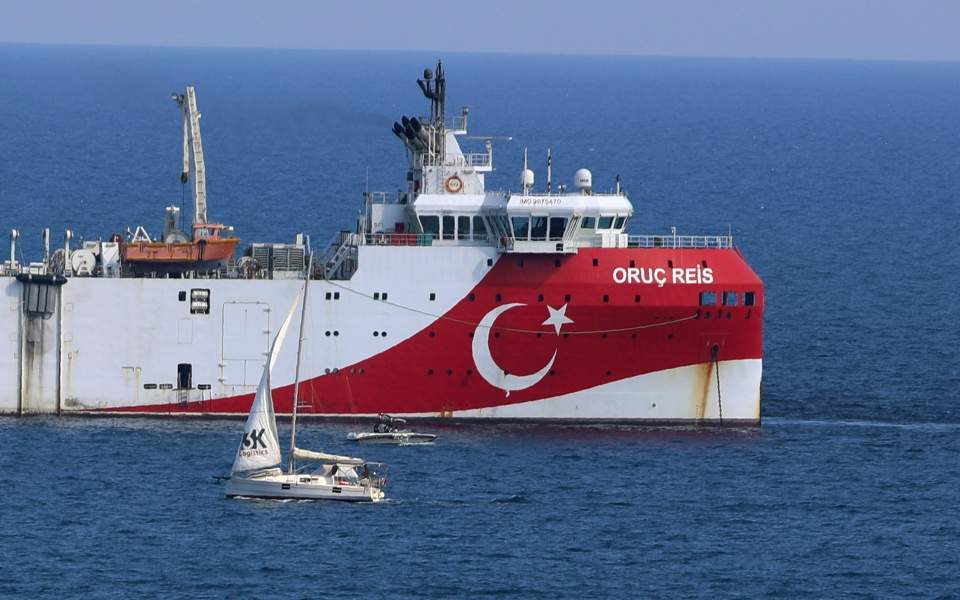
Turkey is well aware that Greece is not Syria, Libya, nor Nagorno-Karabakh. Turkey appreciates the fact that Greece has been a member of NATO since 1952 (the year of its accession along with Turkey) and a member of the European Union and the eurozone – more than a significant part of Greek public opinion does. It takes into account the high level of Greco-American relations and takes this parameter into account now that it is trying to assess the new American landscape following the election of President Joe Biden. It knows that over the next 55 days presidential authority will be exercised by Donald Trump, but over the exact same period the president-elect will be shaping his basic decisions. 

The first decisions of this kind, I believe, along with many others, will be to restore the strategic status of the West based on Euro-Atlantic relations. If this happens, ambitious regional players who have rushed to exploit the large gaps and internal dysfunctions and contradictions of a strategically relaxed West will see a significant reduction in the margin of their initiatives.

The important advantage of its interesting relationship of “controlled conflict and strategic understanding” which it has developed with Russia and tested on various fronts, will not be enough for Turkey. If the direction of Biden’s policy is the one I am describing, Turkey will be asked to answer the question of not whether it is a normal or typical Western country, but if it is a fundamentally Western country that promotes its “exceptionalism,” but knows and respects its own limits. 

Of course, until all this works, the Turkish challenges in the Eastern Mediterranean will continue with periodic hiatuses. Greece must avoid the risk of the continuous tension – lasting almost a year – being regarded as a new form of normality in Greco-Turkish relations. The EU has to use, with some effectiveness and insight, the threat lever of sanctions against Turkey and the lever of conditional financial aid, should Turkey be forced to seek it. The Greek-Cypriot side must urgently form a clear policy, knowing that its choices will determine the national strategy, while we, in the so-called national center, must be aware of our historical debts. 

This is the context in which the question of dialogue with Turkey is raised. History teaches, first of all, that a compliant attitude and defeatism cause and accelerate whatever it is that they want to prevent. History teaches, secondly, that avoidance of dialogue leads to tension, tension leads to crisis and finally crisis leads to dialogue, possibly on worse terms and in any case under the pressure of time. Thirdly, the history of international relations teaches that any party that gives the impression of refusing dialogue becomes vulnerable to the blame game inherent in international conflicts. These three assumptions shape the field in which we must operate. 

Respect for international law is a pillar of Greece’s foreign policy. The international law of the sea requires dialogue on the delimitation of the continental shelf and the exclusive economic zone. Without a final delimitation, the relevant sovereignty rights cannot be exercised and yield practical results. Therefore, our position is still that we are ready for exploratory contacts and then for negotiations on the delimitation of the continental shelf and EEZ in the Aegean and the Eastern Mediterranean, and if no agreement can be reached, our position is the signing of a procedural agreement for a joint appeal to the International Court of Justice. 

The pillar of our foreign policy is international law, but not legalistic naïveté. We therefore do not accept the notion that persistent unilateral claims and challenges can open the way for dialogue on national sovereignty issues. 

We are aware, however, that the delimitation of the continental shelf and the EEZ can de-dramatize the issue of the extent of territorial waters in the Aegean Sea and especially in the Eastern Mediterranean, where Greece and Turkey have territorial waters of 6 nautical miles, while all other countries involved in delimitations that interest us have territorial waters of 12 nm. 

Greece does not engage in dialogue on the extent of its airspace or on the “demilitarization” of its islands. However, it has participated with positive results and is ready to engage again in a dialogue on confidence-building measures in order to avoid unnecessary tensions and accidents. It is also prepared to participate – and already has – in NATO consultations aimed at avoiding friction and conflict, provided that the institutions of the Alliance are ready to ensure respect for the North Atlantic Treaty by all members of the Organization. 

In any case, even our most sincere and bona fide friends in the coming months will ask Turkey to avoid challenges and respect the status quo and at the same time ask Turkey and Greece to resort to dialogue. Therefore, the question is not a “yes” or a “no” to dialogue, but what we mean by that and in what strategic context our stance lies. 

The same applies, mutatis mutandis, to the Cyprus issue, the developments of which affect the climate of Greek-Turkish relations in a major way. It would be ahistorical to think that there may be significant developments in Greco-Turkish affairs without significant developments in the Cyprus issue, which is certainly an international issue, an issue of invasion and continued military occupation by Turkey of a large part of the territory of the Republic of Cyprus. I hope that these developments will be the product of dialogue and will be endorsed by the will of the Cypriot people expressed through a referendum, and not the product of unilateral movements and de facto situations. 

It goes without saying that at the same time Greece must upgrade all the parameters of its national power, from the strengthening of its defense to economic recovery. From managing the pandemic to the quality of our democratic institutions. Such a fundamental parameter is the collective national ability to understand and tell each other the truth.


Evangelos Venizelos is a former deputy prime minister and minister of foreign affairs, and former minister of national defense.

Let's block ads! (Why?)


"discourse" - Google News
December 02, 2020 at 03:01AM
https://ift.tt/3lnfI60

The discourse on the dialogue: The context of Greco-Turkish relations, EVANGELOS VENIZELOS | Kathimerini - www.ekathimerini.com
"discourse" - Google News
https://ift.tt/2KZL2bm
https://ift.tt/2z7DUH4

The Telos Press Podcast: Mark GE Kelly on Michel Foucault and the Politics of Language Today - Telos Press

israelob.blogspot.com

In today’s episode of the Telos Press Podcast, Camelia Raghinaru talks with Mark G. E. Kelly about his article “Foucault and the Politics of Language Today,” from Telos 191 (Summer 2020). An excerpt of the article appears below. If your university has an online subscription to Telos, you can read the full article at the Telos Online website. For non-subscribers, learn how your university can begin a subscription to Telos at our library recommendation page. Purchase a print copy of Telos 191 in our online store.

From Telos 191 (Summer 2020):

Foucault and the Politics of Language Today

Mark G. E. Kelly

We find ourselves today in a conjuncture where the use of language has become an object of political concern to a perhaps unprecedented extent, or at least in unprecedented ways. In particular, the words used to refer to individuals and to groups, down to the use of pronouns, have come into intense question, as have the ways in which groups are represented in the media and in positions of power. In light of this situation, I want to bring the analytical tools of a thinker peculiarly concerned with the nexus of language and politics, Michel Foucault, to bear in order critically to analyze recent developments. This recent mutation of the politics of language has occurred mostly in the four decades since Foucault’s main writings on power and knowledge appeared, during a period in which Foucault’s name has become ubiquitous in academic discourse. Yet for all the ubiquity of references to Foucault, it seems to me that there has been precious little real thinking through of the implications of his analytic of power relations, and that there has been a failure to do this in relation to the use of language in politics in particular.

Much of my critique here will be directed toward what is popularly called “representation” in media and institutions, which I argue essentially treats the inclusion of types of people as a form of signification. This is meant not to uniquely privilege this vector but rather to posit it as an example of a general tendency—in spite of Foucault’s insights—to understand language as politically monovalent, to understand words as having a single possible meaning in a given context and consequently a single political valence. My thesis regarding contemporary concerns around the use of language and representation is that they are literally superficial in being addressed toward the rearrangement of the audible and visible cues of social inequality rather than anything nonlinguistic, while indeed failing properly to account for the very real political import that language and representation have.

Tactical Polyvalence

The core conceptual point from Foucault’s thought that I will use to make this case is best encapsulated in the admittedly unwieldy phrase “the tactical polyvalence of discourses.” Perhaps its ugliness explains why Foucault never thematizes this notion: he uses the phrase in only two of his works, and then only once apiece, namely, in the first volume of his History of Sexuality (as part of the title of a section in which the term is not actually used) and in the contemporaneous Collège de France lecture series Society Must Be Defended, where the phrase appears once, along with a single use of the related phrase “strategic polyvalence.” In the lectures, tactical polyvalence figures as a peculiar property of a specific discourse, but in The History of Sexuality he posits it as a general feature of all discourse, in particular in the following key passage, which I now present as axiomatic:

We must conceive discourse as a series of discontinuous segments whose tactical function is neither uniform nor stable. To be more precise, we must not imagine a world of discourse divided between accepted discourse and excluded discourse, or between the dominant discourse and the dominated one; but as a multiplicity of discursive elements that can come into play in various strategies. It is this distribution that we must reconstruct, with the things said and those concealed, the enunciations required and those forbidden, that it comprises; with the variants and different effects—according to who is speaking, his position of power, the institutional context in which he happens to be situated—that it implies; and with the shifts and reutilizations of identical formulas for contrary objectives that it also includes. Discourses are not once and for all subservient to power or raised up against it, any more than silences are. We must make allowance for the complex and unstable process whereby discourse can be both an instrument and an effect of power, but also a hindrance, a stumbling-block, a point of resistance and a starting point for an opposing strategy. Discourse transmits and produces power; it reinforces it, but also undermines and exposes it, renders it fragile and makes it possible to thwart it. In like manner, silence and secrecy are a shelter for power, anchoring its prohibitions; but they also loosen its holds and provide for relatively obscure areas of tolerance.

For Foucault, discourse is the concrete core of the “power-knowledge” nexus: “it is in discourse that power and knowledge are joined together.” Power is on Foucault’s conception essentially relational, inhering in relations between people, but these relations produce regular, quasi-agential “strategies” across society, and it is here that apparently contradictory discourses cohere with one another. Foucault provides us with three prime examples of this effect in his work. In Discipline and Punish, before he formulated the concept of tactical polyvalence as such, we can nonetheless find an example of it in the way the discourse of prison reform and calls for harsher punitive measures are characterized as effectively combining with one another to support the carceral system in general. In Society Must Be Defended, he claims that discourses of “race struggle” (in the very broad genealogical sense he gives this phrase, according to which both discourses of class struggle and racism are different instances of the same trope) can be utilized either by the oppressed or against them. In the first volume of The History of Sexuality, he discusses how the term “homosexuality” was invented by medics to pathologize those to whom it was applied, but then turned into a badge of identity by homosexuals around which to rally to seek liberation.

Continue reading this article at the Telos Online website (online subscription required). If your library does not yet subscribe to Telos, visit our library recommendation page to let them know how.

Let's block ads! (Why?)


"discourse" - Google News
December 02, 2020 at 01:05AM
https://ift.tt/3qhX6Im

The Telos Press Podcast: Mark GE Kelly on Michel Foucault and the Politics of Language Today - Telos Press
"discourse" - Google News
https://ift.tt/2KZL2bm
https://ift.tt/2z7DUH4

Why the GRA discourse is missing the point – The Oxford Student - Oxford Student

israelob.blogspot.com

I fell in love with the Canterbury Cathedral when I was 14, the first time I saw the Great Cloister, which is truly breathtaking. Rather than some museum-like tourist attraction, the cloisters are a living, breathing part of the cathedral. Past these there is a school, the oldest in the world, that feels completely lost in time.

I decided at that point that I wanted to go to that school, more than I’d ever wanted anything. And for that, I needed a scholarship. So for months, before even my GCSEs, I studied for the exam for an academic scholarship. And despite the challenges I’d faced, I attended the most beautiful school in the world, completely for free.

Unlike the other students, most of my uniforms were second-hand items that the original owners had grown out of. It was completely worth it.

When I was there, the cathedral became my regular church. I attended every Sunday. In the early hours, without the tourists, you can really appreciate the beauty of the place. It was in these services, that I started wondering to myself what it must be like to get married somewhere like this; a right I was sure was reserved for actual, literal princesses.

I soon discovered I was wrong; my Kings Scholarship inducted me into the Cathedral Foundation, and so I have the right to a wedding on Cathedral grounds.

So much of the discussion of trans rights comes down to a right to privacy.

Except I don’t, not really. Without a Gender Recognition Certificate, my wedding vows would call me ‘husband’ and the Church would see it that way too. They wouldn’t allow me to marry. This is a privilege, I thought I had earned through hard work, stripped of me because I’m trans.

The problem is worse too when you realise that any wedding I had, anywhere, would put me in the same position.

Someday I want to be married.

Someday I want someone to be my husband.

Someday I want to be their wife.

I don’t want to send humiliating personal medical details to bureaucrats to judge if I’m trans enough.

That is my only option now.

So much of the discussion of trans rights comes down to a right to privacy. For many people, this can be fairly abstract, bringing to mind the privacy warnings at the bottom of web pages. But for me, and many trans people, this is much more visceral. Due to the long NHS waitlists for trans related healthcare, I transitioned socially well before I started hormone therapy. I was, to anyone walking down the street, visibly trans; I had no privacy.

Instead of a debate about legislation, it’s a campaign of fear.

In this time I was routinely harassed in the street, yelled at in public places, and on one occasion someone attempted to follow me home. However, with hormone therapy and time, privacy returned. But this can always be taken away, and any legal change that threatens to take away the privacy of trans people threatens also to put me, and thousands of others, back to that time.

If you look in the papers today, at how Gender Recognition Act reform is being framed, you’d be forgiven for thinking it is something completely different. A torrent of changing rooms, bathrooms, prisons, shelters. But the GRA is largely bureaucratic, it has no effect on access to any of these. So it leaves us asking why are we having this debate? And why does the opposition argue so strongly?

I would argue that this debate has become a proxy for the right of trans people to exist in public at all. It’s why The Economist can run a headline asking if we should be medically sterilised. It’s why the Telegraph can run a headline declaring that we should carry ID cards.

The tabloid papers are more explicit here. The Sun for example has an article headlined “M&S sparks gender-neutral row after telling customers to use whichever changing room ‘they feel comfortable’ in”, taking issue with the very idea of trans people daring to try on clothes in a store.

Instead of a debate about legislation, it’s a campaign of fear. And while it continues, people, in many cases intelligent, rational people, will be convinced into believing that trans people pose some sort of existential threat.

To do this, they conflate the GRA and the Equality Act, talking about changing rooms and bathrooms as if these aren’t spaces trans people have used safely for decades, and nothing to do with the GRA. And they suggest that trans people, particularly trans women, are somehow dangerous.

Meanwhile, legislative attacks here and around the world try and attack the rights that trans people already have. The GRA does not provide additional rights to trans people, instead, it affords trans people with a Gender Recognition Certificate some of the same rights that others take for granted.

Me, as a trans person, and the media have very different agendas. I want to live my life with the same dignity and self-respect as anyone else. I want to enjoy the same rights and privileges that anyone else in my situation would have.

Be that the meaningful right to a wedding, timely access to healthcare, or meaningful access to public spaces. While not to be overly cynical, the media want clicks. So I’m left to defend these basic rights.

My view is that the media have essentially constructed this debate. Framed this as a clash between trans women and cis women, frequently minimising trans men. And presented the outcome as somehow existential. For legitimacy, this is tied by the loosest threads to the reform of the GRA.

After a years-long consultation, that seems to have done nothing but worsen the media coverage of trans people, I am just tired and worried about the future.

Of course, with any proposed legal change it is a part of a healthy democracy to have good-faith discussion on its impacts. But the discourse that is happening is not that. It is toxic and harmful. And it’s one in which trans voices are rarely included.

Liked reading this article? Don’t forget to share it on social media!

Want to contribute? Join our contributors’ group here or email us – click here for contact details

Share this post:

Let's block ads! (Why?)


"discourse" - Google News
December 01, 2020
https://ift.tt/3lt9Act

Why the GRA discourse is missing the point – The Oxford Student - Oxford Student
"discourse" - Google News
https://ift.tt/2KZL2bm
https://ift.tt/2z7DUH4

Kirchgasler authors new Discourse article, 'The ends of inclusion' - School of Education - University of Wisconsin-Madison

israelob.blogspot.com

UW–Madison’s Christopher Kirchgasler has published an article in Discourse: Studies in the Cultural Politics of Education that is titled, “The end(s) of inclusion: ungrounding globalization and ‘the migrant’ in dialogue with hospitality.”

Chris Kirchgasler
Kirchgasler

Kirchgasler is an assistant professor in the School of Education’s Department of Curriculum and Instruction.

The article “reassesses globalization in light of research, policy, and reforms directed towards ‘the migrant’ during times of crisis,” explains the abstract.

The abstract continues:

In dialogue with Derrida’s discussion of hospitality, the article questions the grounds that figure “the migrant” as a metonym for globalization’s dangers — as excess mobility menacing the foundational sovereignty of nation-states. With Sweden as a point of reference, the article interrelates three seemingly distinct techniques for evaluating notions of arrival — data visualizations comparing “the migrant” against those “without immigrant background,” curriculum, and pedagogy seeking to integrate and include according to psychologized norms and values, and critical qualitative research representing migrant voice. At issue in each is how the gesture of hospitality seeks to render arrival calculable, establishing the authority and beneficence of the host and leaving “the migrant” indefinitely at the threshold of (non)belonging. Efforts to represent the migrant through notions of experience and “voice” risk naturalizing hospitality’s asymmetries and exclusions, while impeding reflexivity toward the conditions upon which hospitality remains tenuously granted.

Access the full article at tandfonline.com, here.

Let's block ads! (Why?)


"discourse" - Google News
December 01, 2020 at 06:01PM
https://ift.tt/37nLt9Z

Kirchgasler authors new Discourse article, 'The ends of inclusion' - School of Education - University of Wisconsin-Madison
"discourse" - Google News
https://ift.tt/2KZL2bm
https://ift.tt/2z7DUH4
Search

Featured Post

I just paid $9.99 for a carton of 18 eggs. Will prices ever drop? | Opinion - Sacramento Bee

[unable to retrieve full-text content] I just paid $9.99 for a carton of 18 eggs. Will prices ever drop? | Opinion    Sacramento Bee ...

Postingan Populer