Rechercher dans ce blog

Saturday, January 2, 2021

Opinion: It’s almost as tough as Cornyn’s brisket to stay positive in Texas - Houston Chronicle

Happy New Year! It’s only been a little more than a day, but so far, so good. God’s in his heaven. Trump’s at his golf course. All’s right with the world. Last year left us as rattled as a ride on the old Astroworld Texas Cyclone, constantly wondering if the safety bar would hold and grateful to be alive at the end. In that spirit of appreciation, the Thumbs’ New Year’s resolution is to stay positive. How hard could it be?

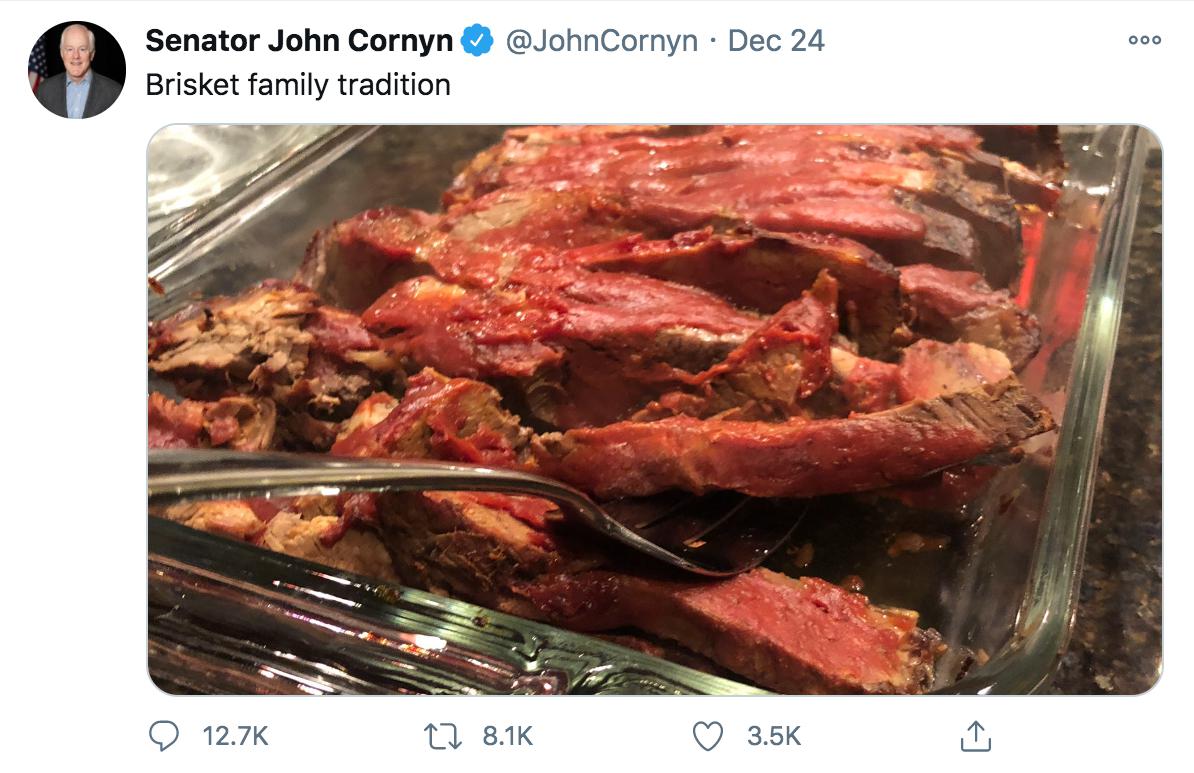
Brisketgate! It was almost too on the nose to have the last big Texas political scandal of the year be about beef, but 2020 was nothing if not basic. U.S. Sen. John Cornyn took a roasting on social media after he posted a photo of his holiday meal with the caption “Brisket family tradition.” The sad, sliced up hunk of leather — looking so dry that pictures of it can be used as a dehumidifier — was covered in a red mystery sauce and seemed to answer the age-old question of what it would look like if a cow fought a bear. People were very mean on social media but Cornyn took it in stride. “There’s a lot of things I don’t want to happen that happen. So you just got to learn to deal with it. And I think this is one of them,” he said. Way to stay positive, senator!

Oh, wait, Cornyn wasn’t talking about the brisket. He handled that with some good humor. He was talking about another unsavory piece of meat: U.S. Sen. Josh Hawley. The Missouri Republican announced Wednesday that he would object to the certification of the Electoral College vote. His action, along with that of U.S. Rep. Mo Brooks, R-Ala., in the House, guarantees that a usually pro forma congressional confirmation of the presidential contest becomes yet another casualty of President Donald Trump’s false allegation of a stolen election. We know Alabama and Missouri are no strangers to lost causes, but it’s time to acknowledge reality. At least the ensuing debate and vote will (hopefully) confirm that a slim majority of our lawmakers still believe in democracy. So, yay!

Unsurprisingly, that slim majority does not include U.S. Rep. Louie Gohmert. The Texas Republican sued Vice President Mike Pence this week to get a federal judge to magically expand the veep’s powers so he can ignore the Electoral College and install Trump as president for another term. Imagine if this was how our political system worked. Nelson Rockefeller would have given us four more years of Gerald Ford. Walter Mondale would have given Jimmy Carter another shot. Dan Quayle would have stumbled and somehow given us President Potatoe. The laughter is starting to catch in our throats, but the bright side is that these coup attempts keep getting sillier and sillier! Right?

You know what else got caught? A bobcat! By a professional mixed martial arts fighter! In Sugar Land! We assume it was an accident and that the two partnered up to fight the Houston criminal underworld and their archenemy Professor Possum! Sorry. No. It’s hard to keep this positivity thing up. The poor animal was trapped and starved, and then the MMA fighter allegedly tried to sell him on Craigslist for $1,000. On the upside, the fine folks at the Harris County Precinct 1 Constable’s Office led the investigation, the bobcat was rescued and the MMA fighter was arrested. Professor Possum remains at large.

That marsupial master of mayhem must have gotten to District G Council Member Greg Travis. How else to explain his abhorrent Facebook post that claimed former first lady Michelle Obama wasn’t “the brightest bulb in the lot” and got into Harvard Law School because of affirmative action. “She was born with her qualification,” Travis wrote beneath a photo of Obama next to one of Melania Trump. Not content to make racist comments, he added sexism to the mix by claiming Vice President-elect Kamala Harris’ skill is that “she sleeps with powerful men.” While Hillary Clinton — an accomplished woman in her own right — “would be nothing without Bill.” Travis deleted the post but disavowed nothing, saying he took it down because Mayor Sylvester Turner asked him to, “as a friend.” Does Travis think the nine women, five of them Black, who sit next to him on the Houston City Council belong there? They do. After his ignorant, disrespectful comments, we’re not sure he does. Travis is unrepentant and we can already feel how this year is going to go. Just over 24 hours in and our resolution has been thwarted.

Let's block ads! (Why?)


"Opinion" - Google News
January 02, 2021 at 04:00PM
https://ift.tt/3hzawvw

Opinion: It’s almost as tough as Cornyn’s brisket to stay positive in Texas - Houston Chronicle
"Opinion" - Google News
https://ift.tt/2FkSo6m
Shoes Man Tutorial
Pos News Update
Meme Update
Korean Entertainment News
Japan News Update

Friday, January 1, 2021

Opinion | ‘Because of You Guys, I’m Stuck in My Room’ - The New York Times

Residents and caregivers at senior living facilities write about life during the pandemic — and trying to stay safe while facing the challenges of long-term isolation.

Devora Greenspon, 88, spent most of April, May and June confined to her room after residents at her long-term care facility in Toronto tested positive for the coronavirus. She couldn’t see her family and had very little human contact at all. A former special education teacher, she told me she found the isolation and loneliness of lockdown “so heartbreaking.”

She said she gets frustrated when she hears about young people flouting social distancing rules. “I think, ‘Because of you guys, I’m stuck in my room. I would like to put you in my room for a week and see how you like it.’”

Residents of nursing homes and senior living communities were vulnerable to some of the earliest Covid-19 outbreaks. They will now be among the first groups to receive vaccines. What has life been like in between? Though we couldn’t visit Ms. Greenspon’s room, we wanted to offer readers a window into nursing homes. So we asked older Americans — as well as their caregivers and family members — to write about what their lives have been like during the pandemic.

Many reflected on the trade-offs they’ve navigated, trying to stay safe while facing the challenges of long-term isolation. A selection of their stories, edited for clarity and length, follows.


M. Anne Schmitz, writing about her mother, G. Louise Schmitz, 84, Portland, Ore.

My mom isn’t able to write or read after suffering from two strokes. In addition to early-stage dementia, she has expressive aphasia, which means she has difficulty talking. In early November, we received an email from her residential care facility saying that four staff members had tested positive. Mom tested negative. But soon after, she called telling me her next-door neighbor was sick with the virus. I started planning how I could remove my mom from the facility.

The next morning, my mom called again and said, after a lot of word salad, “He’s gone.” I asked, “What do you mean, your neighbor?”

She said, clear as a bell, “He died.”

We waited until 4 p.m. for another test result, also negative, and I got her soon after. She had two bags packed and was practically running out the door — away from the boredom, loneliness, scary and confusing events, unknown staff members with covered faces.

We learned later that another neighbor, whom she knew well, also died that day. She heard this news, slumped in her chair, shielded her eyes and was quiet for about 20 minutes. I made a quesadilla for dinner, and by the time it was ready, she was stirring. She quietly dug into dinner and started talking, in her own poststroke words, about her friend.

I understood, “He was wonderful. God love him.”

Jack Cumming, 84, Carlsbad, Calif.

My wife and I live in a senior housing complex with a skilled nursing facility on the premises. Our lives are centered on the facility where we live. We are old, and so are our neighbors. Many are deep into those transitions that lead to life’s ending.

Two cultures dwell side by side in most senior care facilities. One is the staff members’ culture. They are there to do a job, often one that others would never want. They are dedicated and come to work in the face of danger, after which they go home to their families. The residents dwell in a different culture. They never leave. They have few contacts. Both cultures vary widely from one community to another, but the contrast between staff freedom and resident confinement is common. People who live in care facilities trade freedom for security.

Most difficult have been bans on visits. You may wonder whether residents just passively accept these imposed restrictions. Many do, but many don’t. It’s the same as in the general population. Walking the streets, we encounter many unmasked strangers. Are they contagious? Perhaps. They seem oblivious. Similarly, many residents ignore the rules and sneak out (“elopement” in the industry) to visit with family or friends.

Beverly Zeroogian, writing about Dorothy S., Newtown, Conn.

Dorothy lived in the nursing home where I worked for over five years. She had advanced dementia and was no longer able to walk or talk. But every day her husband, daughter and son arrived at about 12:30 to take her to the dining room for lunch. Her husband would sit on one side holding her hand. Her daughter would feed her pureed food, and her son would help Marianne and Joan, two other residents who also had challenges with feeding themselves. They were all like a family.

When Covid-19 hit, all family visits were halted. Dorothy was OK at first, already accustomed to the staff feeding her twice a day. But after a while, I think it hit her. Her family was gone. We could not tell her why or where they were. We could not reassure her, although we tried.

Dorothy slowly went downhill, and in July, she died. She is the collateral damage, the many who decline simply from the isolation and loss of routine, but most important, from the loss of the people who love them. She was one of many here, and she deserves a voice.

Debra L. Eder, writing about her mother, Ruth Eder, 92, Eatontown, N.J.

My 92-year-old mother, Ruth Eder, survived the coronavirus in a long-term care facility in New Jersey. Since recovering, she has left her room only a handful of times in the past nine months. Mom feels grateful she’s in a safe place. The same stalwart staff members have cared for her throughout the pandemic. But that doesn’t prevent her from griping — her sense of humor intact.

“You don’t know what it’s like to be in here,” she told me. “How does it feel to be wandering around in the room all day? How does it feel to be 92 and still a bitch? You don’t know what it’s like — except for being a bitch.”

Mom is showered weekly. Her uncut hair falls to her shoulders, clipped back with a child’s barrette. “I look like that Supreme Court justice,” she told me, referring to Ruth Bader Ginsburg.

Mom’s days follow a routine, but it’s not clockwork: Breakfast. Get dressed. Hot chocolate. Sit in the wheelchair. Organize her tray table, bedstand. Lunch. Read.

Or, as she put it, “Waiting and waiting until things improve and I can get out of this room.”

Shari Casey, writing about her mother, Joan Slocum, 85, Woodstock, Vt.

My mother does not know that she has dementia. She does not understand why some days she does not know where she is. The isolation of the pandemic has made her dementia much worse much faster. The phone is her only stimulation most days. It is a lonely existence. She does her best to cope.

Dreams and reality sometimes blur because of the lack of stimulation. She has been adamant that she won the lottery; various cats and dogs come and snuggle with her in her bed; she has been kept awake all night having tea with a handsome Arabian prince.

My mother is fortunate that she is in an assisted-living facility that cares. It adheres to the guidelines. Unfortunately, the very rules that keep its residents physically protected do not support their emotional health. There are no easy answers.

Ruth Anderson, 81, Daly City, Calif.

We have never gone through a time like this. It is hard to go through our days, learn of hospitals full. I’ve lived in a long-term care facility for a year and a half. Life is different. I know and pray help is on the way. We must be strong and help all we can at this time. I am not able to sleep well. My mind is on the run. I am a strong lady. But for now, all we can do is wait, follow all the instructions and hope we all will pull through to be strong and have our life back. I am alone in this big world. Sometimes I wish it all would go away. But for now, I pray for all and hope life will get better for all of us.

Carol Mead, 87, Louisville, Ky.

I am counting all the days my husband Don and I have sheltered in place in our home on the campus of a retirement community since March 21. I know we’ll still be counting in 2021. But how have we survived since March? Two newspapers and a local one that has a great cartoon to start off our day. I’ve always written letters and notes, and am reaching out to many more long-lost friends and relatives. Our daily companions have become Nicolle Wallace, Rachel Maddow and Judy Woodruff on TV. And who would have thought I’d look forward to our daily 45-minute walks in our beautiful world? Seeing real, masked people, even if we can’t recognize or hear them, and of course, dogs and birds and all of nature can be the high point of our day. But oh, how we are looking forward to and counting the days until sometime in the new year when we can see our children and families and friends — unmasked, close up and sharing hugs, meals and good times again!

The Times is committed to publishing a diversity of letters to the editor. We’d like to hear what you think about this or any of our articles. Here are some tips. And here’s our email: letters@nytimes.com.

Follow The New York Times Opinion section on Facebook, Twitter (@NYTopinion) and Instagram.

Let's block ads! (Why?)


"Opinion" - Google News
January 01, 2021 at 11:00PM
https://ift.tt/3nc1bv2

Opinion | ‘Because of You Guys, I’m Stuck in My Room’ - The New York Times
"Opinion" - Google News
https://ift.tt/2FkSo6m
Shoes Man Tutorial
Pos News Update
Meme Update
Korean Entertainment News
Japan News Update

Opinion | Horrified by the Blackwater Pardons - The New York Times

The F.B.I. agent who led the Blackwater investigation and two other letter writers are appalled by the pardon of men who killed innocent civilians.

To the Editor:

Re “Bullets Ravaged Iraqis. Pardons Renew the Pain” (front page, Dec. 24):

I was the F.B.I. case agent who led the investigation of the Blackwater massacre in Baghdad. We originally went to Iraq thinking this shooting was some form of innocent civilians caught in the crossfire between Blackwater guards and insurgents. After only one week, we determined that this incident was not as presented by Blackwater personnel and their State Department lackeys, but it was a massacre along the lines of My Lai in Vietnam. Three of the guards were convicted of manslaughter and one of murder.

I only recently became aware of the concerted effort for the pardons, which I understand started with a political push by members of Congress. President Trump should have had staff members review the trial evidence that led to the convictions and read the judges’ opinions and sentencing statements. God forbid they might have actually picked up the phone and called the investigators who built the case. I’m so disgusted with the president’s actions!

Having spent many hours with the innocent Iraqi victims who are permanently maimed and crippled because of the actions of these Blackwater guards, and the heartbroken family members of those killed, I am embarrassed for our country. I believe we will pay a heavy price in our relationships with other countries as a result of these pardons.

I’m so glad that I’m retired and will never again be asked to risk my life and those of my fellow investigators, only to have killers pardoned for purely political reasons.

John M. Patarini
Charlotte, N.C.

To the Editor:

In 2007, when private security contractors working for Blackwater in Iraq killed 17 Iraqi civilians, and injured others, the killings provoked outrage in Iraq, and around the world. It took seven years for the U.S. government to successfully prosecute the perpetrators, a case that highlighted the need to hold private contractors accountable.

President Trump has shamefully pardoned four of the perpetrators, upending this valuable example of accountability.

The killings by Blackwater contractors served as a catalyst for several governments, including the United States, Britain and Switzerland, to create the International Code of Conduct Association, or ICoCA, dedicated to creating accountability for private security contractors around the globe.

Mr. Trump’s pardon underscores the need for governments to bolster ICoCA’s role in monitoring private security firms and addressing abuses when they occur. While the Biden administration cannot undo this ill-advised pardon, it should support ICoCA’s important global mission, by providing financial and diplomatic support and by requiring private security companies doing business with U.S. agencies to participate in ICoCA’s monitoring and assessment program.

Michael Posner
Meg Roggensack
The writers are former board members of ICoCA.

To the Editor:

This 73-year-old woman in Texas personally apologizes to the Iraqi people not only for the war this country waged there but now again for the despicable pardons of four convicted killers of your people.

I’m sure I speak for millions of Americans who are horrified by these pardons and are truly sorry. Our apologies may not help, but we still must offer them.

Karen Porter
San Marcos, Texas

Let's block ads! (Why?)


"Opinion" - Google News
January 02, 2021 at 02:30AM
https://ift.tt/38Rnvoj

Opinion | Horrified by the Blackwater Pardons - The New York Times
"Opinion" - Google News
https://ift.tt/2FkSo6m
Shoes Man Tutorial
Pos News Update
Meme Update
Korean Entertainment News
Japan News Update

Judicial gerrymandering: Just say no | Opinion - pennlive.com

In the 2019-2020 session, as in the session before it, bills to amend the Pa. Constitution to create an independent redistricting commission received more co-sponsorships than any other bills. At the same time, over 100,000 Pennsylvanians signed petitions in support of such a commission while 260 townships and 24 counties passed resolutions of support, mailing copies to PA legislators.

Statewide surveys and thousands of meetings with legislators made clear: PA voters don’t like gerrymandering. 72% of survey respondents believe the current system of drawing legislative districts allows party leaders to put party interests above voter interests. 70% believe the system creates polarization and gridlock. 65% believe it allows elected officials to choose their voters.

Despite strong bipartisan support and high levels of public attention, the bills supported by Fair Districts PA to change the system never received a final vote in either chamber across multiple sessions.

Meanwhile, another very different constitutional amendment flew through our legislature without any visible evidence of public interest or approval. House Bill 196 would create judicial regions for Pa.’s highest courts in a way that would give legislators control over those regional maps and, by extension, over the courts themselves. That bill, despite outcry from Pa. law associations and good government groups in Pennsylvania and across the country, passed in both the Pa. House and Senate in the 2019-20 session. If the same bill passes again in early 2021, the constitutional amendment will go to public referendum as early as May 2021.

What is the motivation for the bill?

What experts support it? What voters requested such a change? How would it impact the independence of the court?

If you’re hoping for answers from the Pennsylvania legislature, you have not yet understood how badly broken the legislative process is.

The transcript for the initial House Judiciary Committee meeting is not to be found on the General Assembly website. So much for transparency! The voting meeting in the Senate State Government Committee reflects just nine minutes spent on sketchy explanation, a few unanswered questions, some unaddressed concerns, then a swift party-line vote.

Opponents raised objections before votes on both the House and Senate floor, but those objections went unanswered. A party-line vote, with a few brave Republicans abstaining or voting no, and our legislature apparently felt it had completed due diligence on a constitutional amendment.

Most other states have been moving away from partisan election of judges. Bills to do just that have been regularly introduced in the Pa. legislature across the past decade. All have had much more discussion and far more public support than House Bill 196, but none have ever come to a vote.

Just nine states continue with partisan election of appellate judges. Only two use districts for those elections. And in those two, Illinois and Louisiana, the districts are set in law, not changed after each census at whim by legislators hoping to influence judicial decisions. Pa. is heading into uncharted waters: judicial gerrymandering not yet seen in any other state.

When our legislature defies constitutional requirements in drawing distorted legislative districts, among the worst in the nation, our ability to hold legislators accountable is damaged.

When our legislature passes bills without public support, without the chance of expert testimony or real deliberation, the institution itself is diminished and our Commonwealth is pushed farther back from the real solutions we so badly need.

When the Legislature speeds toward an unprecedented power grab that would smash foundational principles embedded in our constitution, we need to say, as loudly as we can, they’ve finally gone too far.

Russ Diamond’s judicial district amendment is not just another very bad bill. We see many fly through Harrisburg without deliberation or review. This bill is in a class of its own: a hasty, sloppy, cynical attempt to undermine our constitutional rights and protections.

The bill does not deserve a vote in committee, unless committee chairs choose to do their jobs and invite public comment and expert testimony, the norm in any functional state legislature. If our legislative leaders do drive the bill forward, every Pa. legislator, no matter their party, should vote no. A vote for that bill is a vote against the people of Pennsylvania and an assault on representation, judicial independence and the state’s Constitution.

Join Fair Districts PA for Say NO to Judicial Gerrymandering, a virtual town hall on judicial districts, Jan. 6 at 4 p.m.

PA voters want LESS gerrymandering, not more. Help make sure our legislators hear us.

Carol Kuniholm is the chairwoman for Fair Districts PA

Let's block ads! (Why?)


"Opinion" - Google News
January 02, 2021 at 01:00AM
https://ift.tt/3n3C1i4

Judicial gerrymandering: Just say no | Opinion - pennlive.com
"Opinion" - Google News
https://ift.tt/2FkSo6m
Shoes Man Tutorial
Pos News Update
Meme Update
Korean Entertainment News
Japan News Update

Opinion | After Five Centuries, a Native American With Real Power - The New York Times

In the American West, a ration of reverence is usually given to the grizzled Anglo rancher who rises at a public hearing and announces that his people have been on the land for five generations.

So what are we to make of Representative Deb Haaland, a citizen of the Laguna Pueblo, who says that her people have been in the Rio Grande Valley of New Mexico for 35 generations — dating to the 13th century?

“Native history is American history,” she told me. “Regardless of where you are in this country now, you’re on ancestral Indian land, and that land has a history.”

As Joe Biden’s choice for interior secretary, Ms. Haaland is poised to make a rare positive mark in the history of how a nation of immigrants treated the country’s original inhabitants. She would be the first Native American cabinet secretary — a distinction that has prompted celebration throughout Indian Country.

“I haven’t been the one making policy,” she said. “But I’ve been the one on the receiving end of it.”

There will be plenty of sniping, second-guessing and disappointment among the tribes by people who expect much of Haaland having a seat at the big table. But for now, we should let this moment breathe.

I spoke to her on the anniversary of a day of infamy. On December 29, 1890, the U.S. Army slaughtered men, women and children at Wounded Knee in South Dakota. Government policy was to strip Indians of their language, culture and religion, with children sent off to boarding schools where they were taught that the old ways were wrong. At the end of the 19th century, the popular view was that Indigenous people would soon disappear

And yet here is Haaland, one of more than five million Native Americans, ready to knock down some of the last barriers of time and terrain in this country.

Her personal story alone makes Haaland an anomaly in the parlors of power. Soon after graduating from college, she became a single mother. She was sometimes dependent on food stamps, and she once ran a small business selling homemade salsa to make a living and support her child. As a freshman representative in 2019, she was still paying off her student loans.

When she ran for office, her slogan was “Congress has never heard a voice like mine.” Now the person with that voice could soon be overseeing one-fifth of the land in the United States.

As interior secretary, her portfolio would include national parks, wildlife refuges, the United States Geological Survey and the vast acreage of the Bureau of Land Management. Interior, for good reason, is known as the Department of Everything Else.

As such, she would also be overseeing millions of acres taken from Indians in treaties broken over the past several centuries, and would be the top government liaison with 574 federally recognized tribes — the nations within a nation.

This is quite the compass — from a deep slot in the earth near the Grand Canyon, wherein dwell the Havasupai, to the rain forest of the Olympic Peninsula, home of the Makah Nation, to urban neighborhoods that house Indians struggling with health care access.

“I wish we could right some wrongs,” she said of the centuries-old saga of sorrow. But going into the new year, she seems content to try to right the many wrongs that Donald Trump’s administration has inflicted on the land.

Trump’s first interior secretary, Ryan Zinke, literally rode into office on a horse named Tonto, and then promptly launched a campaign to make it easier to drill on public land. The current secretary, David L. Bernhardt, was an oil and gas lobbyist whose public service on behalf of his former clients was warmly received by his old friends.

Biden has pledged to end all new oil and gas drilling on these rangelands, forests and plains — an enormous change that will be fought fiercely by those who profit from land owned by all Americans. He has also promised to restore Bears Ears National Monument, a marvel of sandstone, mountains and Native sacred sites in the Southwest that was gutted by Trump, who reduced the size of the protected area by 85 percent.

Haaland is eager for the opportunity to do something lasting. “I’ll be fierce for all of us, for our planet and all of our protected land,” she said in December.

But it’s the weight of Native history that makes the choice of Haaland so extraordinary, as she acknowledged. “This moment is profound when we consider the fact that a former secretary of the interior once proclaimed it his goal to, quote, ‘civilize or exterminate’ us.” She was referring to Alexander H.H. Stuart, the secretary of the interior in the early 1850s in the Fillmore administration.

“Exterminate” was no exaggeration. The census of 1900 counted over 237,000 Native Americans, a population collapse of nearly 90 percent, in the estimate of many ethnohistorians, from the time of first European contact.

Some of the atrocities are well known. But less well known is how the government made it a crime for Natives to practice their religion. It was a violation of the First Amendment to lock people up for enacting the rituals of faith — unless they worshiped Native gods through certain dances and ceremonies deemed criminal by the government.

A consistent plea from Indian Country today is a request that fellow Americans consider Native people as much more than living relics locked in a tragic past. Haaland aims to ensure that. “I’ll never forget where I came from,” she said. But, she added, “ I love this opportunity.” Even if she can’t reverse history, she is poised to make some.

Timothy Egan (@nytegan) is a contributing opinion writer who covers the environment, the American West and politics. He is a winner of the National Book Award and the author, most recently, of “A Pilgrimage to Eternity.”

The Times is committed to publishing a diversity of letters to the editor. We’d like to hear what you think about this or any of our articles. Here are some tips. And here’s our email: letters@nytimes.com.

Follow The New York Times Opinion section on Facebook, Twitter (@NYTopinion) and Instagram.

Let's block ads! (Why?)


"Opinion" - Google News
January 01, 2021 at 11:00PM
https://ift.tt/3rM0JXx

Opinion | After Five Centuries, a Native American With Real Power - The New York Times
"Opinion" - Google News
https://ift.tt/2FkSo6m
Shoes Man Tutorial
Pos News Update
Meme Update
Korean Entertainment News
Japan News Update
What Trump never said - CNN

But it would be a mistake to remember Trump only for all the vitriol he spewed from the White House and on Twitter. Just as important were the long and never-explained silences and reluctant and insufficient acknowledgment of important issues.
In fact, on a range of issues that called for presidential leadership, Trump routinely spoke and acted in his own interests rather than the country's.
There was silence and denial on the Russian efforts to undermine the US elections in 2016, most starkly in Helsinki when Trump stood with Vladimir Putin against the verdict of US intelligence agencies. There was the failure to bring up with Putin the report of Russian bounties being offered on American soldiers in Afghanistan. "No, that was a phone call to discuss other things, and frankly, that's an issue that many people said was fake news," Trump told Axios' Jonathan Swan.
And Trump was silent for days when Russia engineered perhaps the most widespread and damaging hack ever of the US government computer systems, putting our national and economic security at risk. When pressed, Trump contradicted his own secretary of state and questioned Russian involvement at all.
That reticence extended to other parts of the world.
When a US-based journalist, Jamal Khashoggi, was murdered and dismembered in Turkey as part of a Saudi Arabian plot, Trump waited days to issue a statement that primarily supported Saudi Arabia and its relationship with America. CIA officials assessed that the operation could not have happened without the knowledge of Crown Prince Mohammed bin Salman, but Trump failed to hold him responsible. Bin Salman denied any involvement.
And the administration is now looking for ways to immunize bin Salman from any criminal liability in another incident, which could also shield him from being held responsible for the death of Khashoggi.
When American Otto Warmbier was brought back to the US -- near death, after imprisonment and apparent torture in North Korea -- Trump condemned the regime and offered words of comfort to the young man's parents. (Warmbier died shortly after his return.) But when he met North Korean dictator Kim Jong Un in 2019, Trump said, "He tells me that he didn't know about it and I will take him at his word." He added that Kim "felt badly about it. He felt very badly."
And during a 2018 meeting with his friend, President Xi Jinping of China, he avoided discussing the concentration camps holding Uyghur Muslims in China, according to an account from John Bolton, Trump's former national security adviser, in Bolton's 2020 book. Trump told Axios he had not retaliated against Chinese Communist Party officials or companies about the camps then, so as not to upset a trade deal he was working on with Beijing. (Last June, on the heels of the Bolton book release, Trump signed a bill condemning China for its human rights abuses against the Uyghur Muslim population.)
At Mar-a-Lago, earlier in 2018 (according to a recording obtained by CNN), Trump "praised China's President Xi Jinping for recently consolidating power and extending his potential tenure, musing he wouldn't mind making such a maneuver himself." Maybe he was joking.
Such blind-eye avoidance -- or outright silence -- can be explained in part by Trump's love of authoritarian power. His lust for that kind of authority here at home and admiration for those leaders allowed him to tacitly endorse their behavior by saying nothing at all.
But it was not only what he remained silent about around the world. During the worst pandemic in 100 years, the President failed to properly, publicly grieve or honor those who have died. Except for acknowledging the death of a few of his rich friends, he didn't utter the names of everyday Americans who died of the deadly virus.
He rarely spoke the names of frontline workers, doctors, nurses, grocery clerks -- those who put their lives on the line every day while he withheld information from the American public. Where was he for their funerals -- even virtually? In fact, in May he ludicrously described the spiraling numbers of cases in the United States as a "badge of honor" because it meant the US was testing more people.
As Bob Woodward's book details, Trump never spoke publicly in the early days of the pandemic about how serious the virus was. He told Woodward that he downplayed this because he didn't want to create panic. Early on in the crisis, he held daily -- often self-serving and misleading -- coronavirus task force briefings for the cameras (before suspending them in the spring).
He also found it difficult to regularly speak out for, or even model, the kind of behavior that would have saved tens of thousands of lives: simply putting on a mask. And he was silent about his own health, never fully explaining an emergency visit to the hospital or revealing a full readout of his bout with the coronavirus.
During a year of racial tension the likes of which the country had not seen since the brutal beating in 1991 of Rodney King in Los Angeles, the President focused on law and order, criticizing those who took to the streets in protest as thugs and criminals and downplaying the risk police misconduct can pose to Black people
There was no speech about the underlying issues of systemic racism in America. There were no appearances at funerals or memorial services for unarmed Black people who lost their lives at the hands of police.
Although we don't know the motivation of the Nashville bomber who wreaked havoc on Christmas Day, nearly a week has passed without a single public mention of this horrific act from Trump. (He did have plenty to say when it came to domestic terrorism in Charlottesville, Virginia, in 2017: Recall his comments that there were good people from both sides, despite the presence of neo-Nazis and White nationalists.)
His silence extended to the growing crisis of hunger in America and the millions of Americans who are out of work and desperately trying to make ends meet and put food on the table. Instead, we've heard about the record stock market numbers and how the economy would take off like a rocket post-Covid (something he said he deserved credit for). Only now is he is belatedly calling for raising stimulus payments to Americans to $2,000.
All this silence represents a loss for the White House of both moral and political influence here and around the world. While many have been disgusted by the President's crude and ignorant tweets and statements over the past four years, many have also been shocked and hurt by what he's chosen to be silent about.
And those silences will leave a stain just as damaging to America's reputation as any ignorant tweet.

Let's block ads! (Why?)


"Opinion" - Google News
January 01, 2021 at 11:28PM
https://ift.tt/3rKFw0l

What Trump never said - CNN
"Opinion" - Google News
https://ift.tt/2FkSo6m
Shoes Man Tutorial
Pos News Update
Meme Update
Korean Entertainment News
Japan News Update

Opinion: The coronavirus is here to stay - DW (English)

German Chancellor Angela Merkel has dedicated most of her traditional New Year's speech to the coronavirus pandemic, focusing on what it means for people's lives, says Jens Thurau.

Angela Merkel is right. This year saw us confronted with something entirely unexpected. That is why the chancellor focused much of her New Year's speech — the last of her chancellorship — on the coronavirus pandemic, which has defined what she called the "relentless" year of 2020.

While she briefly talked about climate change and establishing more equal living conditions in Germany towards the end of her address, everything else dealt with the virus outbreak — and, especially, with how it is shaping our lives.

Calling for solidarity

Merkel is often accused of applying an overly sober and analytical approach even to major challenges. But somewhat uncharacteristically, in early 2020, Merkel gave a speech in which she referred to what she considered to be the most important qualities now necessary in German society: solidarity and the acceptance of far-reaching coronavirus restrictions and of unprecedented measures.

Jens Thurau

DW's Jens Thurau

In her New Year's speech, she has made another appeal for this same kind of social cohesion. This comes at a time when many have grown tired of bad news and feel angry or perplexed by the chaos surrounding Germany’s vaccination program. So it was indeed vital to acknowledge the huge efforts that Germany has made in 2020 and will continue to have to make in 2021.

Putting people on center stage

In her speech, Merkel called on people to take a moment to commemorate all those who have died. She did not mince words regarding the small minority that denies the existence of the coronavirus, calling the conspiracy theories they espouse "dangerous and untrue" — and cruelly cynical towards coronavirus victims and their loved ones.

Merkel praised doctors, caregivers, bus drivers, supermarket employees, police officers, soldiers and those working in Germany’s health care facilities. She also mentioned artists and business owners fearing for their livelihoods.

Despite the general focus on the pandemic and its effects, Merkel did also very briefly hint at a hotly debated issue that had been centrally associated with her chancellorship until the outbreak began: the question of how much immigration — and how many asylum-seekers — Germany can handle. She spoke of the German company BioNtech, which developed the coronavirus vaccine now being administered across the globe. She noted that the company employs people from 60 different nations, illustrating that diversity is a force for progress. That sounded almost as if she wanted this diversity to be seen as part of her legacy.

No apologies

Anyone who expected Merkel to apologize for grave mistakes made in handling the pandemic, particularly in the past three months, will have been disappointed. Instead, she described the past 12 months as an ongoing learning process.

But she also refrained from heaping blame on German state premiers, some of whom impatiently urged the coronavirus restrictions imposed in spring to be lifted in summer.

And, refreshingly enough, she did not rail against ordinary people, as she recently did when she seemed to equate drinking mulled wine in the street with an attack on public health.

No unnecessary arguments

Merkel did not dwell on the much-debated question of who will be vaccinated in what order. Instead, in her typically rational way, she simply said: "I, too, will be vaccinated when my turn comes." By which she is effectively meant: Let's not have a senseless argument over this.

Without the coronavirus crisis, Merkel might have used her final New Year's address to reflect on her 15-year tenure in office. Yet doing so now, in these grim times, would have been unfitting. Merkel's time in office will now be defined by whether the country will succeed in fighting this virus so that Germany can prosper once more. Success is not guaranteed, and Merkel knows this. So now is not yet the right time to take stock of her chancellorship.

This article was adapted from German.

Let's block ads! (Why?)


"Opinion" - Google News
January 01, 2021 at 06:40AM
https://ift.tt/3pFqg36

Opinion: The coronavirus is here to stay - DW (English)
"Opinion" - Google News
https://ift.tt/2FkSo6m
Shoes Man Tutorial
Pos News Update
Meme Update
Korean Entertainment News
Japan News Update

Search

Featured Post

I just paid $9.99 for a carton of 18 eggs. Will prices ever drop? | Opinion - Sacramento Bee

[unable to retrieve full-text content] I just paid $9.99 for a carton of 18 eggs. Will prices ever drop? | Opinion    Sacramento Bee ...

Postingan Populer