Rechercher dans ce blog

Sunday, January 3, 2021

Opinion: Put kids’ needs first by opening schools - OregonLive

Ben Hoffman and Alex Foster

Hoffman, MD, is a professor of pediatrics at OHSU. Foster, MD, MPH is the director of the MD/MPH program at the OHSU-PSU School of Public Health and assistant professor of pediatrics.

COVID-19 has blown up what we took for granted as normal. Everything that was part of our routine has had to change, and change is never easy.

As pediatricians, we have dedicated ourselves to ensuring the health and well-being of children and adolescents. One immutable truth about kids is that they are incredibly resilient by nature. They possess immense capacity to adapt. Another is that kids need to learn, to have experiences that allows their brains to develop and grow in the right way. We know what it takes to build kids right, and that includes in-person school.

School attendance is much more than just classroom learning for many kids. School is where crucial therapies happen for kids with special needs, where hungry kids get food, where sedentary kids get exercise, where kids get support and nurturing from caring, committed adults and where kids learn the social and emotional skills that will prepare them to be competent adults. While it is possible for a resilient kid to adapt to learning remotely, many children may not. And even if they can, remote learning cannot serve the needs of the most vulnerable children.

The issue of whether to return to in-person school has become a massive, intensely charged debate. Thankfully, last month, Gov. Kate Brown moved the discussion forward by easing restrictions on schools and identifying teachers and school personnel as priority recipients of COVID vaccines. This was the right decision for kids, and we must continue to prioritize them. Kids do not have power like other stakeholders and consequently, their voice can be lost or even unheard.

As pediatricians we hear them, because we know them. We know the child who can only participate in remote classes from the parking lot of the school, because their home does not have high speed internet. We know the child living with autism and ADHD who simply cannot engage with a computer screen. We know the child who is not getting needed mental health services and has attempted suicide.

Communities of color have been hit disproportionately hard by COVID, at least in part because they make up a larger portion of our front line and essential workforce. They have been impacted to a greater degree by school closure, and we run a significant risk of widening racial disparities in educational outcomes as schools stay closed. As we move forward, we must recognize the disproportionate impact COVID-19 and remote learning have had on our communities farthest from opportunity and ensure that we take a trauma-informed approach to safely getting kids back into the classroom.

Returning Oregon’s kids to in-person school can be done in a way that minimizes the risks to them and to school staff. A growing body of scientific evidence, including data from New York state and Mississippi, strongly suggests that schools are not COVID super-spreaders. Rather, gathering with people outside of their household, close contact with COVID positive people, and not using masks in school remain risk factors. The New York state data shows that infection rates of school staff were a function of infection rates in the broader community and that kids and teachers attending in-person school were not increasing community rates.

We have learned much about how to protect kids and school staff using multiple layers of protection. Teachers and staff must continue to be prioritized for receiving vaccine. Masks, physical distancing, and robust cleaning protocols must be instituted. Protocols for ensuring that any student or staff with COVID symptoms or exposure can be identified and quarantined will be essential.

We cannot just open schools tomorrow and pick up where we left off like nothing happened. We can, however, follow the governor’s lead by putting the best interests of kids first. That conversation must acknowledge that what we are doing is not working for many of Oregon’s kids and establish the urgency to change.

A successful blueprint must prioritize the highest need children and teens, those most impacted and most vulnerable. It must be grounded in principles of equity and anti-racism and be built upon trust and honesty. It must include voices of educators, parents, and community leaders, whose voices must be heard and honored. It must address fear and bias in an authentic way and incorporate all we have learned in the last year much of it the hard way.

The COVID pandemic has required us all to change so many things. The change to remote learning was tremendously difficult and changing back may be even harder. But kids need to be in school. We need to start with those kids who have lost the most and are most at risk. We need to put kids front and center and ensure we can protect school staff as well as students and families. It’s not about us, or the economy. It’s about kids and about their future which is ultimately all of our futures.

Share your opinion

Submit your essay of 500-600 words on a highly topical issue or a theme of particular relevance to the Pacific Northwest, Oregon and the Portland area to commentary@oregonian.com. Please include your email and phone number for verification.

Let's block ads! (Why?)


"Opinion" - Google News
January 03, 2021 at 09:30PM
https://ift.tt/390890O

Opinion: Put kids’ needs first by opening schools - OregonLive
"Opinion" - Google News
https://ift.tt/2FkSo6m
Shoes Man Tutorial
Pos News Update
Meme Update
Korean Entertainment News
Japan News Update

3 Lessons From Climate Change Discourse In Election Fraud Claims - Forbes

Letters: Our Readers' Opinions | Opinion | lmtribune.com - Lewiston Morning Tribune

[unable to retrieve full-text content]

Letters: Our Readers' Opinions | Opinion | lmtribune.com  Lewiston Morning Tribune

"Opinion" - Google News
January 03, 2021 at 03:00PM
https://ift.tt/2KWeaDU

Letters: Our Readers' Opinions | Opinion | lmtribune.com - Lewiston Morning Tribune
"Opinion" - Google News
https://ift.tt/2FkSo6m
Shoes Man Tutorial
Pos News Update
Meme Update
Korean Entertainment News
Japan News Update

OPINION | LET'S TALK: Look back and ahead for sanity - Northwest Arkansas Democrat-Gazette

Early January has me thinking of Janus and Sankofa.

Both point to looking at the past and at the future.

In Roman mythology, Janus is the god of beginnings, endings, door-ways, transitions and such. He's traditionally pictured with two faces to show him looking in both directions ... future and past. He's thought to be for whom the month of January is named. (Well, at least one online source says that farmers almanacs of the day show that the month actually belonged to Juno. Dang, do the gals always have to take a back-seat to the guys?)

Sankofa is an African word from the Akan people in Ghana. According to Berea College's Carter G. Woodson Center, "the literal translation of the word and the symbol is, 'it is not taboo to fetch what is at risk of being left behind.'" The concept is symbolized in a bird, feet facing forward, head turned backward, with an egg in its mouth. "Thus, the Akan believe the past serves as a guide for planning the future," according to the center.

I submit that the concepts of Janus and Sankofa now have a new sibling: We Don't Want to Repeat That Mess!!! The symbol: Not a two-faced guy with a beard, or a bird that's really flexible and ought to teach yoga ... but a human figure looking back as it's running like heck to make sure it's still clear of the huge fireball behind it.

(A pair of secondary symbols, takes on the Old Year/New Year duo: There's still a baby with a top hat indicating the new. But the old dude with the scythe is made up to look like a composite of every zombie extra who appeared in "The Walking Dead.")

Building on last week's Suggested New Year's Resolution column, there are so many ways we can look back on the past as a guide forging a better future. Here are some for-instances.

Looking back: Just before the pandemic hit, I was going hither, thither and yon multiple times a week as a society reporter for the paper. I found myself wishing I could spend more time in our rented high-rise condo, which we hadn't lived in for a very long at the time. Then came covid-19, forcing us all to be homebodies. I did take the opportunity to enjoy getting my wish. But as someone who loves to travel, I also had to fight restlessness and wanderlust (and a husband who has made sure I didn't throw caution to the wind and become a superspreader-event attendee). Looking forward: I'll keep in mind that too much of even what one wishes for can be, well, too much, and I'll have more appreciation for where I am at any given moment.

Looking back: Many of us didn't care where we got our "merch" from. Big chains or small businesses ... if it met our needs, great. Then the pandemic wiped out so many small bizzes. Looking forward, we can plan to support the small businesspeople struggling to come up from the ashes of the shutdowns and do our part to keep them, and their employees, working.

Looking back: Either our relatives got on our nerves, prompting us to avoid them, or we were just too lazy to keep in touch with them. Then the you-know-what ravaged families, taking so many of our loved ones away from us. Looking forward, we can keep utilizing our phones and Zoom to stay in touch with our surviving kin and when herd immunity is achieved, spend our "so glad to get out of the house" time with them ... working out any differences that may exist.

Looking back: Some of us may have naively thought, hey, we're the greatest country in the world, we don't have to think about breakdowns in society order or scarcity of goods on the shelves. Right. Then came the Great Toilet Paper Hoardation, the scary results of multiple protests, the events that spawned said protests, plots to kidnap governors and such. Looking forward, we can be watchful and prayerful, not taking peace and order for granted. We can be prepared, but not hoard. We can appreciate our first responders while holding any bad apples among them accountable.

Looking back: We told our children fairy tales and let them bask in the wonders of Santa Claus, the Easter Bunny, the Tooth Fairy, cartoons, superhero action figures, game consoles. Then a sobering reality came crashing down hard, even breaking into the walls of innocence and fantasy we built around them. Looking forward, we can still allow our young progeny to enjoy themselves but also start early to incorporate the life skills lessons, the what-if lessons ... and teach them the importance of compassion and caring.

One of my suggested New Year's Resolutions was not to expect 2021 to be a magical improvement of 2020. The best thing we can do is look back on all the stuff that blindsided us last year and use these things to be better sighted for any unprecedented futures.

No, We Don't Want to Repeat That Mess. But we can forge into this new year better positioned to meet any of its newfangled challenges.

Looking forward to your email: [email protected]

Let's block ads! (Why?)


"Opinion" - Google News
January 03, 2021 at 03:26PM
https://ift.tt/3oe3f6M

OPINION | LET'S TALK: Look back and ahead for sanity - Northwest Arkansas Democrat-Gazette
"Opinion" - Google News
https://ift.tt/2FkSo6m
Shoes Man Tutorial
Pos News Update
Meme Update
Korean Entertainment News
Japan News Update

OPINION | ON BOOKS: Fundamental reading - Arkansas Online

Books were important last year.

If one reads, it's likely one reads more in a pandemic. Or reads the same amount of books, and watches more Netflix. Or reads fewer books and doomscrolls more. But you have to take into account covid-19. Because surely it had an impact.

At the very least, it pushed back the publication date on some books. And, for a while, it caused a drought of review copies showing up in critics' mailboxes. But there were always new books available to read. And, as people have often lamented, only so much time.

What follows is not a listicle of the best books of 2020. It is a listicle of notable books this critic read in 2020, with a few thoughts about most of the titles offered in the spirit of "look at this," not in the spirit of "you should read this."

In a couple of weeks, when the biweekly On Books column finds its footing again, I'm planning on sharing some friends' thoughts on the books of 2020.

Given that there are far more books published each year than anyone can possibly know about, much less read, I will not pretend to suggest that this is any sort of "best of" list. These are books I read and like and remember.

FICTION

1. From its first sentence, Paul Yoon's "Run Me to Earth" (Simon & Schuster, $26) announces itself as a quiet book about extreme things, about children who grow up amid normalized violence.

In about 250 pages, Yoon measures out the lives of three teenage orphans, living in war-torn Laos in 1969 as a kind of makeshift family, in a precise and restrained voice that delivers horrors in calm cadences and is all the more effective for avoiding overstatement and hyperbole.

This is not a conventional war novel; if it has a precedent it may be Louis Malle's autobiographical film "Au revoir les enfants." Though Yoon was born 11 years after the events he describes in the book's opening section, his writing has the authority of a literary memoir combined with the scope of a historical epic. It reads like poetry but with a satisfying concreteness to the imagery.

There's nothing elliptical about the history Yoon traces, and nothing dreamy about the reckonings his characters endure. While "Run Me to Earth" is not sentimental, like life itself, it's not entirely drained of hope.

2. Emily St. John Mandel's "The Glass Hotel" (Knopf, $26.95) is a high-profile literary novel, a species which often disappoints. This one doesn't, in part because it feels rooted in genuine observation (if not actual reportage) and moves away from fashionable dystopian projection (a trend driven in part by the success of Mandel's last novel, the blockbuster best-seller "Station 11") toward a recognizable reality.

"The Glass Hotel" feels like a Hollywood auteur following up an audience-pleasing sci-fi horror movie with a more personal independent drama. Mandel follows a number of characters as they experience a modern world much like our own — a world of Ponzi schemes and trophy wives and self-doubting magpie artists — was before a pandemic limited our ability to move through it.

3. Charles Baxter's "The Sun Collective" (Pantheon, $27) feels destined to become a prestigious HBO mini-series with Richard Jenkins cast in the role of aging engineer Harold Brettigan and Jessica Lange as his wife Alma, who is slowly disengaging from reality.

While Baxter's narrative gets a little woolly — his story is about the vaguely Scientological title cult and its effects on the Brettigans, who lost their son while acquiring surrogate daughter Christina, whose life choices have been slipping since she's discovered a pharmaceutical product called "Blue Telephone" which alters her relationship with time — his sentences are shiny, tuned and balanced. This novel chimes like a Pachinko machine with a satisfying payoff.

4. Douglas Stuart's "Shuggie Bain," (Grove, $27) a National Book Award finalist and winner of the Booker Prize, is a semi-autobiographical debut novel about an effeminate young lad growing up in the poorer precincts of '80s Glasgow with an alcoholic mother to whom he remains devoted, despite her erratic and self-destructive tendencies. By turns delicate and gritty, bleak and funny, but ultimately as life-affirming as any book I read this year.

5. For pure fun, it's hard to beat David Mitchell's "Utopia Avenue" (Random House, $30), and that's coming from someone who has always been skeptical of Mitchell's work. (It was probably the Wachowskis' film version of "Cloud Atlas" that put me off.) Mitchell fans will appreciate his latest novel in a different and perhaps deeper way than I can.

"Utopia Avenue" is the story of the rise and fall of a rock 'n' roll band cast by Brian Epstein-style Canadian Levon Frankland (who, as Mitchell partisans will immediately recognize, is in "The Bone Clocks") as a superstar group. The story begins in January 1967 (we know this because adventurer Donald Campbell, a name most Americans probably won't remember but is important to people in the U.K., has just died). A certain specificity is among this novel's strengths, though sometimes it's also a weakness, as some of its callouts to real-life rock 'n' roll royalty seem a bit on the nose.

6. To mark Martin Amis' "Inside Story: How to Write" (Knopf, $28.95) down for being self-indulgent would be to miss the point; Amis is engaging in some funny games here with this meta-fiction based on his life and times and specifically with his relationships with Saul Bellow, Christopher Hitchens and Philip Larkin. I don't believe a word of it, but as movie critics sometimes have to admit, a man goes to the movies and doesn't always get to choose how he responds. And the truth is, I devoured this book.

7. Emma Glass' slim (160-page) novel "Rest and Be Thankful" (Bloomsbury, $18) belongs on this list for its timely evocation of the dread and exhaustion nurses face. Glass, who works as a pediatric nurse, apparently draws from life, showing us the world through the eyes of Laura, a nurse who works with dying children and who has a meager life outside the hospital with her bad boyfriend. Glass generally has a fine touch, and though there are moments when she pushes into pathos, her portrait of a front-line health care worker feels important in this blighted time.
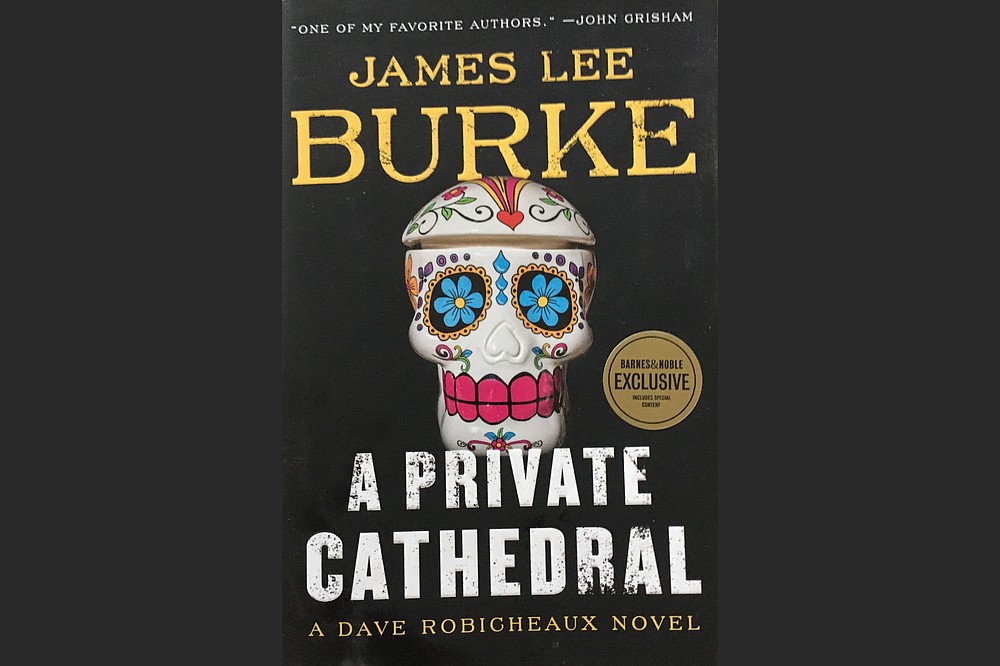
"A Private Cathedral" (Simon & Schuster, $28)

8. James Lee Burke's "A Private Cathedral" (Simon & Schuster, $28) is where I took refuge after reading Glass' lacerating novel — after that dose of reality I needed Dave Robicheaux and Clete Purcell chasing bad guys around the bayou. Yep, a good ol' story of human trafficking with a supernatural voodoo element tossed in makes for a fine Scooby Doo-for-whiskey-drinkers vibe.

While Burke's always ambitious (occasionally over-ambitious) prose can turn downright risible (the first chapter here is a purple wonder), he remains our among our finest producers of top-flight pulp (Michael Connelly, Lee Child and every third John Grisham are also contenders) and not a bad writer to turn to when you need to get out of the real world for a while.

9. I didn't write about Jenny Offill's "Weather" (Knopf, $23) last year, in part because my wife, Karen, did. In one of her Sunday columns she wrote: "Don't be fooled by this novel's compact size and noncommittal cover. It's a fascinating incremental journey by a seemingly ordinary librarian/wife/dog owner/mother in New York who, in a series of abrupt yet related paragraph-length descriptions, starts to lose her grip on practicality as she slides into a tantalizing, fearful, funny, and weird world heading toward apocalypse. I couldn't put it down."

10. Nick Hornby's ninth novel "Just Like You" (Riverhead Books, $27) is no big deal. It's all sparkling dialogue, generous assumptions about human motives, warm and cozy as a crackling fireplace. Its purposefully human scale, a plausible love story about unlikely lovers (what lovers are ever likely?) muddling along in London in the weeks preceding and the months after the Brexit vote.

Other notables: "The Vanishing Sky," L. Annette Binder, Bloomsbury, $27; "The Occultists," Polly Schattel, JournalStone, $19.95; "Radio Eldorado," Tyrone Jaeger, Braddock Avenue Books, $19.95; "Mannequin and Wife," Jen Fawkes (LSU Press, $24.95); "Claire, Wading Into the Danube By Night" (Southeast Missouri State University, $18) by Jeffrey Condran; "The Silver Pigeons," Jeff Howe (Cameron & Greys, $14.99).

NONFICTION

1. Zadie Smith's "Intimations: Six Essays" (Penguin, $10.95) is a collection (the book is only 100 pages) that picks at knotty problems of our moment: race and class and police brutality and economic injustice. Smith is better known as a novelist but her best — and most vital — work reminds us of our complicity in and responsibilities to wider world.

2. Jon David Cash's "Boom and Bust in St. Louis: A Cardinals History, 1885 to the Present" (McFarland, $29.95) is a straightforward specialty reference that will be of much interest to a lot of local readers. It is, as the title suggests, a detailed history of the St. Louis Cardinals' baseball club, judiciously and even-handedly compiled by a fine writer who knows and respects the game.
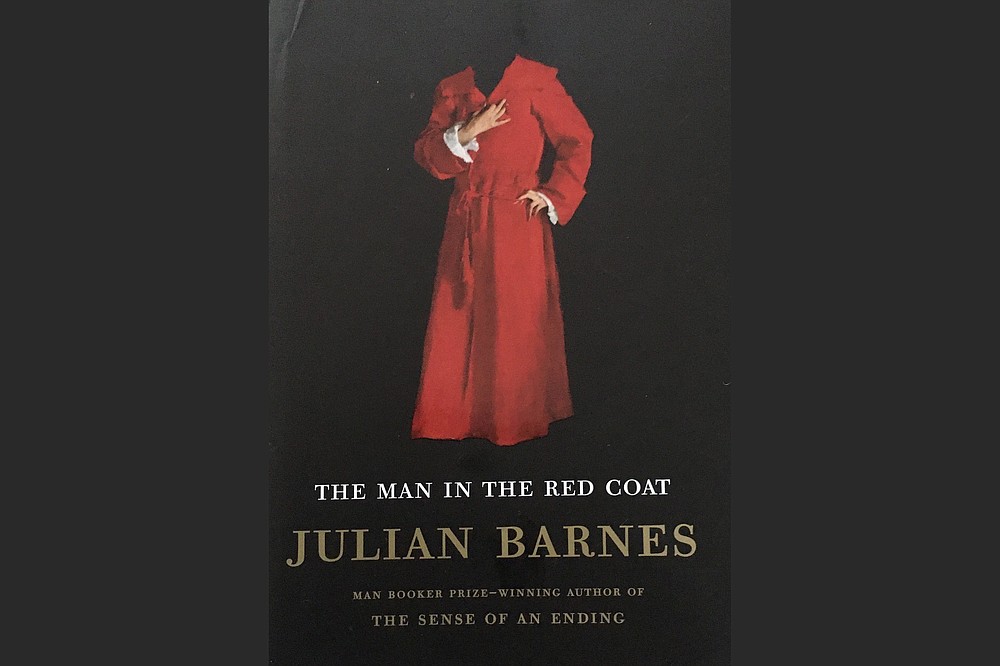
"The Man in the Red Coat" (Knopf, $26.95)

3. Like the aforementioned Smith, Julian Barnes is a novelist whose highest and best use may be as a writer of non-fiction. His "The Man in the Red Coat" (Knopf, $26.95) is a fascinating tour of Belle Époque Paris, with the remarkable life story of surgeon Samuel Pozzi serving as the needle piercing through the tapestry. Pozzi knew everyone worth knowing, and Barnes sews up wonderfully arcane facts and brilliantly diverting connections while puncturing some easy assumptions about the period

4. Speaking of easy assumptions, Heather Clark's "Red Comet: The Short Life and Blazing Art of Sylvia Plath" (Knopf, $40) goes a long way to rescuing the poet from the "crackle and drag" clichés that have come to define her. Clark's book is exhaustive, but if you're planning to submerge yourself in Plath you might also want to take a look at Carl Rollyson's "The Last Days of Sylvia Plath" (University Press of Mississippi, $25), largely based on newly discovered letters the poet wrote in the last seven months of her life.

5. In the midst of sports withdrawal this summer, Tom Callahan's "Gods at Play" (Norton, $26.95) showed up. It's tempting to say that Callahan, who as a young man hung out with Red Smith, is the last of a breed, a sportswriter for whom the writing is more important than broadcast media hits and probably even the games themselves, but there might be someone I'm forgetting. (One at least: Thomas Boswell, Callahan's old colleague at The Washington Post.)

Anyway, Callahan isn't exactly humble about the extent to which he knew (and sometimes advised) greats from Earl Monroe and Bill Walsh to Tiger Woods. But he's got the credentials and the talent to make this sort of memoir — most if not all of this material has appeared in Callahan's columns — an exceptionally satisfying read by one of the best.

6. "Hidden Valley Road: Inside the Mind of an American Family" by Robert Kolker (Doubleday, $29.95) is one of the year's biggest books, making most of the year-end best of lists. The story of the Galvin family, who between 1945 and 1965 had 12 children, 10 of them boys, 6 of whom were eventually diagnosed as schizophrenic, is hallowing and heart-wrenching, and Kolker tells it with precision and compassion.
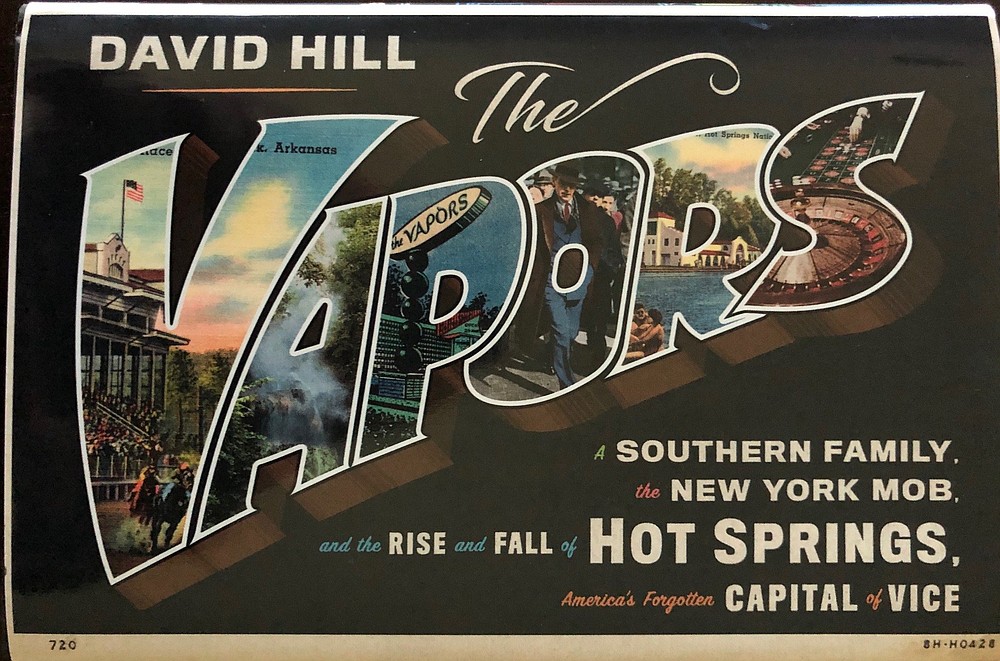
"The Vapors: A Southern Family, the New York Mob, and the Rise and Fall of Hot Springs, America's Forgotten Capital of Vice" (Farrar, Straus and Giroux, $28)

7. I didn't write about David Hill's "The Vapors: A Southern Family, the New York Mob, and the Rise and Fall of Hot Springs, America's Forgotten Capital of Vice" (Farrar, Straus and Giroux, $28) and history of Hot Springs' gambling years entwined with some personal family history because almost everyone else at this newspaper wanted a crack at it. Nevertheless, it is my favorite nonfiction read of the year. And maybe my favorite read of the year.

8. I have been planning for months to write something about Matt Sandler's "The Black Romantic Revolution: Abolitionist Poets at the End of Slavery" (Verso, $26.95) and haven't quite screwed it together. When I do I'll also write about the Library of America's recently published "African American Poetry: 250 Years of Struggle & Song" ($45), edited by New Yorker poetry editor Kevin Young.

9. I was delighted when George Gruel, photographer, raconteur and the late Warren Zevon's aide-de-camp, alerted me to the existence of his ebook "Lawyers, Guns and Photographs," available via Apple Books for $19.99 and as a physical book from Big Gorilla Books (biggorillabooks.com) for $39. I highly recommend the ebook for anyone with any interest in Zevon or the Los Angeles pop scene Gruel documents. I'm excited about the possibilities of this format; the 135 audio tracks he scatters throughout this photographic memoir of his time with Zevon make it seem like a cinematic experience.

10. Carl Safina, an ecologist who has written many books about animal behavior, delves into the world of chimpanzees, sperm whales and macaws to argue that animals learn from one another and pass down to their offspring something very much like culture in "Becoming Wild: How Animal Cultures Raise Families, Create Beauty, and Achieve Peace" (Henry Holt, $29.99).

To save newsprint and editorial sanity, I'll save poetry for a column down the road. And if you've got a recently published book to recommend, let me know at the address below.

Email: pmartin@adgnewsroom.com | blooddirtangels.com

Let's block ads! (Why?)


"Opinion" - Google News
January 03, 2021 at 03:23PM
https://ift.tt/355ORGb

OPINION | ON BOOKS: Fundamental reading - Arkansas Online
"Opinion" - Google News
https://ift.tt/2FkSo6m
Shoes Man Tutorial
Pos News Update
Meme Update
Korean Entertainment News
Japan News Update

Opinion: Silver linings from 2020? 7 leading Houstonians look to the future. - Houston Chronicle

Opinion | The Wreckage Betsy DeVos Leaves Behind - The New York Times

The Education Department lies in ruins right when it’s needed most.

The departing education secretary, Betsy DeVos, will be remembered as perhaps the most disastrous leader in the Education Department’s history. Her lack of vision has been apparent in a variety of contexts, but never more so than this fall when she told districts that were seeking guidance on how to operate during the coronavirus pandemic that it was not her responsibility to track school district infection rates or keep track of school reopening plans. This telling remark implies a vision of the Education Department as a mere bystander in a crisis that disrupted the lives of more than 50 million schoolchildren.

If the Senate confirms President-elect Joe Biden’s nominee, Miguel Cardona, as Ms. DeVos’s successor, he will face the herculean task of clearing away the wreckage left by his predecessor — while helping the states find a safe and equitable path to reopening schools.

Beyond that, the new secretary needs to quickly reverse a range of corrosive DeVos-era policies, including initiatives that rolled back civil rights protections for minority children as well as actions that turned the department into a subsidiary of predatory for-profit colleges that saddle students with crushing debt while granting them useless degrees.

There is still more to learn about Mr. Cardona. But at first glance, the contrast between him and his predecessor is striking. Ms. DeVos had almost no experience in public education and was clearly disinterested in the department’s mission. Mr. Cardona worked his way up from teacher to principal to education commissioner of Connecticut. Moreover, he seems to understand that a big part of his job involves using the bully pulpit to advance policies that benefit all schoolchildren and protect the most vulnerable.

Mr. Cardona would need to pay close attention to how districts plan to deal with learning loss that many children will suffer while the schools are closed. Fall testing data analyzed by the nonprofit research organization NWEA suggests that setbacks have been less severe than were feared, with students showing continued academic progress in reading and only modest setbacks in math.

Amr Alfiky/The New York Times
Tom Brenner/The New York Times

However, given a shortage of testing data for Black, Hispanic and poor children, it could well be that these groups have fared worse in the pandemic than their white or more affluent peers. The country needs specific information on how these subgroups are doing so that it can allocate educational resources strategically.

Beyond that, parents need to know where their children stand after such a sustained period without much face-to-face instruction. Given these realities, the new education secretary — whoever he or she turns out to be — should resist calls to put off annual student testing.

Research has long since shown that a summer vacation can wipe out a month or two of student learning. Making up for an even more serious learning shortfall will require planning that should begin now. An obvious first step would be to use the summer of 2021 for summer school or catch-up tutoring. If the Biden Education Department decides on this approach, it will need to petition Congress to fund the project. The states are too cash poor at the moment and could not undertake such a venture on their own.

The Education Department should also recognize that this pandemic will not be the last one. That means developing a list of best practices and strategic schools plans that can be swiftly rolled out when another medical crisis occurs with a different infectious agent.

In addition to addressing worrisome matters like these, the new education commissioner needs to revoke a series of department communiqués that had the effect of letting school districts off the hook for discriminatory disciplinary practices and other potential violations of civil rights law. The Department of Education’s Office for Civil Rights exposed the depth of this problem during the Obama years, when it released data showing that excessively punitive policies were being used at every level of the public school system — and that even minority 4-year-olds were being disproportionately suspended and expelled.

The new administration needs to underscore the message that these damaging practices are unacceptable. This means renewing civil rights guidance to school districts and opening investigations after credible reports of wrongdoing.

The DeVos administration sold out to predatory for-profit colleges and their various abettors within a nanosecond of taking office. To get a jump on reversing this particular set of policies, the new education secretary can begin rule-making processes where necessary and inform the courts that it will no longer defend against lawsuits filed by state attorneys general and others who have dogged the DeVos department in court for buddying up to the for-profit industry and attacking student borrowers who deserve to have their student loans forgiven because they were defrauded by career education programs.

The department should immediately begin rule-making to reverse Ms. DeVos’s gutting of the “gainful employment” rule, which was supposed to cut off access to federal student aid for career training programs that buried students in debt while failing to prepare them for the job market.

Pending in court is a lawsuit filed by 22 states and the District of Columbia charging that Ms. DeVos unlawfully rescinded an Obama-era rule that allowed students who had been defrauded by career colleges to have their federal loans forgiven. The department should stop defending against this lawsuit and revisit loan discharge claims by borrowers who remain saddled with debt even though the schools they attended were shown to be engaged in fraud. The DeVos version of the so-called borrower defense rule was so onerous for defrauded borrowers that Congress passed a bipartisan measure blocking it. That measure, however, was vetoed by the president.

In yet another sop to the for-profit industry, Ms. DeVos disregarded a scathing indictment by her department’s career staff, reinstating an accrediting body that had been stripped of its authority for exercising lax oversight. The organization was the accreditor for two for-profit institutions that collapsed, leaving tens of thousands of students with debt and useless degrees. The new education secretary would do well to closely scrutinize the department’s methodology for evaluating accreditors.

Yet another set of lawsuits has shown how the companies that are handsomely paid to collect student loans aggravate the debt crisis by giving advice that costs borrowers money while earning the companies cash.

The Department of Education lies in ruins at precisely the time when the country most needs it. The president-elect and his new education secretary, whoever that turns out to be, need to get the institution up and running as swiftly as possible. Given the dire context, there is no time to waste.

The Times is committed to publishing a diversity of letters to the editor. We’d like to hear what you think about this or any of our articles. Here are some tips. And here’s our email: letters@nytimes.com.

Follow The New York Times Opinion section on Facebook, Twitter (@NYTopinion) and Instagram.

Let's block ads! (Why?)


"Opinion" - Google News
January 03, 2021 at 03:00AM
https://ift.tt/3rXJlPY

Opinion | The Wreckage Betsy DeVos Leaves Behind - The New York Times
"Opinion" - Google News
https://ift.tt/2FkSo6m
Shoes Man Tutorial
Pos News Update
Meme Update
Korean Entertainment News
Japan News Update
Search

Featured Post

I just paid $9.99 for a carton of 18 eggs. Will prices ever drop? | Opinion - Sacramento Bee

[unable to retrieve full-text content] I just paid $9.99 for a carton of 18 eggs. Will prices ever drop? | Opinion    Sacramento Bee ...

Postingan Populer