Rechercher dans ce blog

Friday, February 5, 2021

Opinion | They Stormed the Capitol. Their Apps Tracked Them. - The New York Times

In 2019, a source came to us with a digital file containing the precise locations of more than 12 million individual smartphones for several months in 2016 and 2017. The data is supposed to be anonymous, but it isn’t. We found celebrities, Pentagon officials and average Americans.

It became clear that this data — collected by smartphone apps and then fed into a dizzyingly complex digital advertising ecosystem — was a liability to national security, to free assembly and to citizens living mundane lives. It provided an intimate record of people whether they were visiting drug treatment centers, strip clubs, casinos, abortion clinics or places of worship.

Surrendering our privacy to the government would be foolish enough. But what is more insidious is the Faustian bargain made with the marketing industry, which turns every location ping into currency as it is bought and sold in the marketplace of surveillance advertising.

Now, one year later, we’re in a very similar position. But it’s far worse.

A source has provided another data set, this time following the smartphones of thousands of Trump supporters, rioters and passers-by in Washington, D.C., on January 6, as Donald Trump’s political rally turned into a violent insurrection. At least five people died because of the riot at the Capitol. Key to bringing the mob to justice has been the event’s digital detritus: location data, geotagged photos, facial recognition, surveillance cameras and crowdsourcing.

This timelapse animation shows smartphones as they moved from Trump’s rally to the Capitol building.

From Trump’s Rally to Congress

This time-lapse animation shows smartphones as they moved from Donald Trump’s rally to the Capitol.

8:00 a.m.
6:00 p.m.

White House

WASHINGTON, D.C.

Rally Stage

U.S. Capitol

Trump supporters

attend the rally

Mob storms

the Capitol

8:00 a.m.
6:00 p.m.

Rally

Stage

White

House

Trump supporters

attend the protest

WASHINGTON, D.C.

Mob storms

the Capitol

N

U.S. Capitol

Satellite Imagery: Microsoft Corporation, Maxar.

The sacking of the Capitol was a shocking assault on the republic and an unwelcome reminder of the fragility of American democracy. But history reminds us that sudden events — Pearl Harbor, the Soviet Union testing an atomic bomb, the Sept. 11 attacks — have led to an overreach in favor of collective security over individual liberty that we’d later regret. And more generally, the data collected on Jan. 6 is a demonstration of the looming threat to our liberties posed by a surveillance economy that monetizes the movements of the righteous and the wicked alike.

The data we were given showed what some in the tech industry might call a God-view vantage of that dark day. It included about 100,000 location pings for thousands of smartphones, revealing around 130 devices inside the Capitol exactly when Trump supporters were storming the building.

About 40 percent of the phones tracked near the rally stage on the National Mall during the speeches were also found in and around the Capitol during the siege — a clear link between those who’d listened to the president and his allies and then marched on the building.

While there were no names or phone numbers in the data, we were once again able to connect dozens of devices to their owners, tying anonymous locations back to names, home addresses, social networks and phone numbers of people in attendance. In one instance, three members of a single family were tracked in the data.

The source shared this information, in part, because the individual was outraged by the events of Jan. 6. The source wanted answers, accountability, justice. The person was also deeply concerned about the privacy implications of this surreptitious data collection. Not just that it happens, but also that most consumers don’t know it is being collected and it is insecure and vulnerable to law enforcement as well as bad actors — or an online mob — who might use it to inflict harm on innocent people. (The source asked to remain anonymous because the person was not authorized to share the data and could face severe penalties for doing so.)

“What if instead of going to you, I wanted to publish it myself?” the source told us. “What if I were vengeful? There’s nothing preventing me from doing that. It’s totally available. If I had different motives, all it would take is a few clicks, and everyone could see it.”

There is an argument to be made that this data could be properly used by law enforcement through courts, warrants and subpoenas. We used it ourselves as a journalistic tool to bring you this article. But to think that the information will be used against individuals only if they’ve broken the law is naïve; such data is collected and remains vulnerable to use and abuse whether people gather in support of an insurrection or they justly protest police violence, as happened in cities across America last summer.

The data presented here is a bird’s-eye view of an event that posed a clear and grave threat to our democracy. But it tells a second story as well: One of a broken, surreptitious industry in desperate need of regulation, and of a tacit agreement we’ve entered into that threatens our individual privacy. None of this data should ever have been collected.


This is Ronnie Vincent.

We traced a phone inside the Capitol to Mr. Vincent’s home in Kentucky. Confirming his identity led us to his Facebook page, where we found a few photos of him standing on the steps of the building during the siege. Another photo shows a crowd standing in front of the Capitol, its doors wide open.

At the Capitol

Smartphones tracked between 2 p.m. and 5 p.m. record the seige on the Capitol.

A phone “ping” tied

to Ronnie Vincent

A phone “ping” tied

to Ronnie Vincent

U.S. Capitol

A phone “ping” tied

to Ronnie Vincent

A phone “ping” tied

to Ronnie Vincent

U.S. Capitol

Satellite imagery: Microsoft Corporation and DigitalGlobe.

“Yes we got inside. One girl was shot by the DC cops as she was knocking on the glass. She probably will die. We stopped the voting in the house,” he wrote.

Shortly after he posted the photos, Mr. Vincent, a pest control business owner in Kentucky who goes by the nickname Ole Woodsman, took them down. When we reached him by phone, he insisted he never entered the Capitol.

“There is no way that my phone shows me in there,” he said. Yet it did.

Screenshot from Facebook

For all its appearance of omniscience, the data can be imprecise. In a situation such as the Capitol riot, exact locations matter. A few feet can be the difference between a participant who committed a serious crime and an onlooker.

While some location data is accurate to within a few feet, other data is not. Location companies can work with data derived from GPS sensors, Bluetooth signals and other sources. The quality depends on the settings of the phone and whether it is connected to Wi-Fi or a cell tower. Issues like population and building density can sometimes play a role in the quality of the data.

Mr. Vincent told us that when he wrote “we got inside,” he meant “we the people got in.”

He added, “I did not go in.”

Can we say definitively Mr. Vincent was inside the Capitol on Jan. 6? No, and that is one of the problems with this type of data.

Ronnie Vincent’s Journey

It was easier to identify Mr. Vincent — and discover the path he took to get to Washington, D.C. — because an email was matched to the phone’s anonymous advertising ID.

The trip to Washington, D.C.

OHIO

Washington,

D.C.

Home

WEST

VIRGINIA

VIRGINIA

KENTUCKY

Home location has been obscured.

The day of the protest

Hyatt Regency

hotel at 1:48 p.m.

7:30 a.m.

Rally stage

8:17 a.m.

Around the Capitol

Building at 3:00 p.m.

At the Capitol

Accuracy

322 feet

187 feet

The trip to Washington, D.C.

OHIO

Washington,

D.C.

WEST

VIRGINIA

Home

VIRGINIA

KENTUCKY

Home location has been obscured.

The day of the protest

Hyatt Regency

hotel at 1:48 p.m.

7:30 a.m.

Rally stage

8:17 a.m.

Around the Capitol

Building at 3:00 p.m.

At the Capitol

Accuracy

322 feet

187 feet

The trip to Washington, D.C.

KENTUCKY

Home

OHIO

WEST

VIRGINIA

VIRGINIA

Washington,

D.C.

N

Home location has been obscured.

The day of the protest

Rally stage

8:17 a.m.

7:30 a.m.

Hyatt Regency

hotel at

1:48 p.m.

Around the Capitol

Building at 3:00 p.m.

N

At the Capitol

Accuracy

322 feet

187 feet

N

Note: Location pings may not be precise. Satellite imagery: Microsoft Corporation, Earthstar Geographics, SIO, Maxar

By The New York Times

While the power and scope of this commercial surveillance come into sharp focus when we look at the specific time of the attack on the Capitol, it’s important to remember that it is recording the movements of millions of Americans all day, all night, all year, wherever they are.

The data set Times Opinion examined shows how Trump supporters traveled from South Carolina, Florida, Ohio and Kentucky to the nation’s capital, with pings tracing neatly along major highways, in the days before the attack. Stops at gas stations, restaurants and motels dot the route like bread crumbs, each offering corroborating details.

In many cases, these trails lead from the Capitol right back to their homes.

Trump Supporters Go to Washington

While protesters may have felt anonymous, their journeys to Washington and back were recorded in meticulous detail by apps on their phones.

Washington,

D.C.

New

Mexico

Florida

South

Carolina

Florida

New Hampshire

New York

Washington,

D.C.

New

Mexico

Florida

New Hampshire

Washington,

D.C.

New

Mexico

Florida

South

Carolina

Florida

New Hampshire

New York

Satellite imagery: Microsoft Corporation and Earthstar Geographics.

In the hands of law enforcement, this data could be evidence. But at every other moment, the location data is reviewed by hedge funds, financial institutions and marketers, in an attempt to learn more about where we shop and how we live.

Unlike the data we reviewed in 2019, this new data included a remarkable piece of information: a unique ID for each user that is tied to a smartphone. This made it even easier to find people, since the supposedly anonymous ID could be matched with other databases containing the same ID, allowing us to add real names, addresses, phone numbers, email addresses and other information about smartphone owners in seconds.

The IDs, called mobile advertising identifiers, allow companies to track people across the internet and on apps. They are supposed to be anonymous, and smartphone owners can reset them or disable them entirely. Our findings show the promise of anonymity is a farce. Several companies offer tools to allow anyone with data to match the IDs with other databases.

How “Anonymous” Pings Could Be Identifiable

The “anonymous” mobile advertising ID can be matched across databases, creating a new deanonymized database.

MARKETING

DATABASE

APP

DATABASE

First name

Last name

Home address

Mobile Ad ID

Phone number

Mobile Ad ID

Email address

App name

ANONYMOUS

LOCATION

DATABASE

NEW

DATABASE

Mobile Ad ID

First name

Last name

Home address

Phone number

Email address

App name

Precise location

Date

Time

Mobile Ad ID

Precise location

Date

Time

The “anonymous” mobile advertising ID can be matched across databases ...

... creating a new

deanonymized

database

ANONYMOUS

LOCATION

DATABASE

MARKETING

DATABASE

APP

DATABASE

NEW

DATABASE

First name

Last name

Home address

Mobile Ad ID

Phone number

Mobile Ad ID

Email address

App name

Mobile Ad ID

Precise location

Date

Time

Mobile Ad ID

First name

Last name

Home address

Phone number

Email address

App name

Precise location

Date

Time

The “anonymous” mobile advertising ID can be matched across databases, creating a new deanonymized database.

MARKETING

DATABASE

APP

DATABASE

First name

Last name

Home address

Mobile Ad ID

Phone number

Mobile Ad ID

Email address

App name

ANONYMOUS

LOCATION

DATABASE

NEW

DATABASE

Mobile Ad ID

First name

Last name

Home address

Phone number

Email address

App name

Precise location

Date

Time

Mobile Ad ID

Precise location

Date

Time

By The New York Times

We were quickly able to match more than 2,000 supposedly anonymous devices in the data set with email addresses, birthdays, ethnicities, ages and more.

One location data company, Cuebiq, publishes a list of customers that may receive the ID with precise smartphone locations. Companies listed there include household names like Adobe and Google, alongside a litany of lesser-known upstarts, like Hivestack, Mogean, Pelmorex and Ubimo.

In an emailed statement, Cuebiq said it prohibits attempts to merge location data with personally identifiable information and requires customers to undergo yearly third-party audits.

Smartphone users will never know if they are included in the data or whether their precise movements were sold. There are no laws forcing companies to disclose what the data is used for or for how long. There are no legal requirements to ever delete the data. Even if anyone could figure out where records of their locations were sold, in most states, you can’t request that the data be deleted.

Their movements could be bought and sold to innumerable parties for years. And the threat that those movements could be tied back to their identity will never go away.

Mark Peterson for The New York Times

If the Jan. 6 rioters didn’t know before, they surely know now the cost of leaving a digital footprint. Tip lines at the Federal Bureau of Investigation have been flooded for weeks in an effort to identify participants, and detectives in Miami and other police departments are using facial recognition software. Amateur investigators on TikTok, Instagram and other platforms have launched their own identification efforts.

Law enforcement has used cellphone footage from the siege to identify participants. As of February 4, there were 181 federal cases pending against individuals involved in the Capitol Hill siege, according to an analysis by George Washington University’s program on extremism. Affidavits show that federal investigators were easily able to cross-reference footage with public social media posts.

A leak of data from the social media platform Parler also helped investigators and journalists place rioters in the building, using posts that were geotagged with GPS location data. For some, like 38-year-old Oath Keepers member Jessica Watkins, there was no need for precise location data. Her words tell the story: “Yeah. We stormed the Capitol today. Teargassed, the whole, 9. Pushed our way into the Rotunda. Made it into the Senate even,” she wrote on Parler.

Which is to say that law enforcement may not need this data. But as a recent Wall Street Journal report shows, military agencies use these data sets — without a warrant, no less. How? They purchase it. Because we have seen what’s in the data, that revelation is deeply troubling.

While some Americans might cheer the use of location databases to identify Trump supporters who converged on the Capitol, the use of commercial databases has worrying implications for civil liberties. The American criminal justice system is set up for a judge or jury to determine whether, in fact, Ronnie Vincent broke any laws on Jan. 6. But the data leads us directly to him, and in the hands of law enforcement officials — or rogue employees of the company that collected the data — it could narrow their search for participants and offer clues about their activity.


To focus attention only on those people present at the deadly sacking of the Capitol is to lose sight of the larger context of the campaign of incitement and lies from Mr. Trump, right-wing media and members of Congress that set the stage for it. Just as focusing on the movements of Mr. Vincent’s cellphone is to lose sight of the larger surveillance ecosystem that he — and all of us — are trapped in.

The location-tracking industry exists because those in power allow it to exist. Plenty of Americans remain oblivious to this collection through no fault of their own. But many others understand what’s happening and allow it anyway. They feel powerless to stop it or were simply seduced by the conveniences afforded in the trade-off. The dark truth is that, despite genuine concern from those paying attention, there’s little appetite to meaningfully dismantle this advertising infrastructure that undergirds unchecked corporate data collection.

This collection will only grow more sophisticated. This new data set offers proof that not only is there more interest in location data than before, but it is also easier to deanonymize. It gets easier by the day. As the data from Jan. 6 eerily demonstrates, it does not discriminate. It harvests from the phones of MAGA rioters, police officers, lawmakers and passers-by. There is no evidence, from the past or current day, that the power this data collection offers will be used only to good ends. There is no evidence that if we allow it to continue to happen, the country will be safer or fairer.

In our previous investigation, we wrote that Americans deserve the freedom to choose a life without surveillance and the government regulation that would make that possible. While we continue to believe the sentiment, we fear it may soon be obsolete or irrelevant. We deserve that freedom, but the window to achieve it narrows a little more each day. If we don’t act now, with great urgency, it may very well close for good.

The Times is committed to publishing a diversity of letters to the editor. We’d like to hear what you think about this or any of our articles. Here are some tips. And here’s our email: letters@nytimes.com.

Follow The New York Times Opinion section on Facebook, Twitter (@NYTopinion) and Instagram.

Let's block ads! (Why?)


"Opinion" - Google News
February 05, 2021 at 05:00PM
https://ift.tt/3jj7fRO

Opinion | They Stormed the Capitol. Their Apps Tracked Them. - The New York Times
"Opinion" - Google News
https://ift.tt/2FkSo6m
Shoes Man Tutorial
Pos News Update
Meme Update
Korean Entertainment News
Japan News Update

Lariat Letter: 'Civil discourse' cannot encompass hate speech - The Baylor Lariat

israelob.blogspot.com

By Timothy S. Morizot | Parent of alumni

I am the parent of two Baylor alums. I do not speak for them, but I have supported Baylor, and after more than a decade involved through two of my children in various programs, I feel a degree of investment in the university. I read with dismay the article on the public, transphobic comments by a guest lecturer and the affirmation by the chair of the English department in writing that she will be invited back in the future.

And those comments were not “controversial;” they were transphobic. They were public hate speech. Had I seen them on twitter, I would have reported them as such. From the United Nations strategy and plan of action on hate speech:

“There is no international legal definition of hate speech, and the characterization of what is ‘hateful’ is controversial and disputed. In the context of this document, the term hate speech is understood as any kind of communication in speech, writing or behaviour, that attacks or uses pejorative or discriminatory language with reference to a person or a group on the basis of who they are, in other words, based on their religion, ethnicity, nationality, race, colour, descent, gender or other identity factor. This is often rooted in, and generates intolerance and hatred and, in certain contexts, can be demeaning and divisive.”

Gender identity, of course, goes well beyond trans women, though somehow they are often the only ones targeted by this sort of hate speech. Referencing trans women as “biological boys” is publicly demeaning and divisive, rooted in and generating intolerance and hatred. It also misrepresents science and biology. Trans women are already the target of enormous violence. Public comments like those made by the guest lecturer promote and sustain that culture of intolerance, hatred and ultimately violence.

I filed my own report with the Office of the President and the Title IX office. I am deeply disappointed by the comments of the Provost. If Baylor plans to be an institution that supports hate speech under the false flag of “free speech,” I will be certain to note that in every future public discussion of the institution I have. I hope other students, alumni and parents join in public agreement, though I’m certain many will not.

As Karl Popper wrote in 1945:

“Unlimited tolerance must lead to the disappearance of tolerance. If we extend unlimited tolerance even to those who are intolerant, if we are not prepared to defend a tolerant society against the onslaught of the intolerant, then the tolerant will be destroyed, and tolerance with them.”

An educator is granted a position of trust. Hate speech violates that trust and cannot be tolerated, or it will be normalized. A supposedly Christian institution acting to tolerate and support public hate speech demonstrates the truth in Popper’s words. Love, of course, should be the Christian standard, but where love is apparently impossible, tolerance is its weaker cousin.

Let's block ads! (Why?)


"discourse" - Google News
February 05, 2021 at 10:50AM
https://ift.tt/2YPFqXU

Lariat Letter: 'Civil discourse' cannot encompass hate speech - The Baylor Lariat
"discourse" - Google News
https://ift.tt/2KZL2bm
https://ift.tt/2z7DUH4

Letters: Our Readers' Opinions | Opinion | lmtribune.com - Lewiston Morning Tribune

[unable to retrieve full-text content]

Letters: Our Readers' Opinions | Opinion | lmtribune.com  Lewiston Morning Tribune

"Opinion" - Google News
February 05, 2021 at 03:00PM
https://ift.tt/2YNJxUw

Letters: Our Readers' Opinions | Opinion | lmtribune.com - Lewiston Morning Tribune
"Opinion" - Google News
https://ift.tt/2FkSo6m
Shoes Man Tutorial
Pos News Update
Meme Update
Korean Entertainment News
Japan News Update

Thursday, February 4, 2021

Opinion: QAnon, conspiracy theories are no joke - DW (English)

More and more people seem ready to believe theories that not so long ago would have been dismissed as sheer nonsense. This isn't just a strange, laughable phenomenon — it's dangerous for democracy, says Martin Muno.

If, just a few years ago, someone had stated in public that a global elite was kidnapping children and torturing them to harvest their blood to make an elixir of youth, they would have been directed to the nearest psychiatric ward. Yet according to a British poll, some 10% of US citizens say they believe in at least some elements of this absurd theory known as QAnon. 

The conspiracy theory has also been doing the rounds in Germany and, according to the Amadeu Antonio Foundation, which sets out to combat far-right ideologies and racism, it has already attracted some 150,000 supporters. This makes the German QAnon community the largest outside of the English-speaking realm.

A Konrad Adenauer Foundation study conducted from October 2019 to February 2020 found that around a third of Germans were open to conspiracy theories. Not counting children under 14, that's 24 million people. Other polls support this figure, and have found many links between QAnon supporters, COVID-19 deniers and right-wing extremists.

At the click of a mouse

How can such blatant nonsense resonate in an enlightened world? After all, this is the 21st century, not the Middle Ages. The answer is: It's just all a mouse click away. Social networks are the perfect breeding ground for fake news and conspiracy theories.

A study conducted in Germany by Correctiv, which describes itself as a nonprofit investigative newsroom, concluded that Facebook and YouTube were the platforms on which the most false information was spread, with messaging services such as Telegram and WhatsApp not far behind. Researchers at the Massachusetts Institute of Technology found that it took six times longer to reach 1,500 people with real news than with fake news.

Wake-up call for social media platforms

Social media platforms are in a predicament. On the one hand, they have tended to defend a very broad concept of free speech and tolerate content that amounts to fake news, profanity and insults. It was only in October 2020 that Facebook agreed to take down "content that denies or distorts the Holocaust." Holocaust denial has long been considered a crime in many countries.

On the other hand, these platforms are beginning to admit that the rapid spread of fake news and hatred facilitated by their platforms poses a danger — as shown by the storming of the US Capitol last month.

In response to this wake-up call, some platforms are beginning to hold users to account and have blocked the accounts of prominent and less prominent people. Some also now flag fake news with a warning.

Hold social platforms to account

But this isn't enough. Facebook and the rest must also be made liable for content such as fake news and hate speech posted on their platforms. The European Commission has tried to address this with its Digital Services Act but faces the difficulty of navigating the thin line between curbing the spread of fake news and censorship.

Muno Martin

Martin Muno

Not only that — media competence must also be taught more in schools. Young people are more likely to gain their information from social media than traditional news outlets, which need to develop formats better suited to reaching the "YouTube generation."  

These are urgent, crucial changes. Conspiracy theories must be resisted because they harbor the potential to destroy democracies, as witnessed not so long ago in Washington.

Last week, in her speech to the German Bundestag on International Holocaust Day, the activist and politician Marina Weisband made it clear: "Being Jewish in Germany means understanding that [the Holocaust] did happen, and that it could happen again. It means that anti-Semitism doesn't start when somebody shoots at a synagogue. That the Shoah did not begin with the gas chambers. It starts with conspiracy narratives."

This article has been adapted from German

Let's block ads! (Why?)


"Opinion" - Google News
February 04, 2021 at 11:32PM
https://ift.tt/3jinRJu

Opinion: QAnon, conspiracy theories are no joke - DW (English)
"Opinion" - Google News
https://ift.tt/2FkSo6m
Shoes Man Tutorial
Pos News Update
Meme Update
Korean Entertainment News
Japan News Update
She's been hiding in a church for three years. Now she feels a glimmer of hope - CNN

"Look, we've finally got a (new) president now," the Honduran mother of two said, squeezing her three-year-old daughter as they watched Biden put his hand on the Bible and take the oath of office.
"Does this mean we can go to Disneyland?" her daughter asked, hopefully.
"Not yet," Chávez said, stroking her hair and holding her close. "But hopefully soon."
Over the past three years, Chávez hasn't been able to take her daughters to Disneyland -- or anywhere else, for that matter -- because they have been living in the confines of the First Unitarian Church in Salt Lake City. When she lost her last appeal to stay in the country, after an immigration judge rejected her asylum claim and US Immigration and Customs Enforcement (ICE) issued her a deportation order, the church offered her a temporary haven. All Chávez had to do was show up, and she and her daughters could stay for as long as they needed.
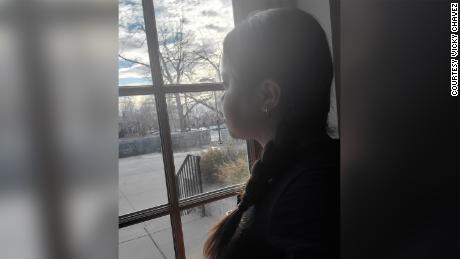
Chávez looks out the window of the First Unitarian Church in Salt Lake City, which she has called home for the past three years.
"All of my family is here in the United States," Chávez told me, describing her decision to accept the church's offer of sanctuary, a practice that dates back to the 1980s when congregations across the country offered refuge to Central American refugees in protest of the Reagan administration's crackdown on asylum seekers.
More recently, ICE has categorized churches -- along with hospitals, schools and other places of worship -- as "sensitive locations" where enforcement officers need prior authorization to conduct raids and arrests. For this reason, a handful of churches across the country have been able to open their doors to shelter immigrants and asylum seekers who are facing deportation orders.
While Biden's proposed comprehensive immigration reform for the 11 million undocumented immigrants in the United States could mean an end to the need for these kinds of practices in the future, until now, sanctuary has been one of the only options for people like Chávez who have run out of alternatives and fear violence or persecution in their home country.
If Biden really wants to send a message to asylum-seekers that his administration is the new beginning that he promised, he should also grant those living in sanctuary the protection they need to leave church safely, and ensure that they will be able to stay in the country until they are on a viable path to citizenship.

Living in sanctuary

"I couldn't take my girls back to Honduras," Chávez explains to me, alluding to the fact that the country is known for being one of the most dangerous in the world due to gang violence, and that women and girls are particularly targeted. "I knew that I had to stay and fight."
And since the day that she moved to the church, fight she has. Chávez has been speaking out -- first to local media outlets, then as part of the National Sanctuary Collective, a network of immigrants churches across the country and their faith-based allies, dedicated to raising the voices of those who have sought sanctuary. The network estimates that there are around 50 immigrants living in sanctuary at this time.
"Some of those in sanctuary have stories in the US that go back for decades," David Bennion, an immigration attorney who represents some of the immigrants in sanctuary and the director of the Free Migration Project, told me. "There are others who came more recently to seek asylum and had their cases wrongly denied."
While a handful of people sought sanctuary under the Obama administration, many of those currently living in sanctuary say they sought protection in response to the Trump administration expanding deportation priorities, essentially criminalizing all undocumented immigrants, even if they had never had an encounter with law enforcement.
"It got much worse under Trump," NYU clinical law professor and co-director of the NYU Immigrant Rights Clinic Alina Das told me, explaining that these policy changes saw many who wouldn't have been flagged under previous administrations suddenly targeted for deportation.
Living in sanctuary means never leaving the church grounds, even for a short walk or a breath of fresh air. While some have drawn the natural parallels between living in sanctuary and sheltering from the coronavirus, immigrants in sanctuary cannot receive stimulus checks and are nervous that they might not be able to access the vaccine. Instead, they depend on the church community for all of their needs -- a difficult dynamic that has gotten even more challenging during the pandemic.
Meanwhile, speaking out about her case and the cases of others in sanctuary has come at a cost. At one point, ICE slapped Chávez and several other outspoken members of the National Sanctuary Collective with civil fines close to half a million dollars each. While ICE has since rescinded the initial fine, Chávez is still facing a smaller, but significant fine of approximately $60,000 and is fighting to have it dropped.
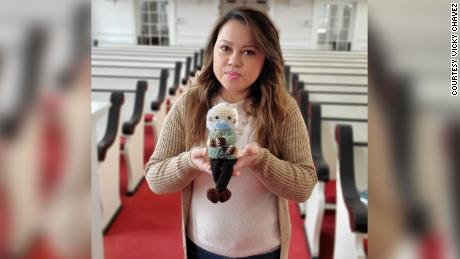
Still, Chávez does her best to keep her spirits up, playing with her kids and making arts and crafts -- she even recently crocheted the Vermont Sen. Bernie Sanders meme into a doll. But the extended time indoors and in limbo weighs on her, particularly as she watches her daughters grow up not knowing what the future holds.
Chávez holds up the Bernie Sanders doll she crocheted.
"My oldest daughter is starting to ask questions," she says, mentioning that ever since she started online school, her 9-year-old is wondering why their family lives in a church, and whether or not she should tell her friends about where her family lives.
"Meanwhile for my youngest, her entire world is me and this church," she continued, mentioning that she was only 5 months old when they sought sanctuary three years ago. "I don't know what is going to happen when I bring her to preschool and she meets other kids for the first time."
Yet, Chávez is cautiously optimistic that the day could come soon.

What Biden can do

Biden has already shown that he is eager to turn over a new leaf on Trump's draconian immigration and asylum policies, and even quickly delivered on campaign promises like scrapping the travel ban that targeted predominantly Muslim countries, creating a task force to reunite families separated at the border and putting a 100-day moratorium on deportations within his first days in office
However, just a few days after Biden's inauguration, Texas Attorney General Ken Paxton sued the Biden administration, prompting a federal judge to temporarily block the moratorium, and once again putting undocumented immigrants' lives in the crosshairs of a familiar game of cat and mouse.
For immigration advocates like Das, the lawsuit shows how easy it is to overturn these protections, and how vulnerable those in sanctuary still are, even under the new administration.
"There will always be anti-immigrant forces at work trying to delay some of the more humanitarian actions that the Biden administration is taking," she continued, explaining that one of the best ways to protect those living in sanctuary would be to individually review their cases. "Nothing can stop the Biden administration from exercising discretion in individual cases and granting stays of removal to allow people to live a more safe and secure life."
While President Biden's multiple executive orders addressing immigration policy are a promising start, and his comprehensive immigration reform will almost certainly help undocumented immigrants in the long run, he has yet to address the fact that people like Chávez have been traumatized by the previous administration's policies -- and that living in a church is not a sustainable solution, even in the short term. By giving these cases individual attention, he can ensure that those living in sanctuary are finally able to walk free and pursue a legal path to citizenship.
For Chávez, Biden's attention to her unique plight would go a long way in closing the chapter on Trump's legacy of anti-immigrant rhetoric and policy. "We have so much to give this country," Chávez continued, smiling. "I can't wait until we can all walk free."

Let's block ads! (Why?)


"Opinion" - Google News
February 05, 2021 at 04:43AM
https://ift.tt/2MVxXUr

She's been hiding in a church for three years. Now she feels a glimmer of hope - CNN
"Opinion" - Google News
https://ift.tt/2FkSo6m
Shoes Man Tutorial
Pos News Update
Meme Update
Korean Entertainment News
Japan News Update

Opinion | Pumps and Dumps and Chumps - The New York Times

Please, stop falling for fake populism.

In a more reasonable world, hardly anyone would care about the ups and downs of a smallish retailer’s stock price. Even near the top of its Reddit-fueled roller coaster, GameStop accounted for only about 0.06 percent of the total value of U.S. stocks. Furthermore, the stock market itself is mainly a sideshow to the real economy.

But we don’t live in a reasonable world, we live in a world where the GameStop story briefly commanded global attention. And the craziness did offer some important lessons — not so much about economics and markets as about psychology and politics.

For it turns out that despite four years of Donald Trump, our society remains remarkably gullible. And it is not just members of the public who believe what they see on social media; far too many influential people still keep falling for fake populism.

The story so far: GameStop is a chain of stores selling video games and other electronic goods. With the rise of online gaming the company’s underlying business has been in gradual decline. Recently some hedge funds, which believed that this decline wasn’t fully reflected in its stock price, began selling the stock short — that is, borrowing stocks and selling them, expecting to buy the stocks back at lower prices.

Enter Reddit, an online discussion site. WallStreetBets, a “subreddit” (discussion board) that caters to small, risk-taking investors, has become a force in the market: Stocks promoted on the board, so-called meme stocks, sometimes soar. And that’s what happened to GameStop.

In fact, GameStop surged so much that the short-sellers were forced to fold their cards. The rising stock price meant that they were losing money, and to limit their losses they had to unwind their positions — which meant buying the stock back, which sent its price even higher.

That was last week. This week GameStop’s stock price has come mostly, although not entirely, back down to earth. And now, instead of reading about little guys who suddenly became rich, we’re reading about small investors who bought near the top and lost their life savings.

So what was all that about? Social media acted as an accelerant, but the basic story of what happened is a very old one. This was basically a pump and dump, with a side order of predatory trading.

A pump and dump takes place when an investor or group of investors buy a stock cheaply, then drive its price up by spreading rumors and/or misinformation, letting them unload their shares on naïve chumps — “bag holders” — at a profit. In principle that’s an illegal practice, but it’s unlikely that anyone will end up being charged in the GameStop affair, since it will probably be impossible to prove intent.

Still, the stock did in fact get pumped — we don’t know who exactly pushed GameStop, but many WallStreetBets posts are reportedly coming from bots, not actual human beings — and somebody made a lot of money selling it to bag holders.

Predatory trading is wheeling and dealing that exploits the limited financial resources of other traders, forcing them to unwind their positions and reinforce price moves. We normally think of hedge funds as the predators in such situations; the most famous example may be George Soros’s play against the British pound in 1992. But last week some of the hedge funds were the prey.

All in all, it’s a nasty story with no obvious good guys. Who’s going to shed tears for short-sellers? But it’s also, in financial terms, small potatoes. What’s distressing about the GameStop saga isn’t the fact that some people lost money; it is, as I said, the continuing gullibility these events exposed.

Let’s be clear: What just happened was not a populist uprising. Our economy has left many families behind, but what working Americans need is an end to wage stagnation, not the opportunity to gamble on stocks. Indeed, when the dust settles we’ll probably find out that small investors as a group lost money in the trading frenzy, while Wall Street gained.

But the narrative of little guys taking on The System surely sucked in some unwary victims. And things turned really ugly once GameStop stock began its inevitable descent.

When the trading platform Robinhood temporarily stopped accepting orders for some volatile stocks because it didn’t have enough cash to support the trades, far too many public figures immediately claimed conspiracy. It’s no surprise that Senator Josh Hawley, arguably America’s leading fake populist and a fist-pumping promoter of the election lies that led to the sacking of the Capitol, joined in. But some progressives echoed the complaint.

They should have known better. There was always an obvious QAnonish tinge to the meme stock phenomenon, and it has gotten ever stronger as those stocks sink; yes, there are people on Reddit and other social media assigning all the blame to Jewish bankers.

So let me make a plea to everyone who cares about the inequalities of our society: It’s fine to support populism, but make sure that the populism is real. We need serious policies to make American lives better, not conspiracy theorizing and phony culture wars against “elites.”

The Times is committed to publishing a diversity of letters to the editor. We’d like to hear what you think about this or any of our articles. Here are some tips. And here’s our email: letters@nytimes.com.

Follow The New York Times Opinion section on Facebook, Twitter (@NYTopinion) and Instagram.

Let's block ads! (Why?)


"Opinion" - Google News
February 05, 2021 at 07:00AM
https://ift.tt/3tvBHNe

Opinion | Pumps and Dumps and Chumps - The New York Times
"Opinion" - Google News
https://ift.tt/2FkSo6m
Shoes Man Tutorial
Pos News Update
Meme Update
Korean Entertainment News
Japan News Update

Opinion: The power of Black community | News, Sports, Jobs - Lawrence Journal-World

An open letter to African-American people:

February marks the 95th observation of what started as Negro History Week and later became Black History Month. I wanted to use the occasion to talk about what being Black means, about how it feels, being us.

Hearing that, you’re probably braced for a litany of depressing statistics, indignities and cruelties. But that’s not why I’m here. No, I want to talk about community.

Lately, I find myself thinking a lot about Shonda Rhimes, which is weird. I’ve never met the lady, or even watched any of the hit shows — “Bridgerton,” “Scandal,” “Grey’s Anatomy” — that have made her one of the hottest producers in television. And yet … I’m so deeply invested in her success, so all-fired proud of what she’s achieved, you’d swear we were related.

Same with Tyler Perry building his studio complex, Regina King winning her Oscar, Kamala Harris taking her oath. But the pride and investment I speak of is not limited to the celebrated and powerful. Maybe you remember a 2019 story about Morehouse College professor Nathan Alexander teaching a class with the infant daughter of his student, Wayne Hayer, strapped to his chest in a baby carrier after Hayer was unable to find child care. I exulted in those brothers for the way they refuted a hundred lies about Black men in a single viral image.

That pride speaks to a truth about being us, something I think even well-meaning white people find hard to grasp. Meaning how profound is that sense of connectedness, of community, that sense that each of us is all of us. I doubt your average white guy feels any special investment in Brad Pitt’s successes or any particular pride when some random white person makes news for doing good.

But it is different, being us. Because for as much as people pretend otherwise, the thing that most defines us as “Black” is not common skin tone nor even common ancestry. Rather, it is common experience — all of us having gone through some variation of the same old story of denial and denigration. In the broad outlines, I know what you’ve been through and you know the same about me. And this is what binds us. Oppression from without creates cohesion from within.

Often, that bond expresses itself in the wake of tragedy — George Floyd was my brother, Breonna Taylor was my daughter, Trayvon Martin was my son — but it is not limited to that. We are bound in our joys and achievements as well.

Not to sound naive or to romanticize. We don’t — nor should we — always agree on everything. And I know Zora Neale Hurston was right when she said not all skinfolk are kinfolk; there are some self-interested scoundrels among us.

On the other hand: Many years ago, I wrote a column — not one I’m particularly proud of — that caused an uproar in Miami, even within the hallways of my paper, the Miami Herald. One day, at the height of the controversy, I get a call. This brother I’ve never met has heard a rumor — untrue, as far as I knew — that I was about to be fired. He has a group together, and they’re ready to picket the building on my behalf.

I thanked him and told him No, but the gesture has always stuck with me. It reminded me that I was part of something that would always have my back. That would stand in the gap for me. That took pride in me. I felt humbled by that. I felt uplifted. And that, ladies and gentlemen, is the best of what it means, being us. I am here for you.

And I know without asking that you are always there, for me.

— Leonard Pitts Jr. is a columnist for the Miami Herald.

Let's block ads! (Why?)


"Opinion" - Google News
February 04, 2021 at 07:00PM
https://ift.tt/2YKPkdn

Opinion: The power of Black community | News, Sports, Jobs - Lawrence Journal-World
"Opinion" - Google News
https://ift.tt/2FkSo6m
Shoes Man Tutorial
Pos News Update
Meme Update
Korean Entertainment News
Japan News Update

Search

Featured Post

I just paid $9.99 for a carton of 18 eggs. Will prices ever drop? | Opinion - Sacramento Bee

[unable to retrieve full-text content] I just paid $9.99 for a carton of 18 eggs. Will prices ever drop? | Opinion    Sacramento Bee ...

Postingan Populer