Rechercher dans ce blog

Wednesday, August 3, 2022

Discourse café planned on Milwaukee School of Engineering campus - Milwaukee Business Journal - The Business Journals

israelob.blogspot.com

[unable to retrieve full-text content]

Discourse café planned on Milwaukee School of Engineering campus - Milwaukee Business Journal  The Business Journals

"discourse" - Google News
August 04, 2022 at 04:30AM
https://ift.tt/OkLy9f7

Discourse café planned on Milwaukee School of Engineering campus - Milwaukee Business Journal - The Business Journals
"discourse" - Google News
https://ift.tt/qvWmIjY
https://ift.tt/PAhCp39

Rediscovering Statesmanship - Public Discourse

israelob.blogspot.com

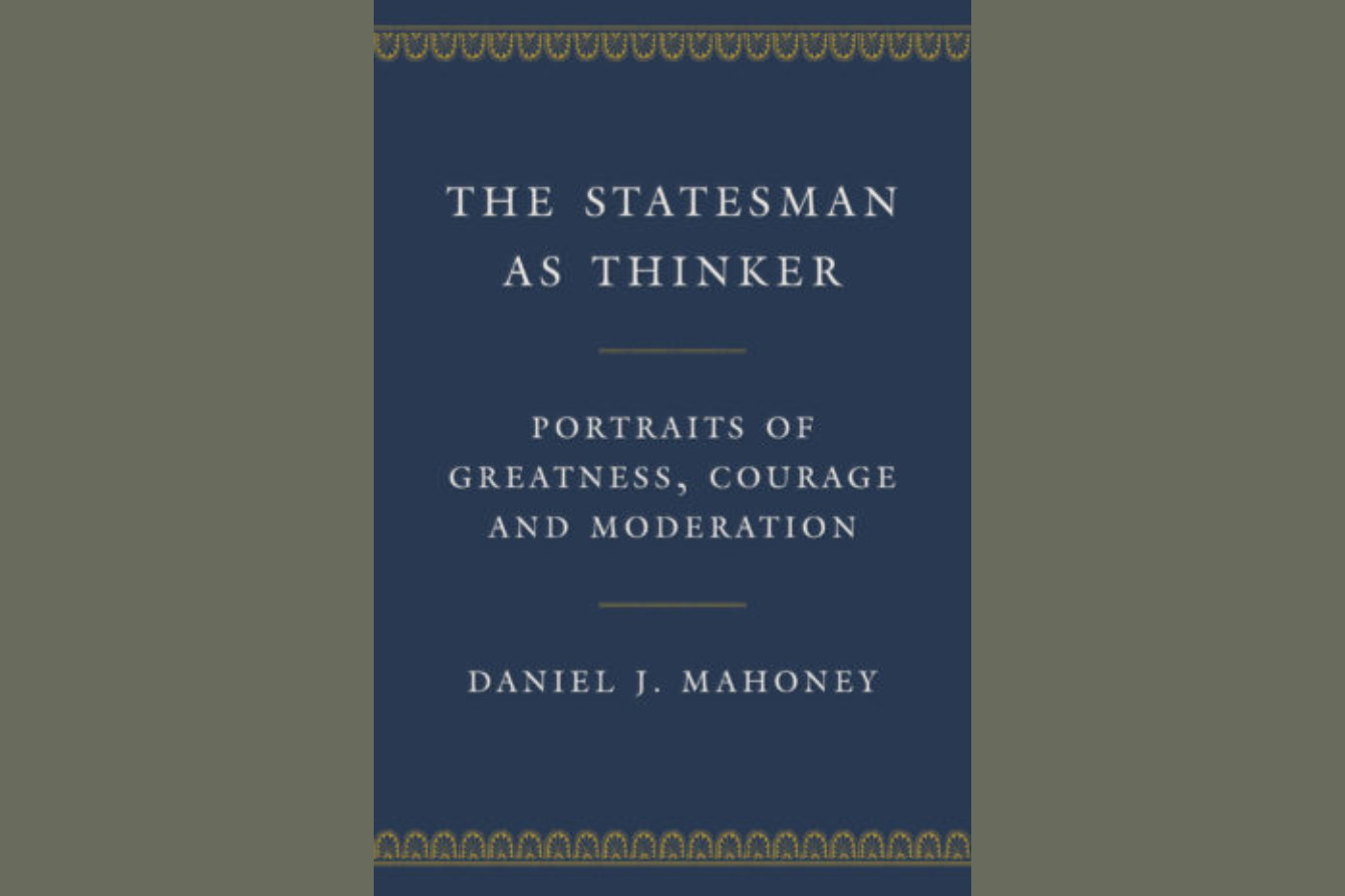
Our current way of seeing and judging our political leaders is peculiar. We’re skeptical of words like “greatness” and everyone’s motives are suspect. Displays or admissions of ambition make us uncomfortable. Yet in recent years, both Barack Obama and Donald Trump developed cult-like followings—neither could do wrong from their followers’ perspective. We are cynical about the possibility of a leader’s ambition being linked to the common good. Yet we also willfully and irrationally submit to demagoguery. In his new book The Statesman as Thinker: Portraits of Greatness, Courage and Moderation, Daniel J. Mahoney seeks to restore a standard for principled statesmanship—one that could guide democratic citizens in evaluating seekers of high office.

Mahoney’s restoration of principled statesmanship proceeds through portraits of six figures who combined political authority with uncommon reflection: Edmund Burke, Alexis de Tocqueville, Abraham Lincoln, Winston Churchill, Charles de Gaulle, and Václav Havel. Before taking up these figures in turn, he lays out his conception of statesmanship and explains why it has been declining for some time.

False Realism and False Idealism

Statesmen make use of an “authoritative exercise of judgment and foresight at the service of the common good.” Mahoney argues that our ability to grasp and evaluate this skill has been corrupted by two different sources. The first source is modern social science, which reduces the full range of human motives to the passions. Politics quickly becomes a mere struggle for power—an undifferentiated motive that garners unwarranted respect solely because its proponents cast themselves as “realists.” However, this realism is decidedly unrealistic because it obfuscates the fact that people have many motives. Here Mahoney has recourse to one of his intellectual guides, Raymond Aron: “Anyone who does not see that there is a ‘struggle for power’ element is naïve; anyone who sees nothing but this aspect is a false realist.”

The antidote to this false realism is an “openness to the judicious mix of realism and moral aspiration that informed the classical political philosophies of Aristotle and Cicero.” A second introductory chapter allows Mahoney to engage with another contemporary scholar of statesmanship, Robert Faulker, who sought to rehabilitate “honorable ambition” in his 2007 book The Case for Greatness. Mahoney follows Faulkner in emphasizing the importance of Aristotle’s virtue of magnanimity—or greatness of soul—and then supplements this analysis with his own invocation of Cicero’s work On Duties.

Mahoney ultimately differs from Faulkner in finding Aristotelian greatness of soul an insufficient foundation for statesmanship. As Mahoney puts it, “The philanthropy of the [Aristotelian] ‘great-souled man’ is qualified by his refusal to acknowledge his debts to others, and his quest for self-sufficiency is ultimately in deep tension with a generous appreciation of moral limits and what one owes one’s country.” These shortcomings of Aristotle’s great-souled man are the reason Mahoney must turn to Cicero’s honorable statesman, who is guided by duty and the “honestum” (the fine, the noble, the honorable). Mahoney’s Cicero sought to link moral and political virtue with the highest goods for human beings. He goes so far as to suggest that “Cicero, more than Plato and Aristotle, provides the most substantial and elevated argument for the inherent choice-worthiness of the life of the thoughtful and reflective statesman who combines greatness of soul with moderation and self-control.”

This brings me to the second source from the which a proper grasp of statesmanship is corrupted. While the reductionist impulse to root everything in a lust for power leads to a false realism, our view of statesmanship is also corrupted by an inordinate exaltation of the human will. Such exaltation recognizes neither natural nor divine limits on power, and leads us to a false idealism. If there are no ultimate limits on the reach of our will, then there’s nothing to stop leaders from embracing unrealistic or radical political projects. The limitless will is rooted in a simplified view that human nature is ripe for manipulation. An approach to political life and leadership that obscures humanity’s various motives and desires can thus lead to both cynical hopelessness and utopian triumphalism.

Unexpected Resemblance

After his examination of how our conception of statesmanship has been corrupted, Mahoney then turns to his discussion of the six statesmen. He calls Edmund Burke—the first of the six—the “first and greatest critic of the ‘emancipation of the will’ from natural and divine superintendence.” Burke identified this as the animating principle of the French Revolution—and did so well before the Revolution would enter its Jacobin phase. Mahoney points readers to Burke’s “Letter to Charles-Jean-François Depont” from November 1789. Burke saw that emancipating the will could lead to both moral anarchy and oppressive tyranny intent on crushing independence and individual initiative. The revolutionaries’ theoretical designs tend to dismiss the significance of people’s independent and uncoerced action. The result of such over-theorized revolution is that individual initiative not approved or acknowledged by the theory must be punished or repressed. In articulating the dangers of excessively abstract theories, Mahoney suggests Burke remains very much our contemporary. Burke sought to defend “sound practice” against “pernicious theory”; such a task is highly relevant for us who inhabit a “world overrun by the ideological thinking Burke so despised.”

Here there is an interesting connection between the eighteenth-century Whig statesman and Václav Havel—the sixth and last figure Mahoney treats in this volume. Such a pairing may be surprising to many, and Mahoney doesn’t directly compare them. Havel, after all, considered himself a man of the left. Yet if one pays attention to Mahoney’s commentary on Havel’s dissident phase and his reflections once he became president of the former Czechoslovakia (and subsequently of the Czech Republic), some continuities emerge.

First, in his dissident writings, Havel argued that communism results in tyranny because its underlying theory is completely divorced from the realities of human nature. In his justly famous essay “The Power of the Powerless,” Havel argues that under communist rule, rather than theory taking its bearings from human experience and political practice, theory becomes dictatorial. As Havel puts it, “Theory itself, ritual itself, ideology itself, makes decisions that affect people, and not the other way around.”

Mahoney emphasizes the continuities between dissident Havel and statesman Havel. In his 1992 work Summer Meditations, Havel elaborates a vision of politics first mentioned in some of his earlier essays: “nonpolitical politics” or “politics as morality in practice.” He suggests politics must take its bearings from the Lebenswelt or natural world—a world where conscience is an experiential reality and where categories like courage or empathy or friendship have tangible content. Politics must take such categories as givens, and it cannot be reduced to a technology of power or to a mere economic problem. Mahoney emphasizes that Havel was attentive to the “moral foundations of a free society.”

The connection to Burke is striking indeed. In his letter to Depont, Burke states: “it is with man in the concrete, it is with common human life and human actions that you are concerned.” And Burke too urged caution if achieving political goals depends on using questionable means: “Whenever the sacrifice of any subordinate point of morality, or of honour, or of common liberal sentiment and feeling is called for, one ought to be tolerably sure that the object is worth it. Nothing is good, but in proportion and with reference.” Havel’s anti-political politics echoes such sentiments.

Recognizing Greatness

As the foregoing discussion might suggest, Mahoney’s book revisits and expounds statesmanship’s timeless principles. Another virtue of his book is that, though he often has recourse to the well-known and justly famous writings of his six statesmen-thinkers, he also brings lesser-known works to the fore. One of these is Havel’s strange and intriguing book To the Castle and Back. The volume consists of three threads woven together: an extended interview with a Czech journalist, detailed notes to his staff during his decade a president, and a diary from his years after departing office in 2003. It is a most unconventional and “artful philosophical memoir,” and in a remarkably short space Mahoney provides his readers with a striking picture of the diversity of tone and message in the book. This is one of the many benefits of The Statesman as Thinker. Alongside Havel’s To the Castle and Back, readers are also introduced to de Gaulle’s The Enemy’s House Divided (1924) and The Edge of the Sword (1932), Churchill’s The River War (1899), and Tocqueville’s Recollections (his memoir of the revolution of 1848).

In the course of each chapter, Mahoney also discusses some recent books on the statesmen, and each chapter concludes with suggested readings on specific themes, events, or time periods. Andrew Roberts’s biography of Churchill titled Walking with Destiny, Julien Jackson’s De Gaulle, Hugh Brogan’s Alexis de Tocqueville: A Life, and Michael Zantonvsky’s Havel: A Life are among the recent works Mahoney discusses. And classic works like Harry Jaffa’s Crisis of the House Divided and Isaiah Berlin’s essay from the Atlantic Monthly “Winston Churchill in 1940” are also analyzed. This gives the book a certain charm—it’s as if one is walking through a bookstore or library with a friend with a certain expertise and depth of learning and he’s handing you things of interest as you walk and talk. Occasionally one wishes that these conversational pauses were longer. The book is compact, moving quickly and gracefully. But, there are times when I wanted an author with this much learning to linger and spend more time delving deeply into these figures.

The book nonetheless provides bounteous occasions for reflection. In his portraits of human excellence, Mahoney does not set up wooden idols. These are human beings, after all, with imperfections and limitations. But such imperfections ought not prevent us from acknowledging greatness when we see it. And, in Mahoney’s view, it takes courage to see it—especially now when a democratic egalitarianism is so pervasive. Such egalitarianism, Mahoney notes in his chapter on Lincoln, “that cannot acknowledge the complexity of the human soul and the variety of human types is bound to degenerate into either egalitarian complacency or, in due time, an open war on human excellence.”

With these portraits, Mahoney aims to reinvigorate our capacity to recognize human excellence. As Czeslaw Milosz once wrote, “Behind the vanity contest, behind all the comedy (of the weak judging the weak) and sheer ordinary folly, the longing for greatness, however misguided, must be acknowledged.”

Adblock test (Why?)


"discourse" - Google News
August 03, 2022 at 07:00AM
https://ift.tt/EMmyvZA

Rediscovering Statesmanship - Public Discourse
"discourse" - Google News
https://ift.tt/gxBfi2o
https://ift.tt/UMrCcyj

Tuesday, August 2, 2022

Discourse - Star of Mysore

israelob.blogspot.com

A week-long discourse on ‘Ramacharitryamanjari’ by Pt. Krishnacharya Nagasampige  began at Sri Raghavendraswamy Mutt in Krishnamurthypuram yesterday. The discourse will be delivered everyday between 6.30 pm and 7.30 pm till Aug. 7.

Adblock test (Why?)


"discourse" - Google News
August 02, 2022 at 06:06PM
https://ift.tt/Km8C5Ze

Discourse - Star of Mysore
"discourse" - Google News
https://ift.tt/gxBfi2o
https://ift.tt/UMrCcyj

Opinion: Boston's checkered history with its greatest sports icon - CNN

Peniel E. Joseph is the Barbara Jordan chair in ethics and political values and the founding director of the Center for the Study of Race and Democracy at the LBJ School of Public Affairs at the University of Texas at Austin, where he is also a professor of history. He is the author of the forthcoming book "The Third Reconstruction: America's Struggle for Racial Justice in the Twenty-First Century" as well as "Stokely: A Life" and "The Sword and the Shield: The Revolutionary Lives of Malcolm X and Martin Luther King Jr." The views expressed here are his own. View more opinion on CNN.

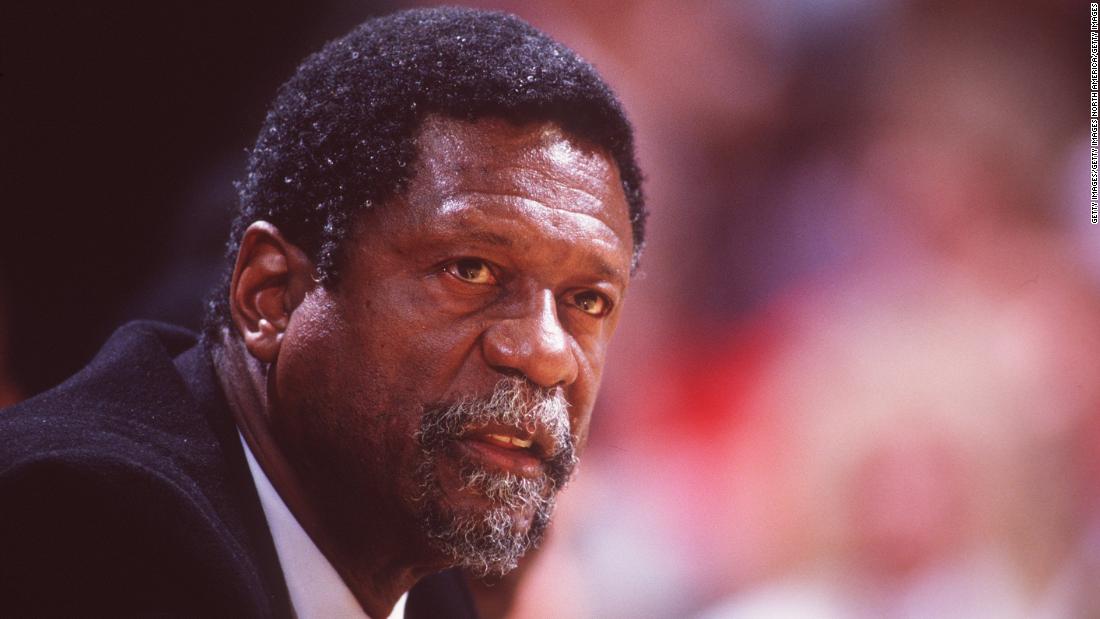
(CNN)With apologies to basketball greats Bob Cousy and Larry Bird, Bill Russell will forever be the most important superstar ever to play for the Boston Celtics.

And with another apology, to legendary NFL quarterback Tom Brady, Russell will always be the GOAT -- not just of Boston, but of excellence and winning in American sports.
The 11-time NBA champion, who passed away this weekend at the age of 88, was among the greatest ever to play the game of basketball. But his greatness was also measured by his achievements off the court -- his tireless social justice activism reflecting America's postwar evolution away from Jim Crow racial segregation as well as the struggle for civil rights and Black Power that transformed the country.
Russell's early life was marked by the tragic death of his mother and the daily challenges of growing up in racially segregated Monroe, Louisiana, where his father was threatened with a shotgun for challenging Jim Crow-era rules that allowed Whites to be served ahead of Blacks. His mother, who passed away when he was 12, was nearly arrested once for being too elegantly dressed for a Black woman.
Russell's family later migrated to Oakland, California, where he became a top player on his high school basketball team, followed by a star turn in college basketball, leading the University of San Francisco to two NCAA championships. In 1956, he led the US Olympic team to a basketball gold medal.
Then came the proving ground of Boston.
Russell joined the Boston Celtics in 1956, just two years after the Supreme Court's Brown v. Board of Education decision announced the notion of "separate but equal" schooling unconstitutional. As one of few Black players on the Celtics, Russell experienced a unique kind of racial trauma.
He would remember Boston as "a flea market of racism" possessing an astonishing variety of ways to display contempt toward African Americans.
"The city had corrupt, city-hall-crony racist, brick throwing, send-'em-back-to-Africa racist, and in the university areas, phony radical-chic racists (long before they appeared in New York)," he bitterly recalled in his memoir, "Second Wind," written with the great author and historian Taylor Branch.
Perhaps out of defiance against the racism he encountered throughout his life, Russell became one of the country's most visible athletes in the civil rights realm. He charged the overwhelmingly White NBA in the late 1950s with purposely excluding Black players. In 1961, after two Black Boston Celtics were denied service at a Lexington, Kentucky, restaurant before a preseason exhibition game, Russell led a boycott in which he and other Black players refused to play in the state.
On the court, Russell was subjected to racist taunts and slurs. In the town of Reading outside Boston where he resided, Russell and his family endured threats, break-ins and vandalism. But he undoubtedly channeled the emotion and intensity into his matchless play on the court.
Russell was a 6-foot-10 center whose defensive prowess, rebounding skills and all-around leadership propelled the Celtics to 11 titles in 13 years. For the final two championships, Russell served as a player coach for the Celtics, which he had helped make one of the most successful franchises in the league.
That record of success eventually helped win over reticent Boston fans, but it took a number of years, and by then the relationship was beyond repair. Russell said that he "played for the Celtics" but "not the city of Boston," according to his daughter, Karen, who movingly wrote about the family's encounters with racism in an essay for The New York Times.
Russell continued to leave a mark on the sport of basketball long after his playing days were over. In 2009, the National Basketball Association renamed its Finals MVP trophy after him. He became the league's elder statesman, building cordial relationships with a new generation of players that included LeBron James, the player whose activism and authenticity is most reminiscent of Russell's.
And he was the first African American -- not just in pro basketball but in pro sports -- to serve as head coach.
Among the many tributes after his death was announced on Sunday was one from NBA Commissioner Adam Silver, who hailed Russell as a figure whose symbolism and substance injected racial justice and equity "into the DNA" of the league.
As if appearing in a news reel of the most significant events of the civil rights era, he was present, time and again, at key moments for the movement, from the March on Washington in 1963 to his visit to Mississippi that same year following the assassination of civil rights leader Medgar Evers.
Russell also supported Muhammad Ali's refusal to be drafted into the Vietnam War and actively resisted racial segregation and injustice in all of its forms. In 2011, then-President Barack Obama awarded Russell the Presidential Medal of Freedom, not just in honor of his athletic feats, but for his sense of commitment to social justice and equality.
After retiring from the NBA in 1969, Russell insisted that the ceremony to retire his number be held in private and skipped his 1975 induction into the Basketball Hall of Fame. "I have very little faith in cheers," he once noted, saying that he found his inspiration on the court from his intrinsic love for the game.
Russell's antipathy toward Boston softened a bit over time. Cousy, the Hall of Fame Celtics point guard and teammate of many years, expressed regret for not having publicly confronted the racism that Russell and other Black players faced in their playing days. And Boston paid tribute to Russell with a bronze statue of his likeness in 2013, a long overdue honor.
Over the years, he never lost his willingness to call out racism, or perceived indifference to it. In recent years, he chided White Americans for their incredulity -- in the aftermath of George Floyd's murder and the racial and political reckoning that followed -- about the existence of systemic racism.
In an essay two years ago for The Players' Tribune called "Racism Is Not a Historical Footnote," Russell offered a brilliantly layered analysis of structural racism through memoir, anecdote and biography.
Get our free weekly newsletter

Sign up for CNN Opinion's newsletter.

Join us on Twitter and Facebook

"In 2020, Black and Brown people are still fighting for justice, racists still hold the highest offices in the land, and kids today still grow up with cultural norms that aren't different enough from the ones that Lester Maddox grew up with," Russell wrote, referring to the restaurateur-turned-Georgia governor, who infamously turned Black patrons from his chicken shack with an ax handle.
"This surprise is particularly dangerous because racial injustice is rampant throughout every sector of American society, from education to health care to sports," Russell wrote, "and the fact that this remains surprising to many reveals exactly how different Black and White people's experiences of life in America are."

Adblock test (Why?)


"Opinion" - Google News
August 02, 2022 at 07:22AM
https://ift.tt/2hzPZIB

Opinion: Boston's checkered history with its greatest sports icon - CNN
"Opinion" - Google News
https://ift.tt/NSJ9O8r
Shoes Man Tutorial
Pos News Update
Meme Update
Korean Entertainment News
Japan News Update

Tuesday's Headlines: Make Your Opinion Known Edition – Streetsblog New York City - Streetsblog

We couldn’t help but notice that there’s yet another group of self-styled champions of democracy in Jackson Heights claiming it speaks for the ignored supposed majority of residents who oppose the Department of Transportation’s “Paseo Park” plan for 34th Avenue on the grounds — get this — that creating plaza blocks is “dangerous” because the DOT has not done “ANY environmental impact analyses” about the apparent danger that supposedly happens when cars are removed from a roadway.

The group is called “Voices of Jackson Heights” — and it claims that neighborhood residents have not been given “representation.” (Though there’s some irony there, because opponents of the Paseo Park plan also claim that they’ve spoken up loudly at numerous public hearings, so it’s a bit odd to hear people complaining that their voices are not being heard while at the same time boasting how much noise they have made. Our guess is that their voices are indeed being heard; but they are simply losing to more-compelling other voices.)

But to get to the substance of the Voices of Jackson Heights complaint about the supposedly dangerous car free spaces that haven’t been properly studied: there is in fact one major impact statement that the city publishes every day. It’s called NYC Open Data, and it’s a trove of information about the environmental impact of cars on public roadways.

For example, according to that database, there were 99 reported crashes on 34th Avenue between 69th Street and Junction Boulevard in calendar year 2019 (before the city created the open street). Those crashes injured seven cyclists, 10 pedestrians and 36 drivers. But in calendar year 2021, during the hours when the open street barricades are up, there were 23 reported crashes, injuring one cyclist, four pedestrians and three motorists. That’s a drop in crashes of 77 percent and a decrease in injuries of 85 percent.

That’s certainly evidence that the creation of the open street has benefitted  “everyone’s safety and security” — though Voices of Jackson Heights uses those very words to argue against the DOT’s plans to further reduce car traffic on the street.

The safety argument is compelling enough, but let’s not forget that Jackson Heights has among the lowest open space per capita in the city. Its lone park — Travers Park — is great, but it is small. The open street has created a public space amenity in a neighborhood that desperately needs it. Not everyone in Jackson Heights lives in a building with a verdant courtyard — and very few people have access to country houses or cottages.

Conveniently, Voices of Jackson Heights has posted a survey to seek the voices of the neighborhood. Our hope is that the many many supporters of Paseo Park will take a few minutes to fill out the survey and tell the new group how beloved the open street actually is. Then Voices of Jackson Heights may indeed be a truly representative group.

In other news:

  • Nicole Gelinas writes for the NY Post and the Manhattan Institute — both outlets with which we often bitterly disagree (especially on policing). Yet when it comes to demanding that we dismantle all the terrible systems that encourage global warming, she’s on point. You can blame Joe Manchin all you want for, well, being Joe Manchin, but as Gelinas points out in this (badly headlined) Post column, we are all guilty in our own way of not tearing down Car Culture.
  • Everyone jumped on the news that Manhattan Borough President Mark Levine was going to ratchet up the West Side Highway road diet machine again, but Levine was smart enough to hand out a super hot rendering to reporters covering his letter to state DOT. We were on it big time, as was Clayton Guse of the Daily Newsuh,
  • Mayor Adams put transit workers union boss John Samuelson on the Transit Mobility Review Board, which will decide on all the details about congestion pricing later this year. (NYDN, amNY)
  • Speaking of Adams and transit, the mayor defended his decision to cut the hours on two successful busways as listening to “the community.” Which community? Certainly not bus riders. (amNY, Streetsblog)
  • Graphic: R. Kikuo Johnson
    Graphic: R. Kikuo Johnson

    We’ve slammed the New Yorker in the past for its pro-car agenda, as well as for getting financial backing from the maker of one of America’s most violent SUVs, but this week, we offer a hat tip to R. Kikuo Johnson for his bike-to-the-beach cover image (right). Now can he do the Mets next?

  • Of course, the New Yorker reverted almost immediately to form with this piece about how great it’s going to be when all the cars go electric and are perfectly quiet.
  • We went out to cover the ground-breaking of the Portal North Bridge in New Jersey and came away with a bloggy post about Secretary Pete Buttigieg. Gothamist played it straight.
  • A 74-year-old woman was struck and badly injured by the driver of an SUV in Bayside. (NY Post)
  • Media- and pol-whipped fear of crime — not crime itself — is undermining New York’s recovery, argues Bloomberg. Equality Alec had the perfect thread, as always:
  • Even though everyone did previews, some outlets still covered the mayor’s presser on Monday that the city’s speed cameras would — indeed and as promised — begin 24-7-365 coverage starting at 10 p.m. (amNY)
  • That’s two! Another Staten Island cop has been arrested for using fake plates. (Gothamist)
  • Livery cab owners and base operators want more licenses. (amNY)
  • Don’t miss the three-way debate with Reps. Jerry Nadler and Carolyn Maloney and challenger Suraj Patel on Tuesday night (you can catch Jacob deGrom’s return and still catch the best parts) (Gothamist). Patel, the Post says, is surging.
  • And, finally, here’s some great public service journalism from our friend Ben Kabak, who collected some tweets from drivers who were upset that the city’s speed cameras would finally, as of Monday night, be operating 24-7-365. Too many drivers actually believe that driving recklessly is OK and that being held accountable for it is unjust:

Adblock test (Why?)


"Opinion" - Google News
August 02, 2022 at 11:04AM
https://ift.tt/QJG78dU

Tuesday's Headlines: Make Your Opinion Known Edition – Streetsblog New York City - Streetsblog
"Opinion" - Google News
https://ift.tt/NSJ9O8r
Shoes Man Tutorial
Pos News Update
Meme Update
Korean Entertainment News
Japan News Update

Monday, August 1, 2022

Harry Rakowski: Arguments over Anne Frank's 'white privilege' reveal the absurdity of our discourse - The Hub

israelob.blogspot.com

A recent Twitter thread circulating broadly remarkably suggests that Anne Frank, a Jewish teenager who famously chronicled her terrifying two-year experience as a child hidden from the Nazis in an attic in Amsterdam during the Second World War, was somehow the beneficiary of white privilege. Anne ultimately was captured and sent to the Bergen Belsen concentration camp where she died a short time before the camp was liberated. She was yet another victim of the Nazi goal to exterminate all Jews.

The Twitter narrative that her experience could somehow be equated with privilege of any kind is so insulting that it is hard to believe that it is not a sick joke. It is argued that she must have had privilege by definition because she was white and her father was not poor. The truth is rather she had the privilege to die a lonely painful death.

I am a child of Holocaust survivors, a mother who survived the horrors and the death march of Auschwitz and a father who also somehow survived Buchenwald. Very few family members survived the brutal atrocities of the war. I am alive only because the infamous Dr. Mengele couldn’t draw blood from my mother and thus rejected her for sterilization experiments. Yet my family and those that perished would still be considered as having a history of white privilege simply because of their skin colour. Indeed the fact is that “white” Jews have faced centuries of religious racism, oppression, restrictions to work and pray, crusades, pogroms, and finally the Holocaust.

The concept of privilege benefitting white people has been postulated for decades. Peggy McIntosh, an American academic, wrote a paper in 1988 about white privilege and male privilege and detailed many instances where being white and/or male conveyed an undeserved and unearned advantage.1White Privilege: Unpacking the Invisible Knapsack https://psychology.umbc.edu/files/2016/10/White-Privilege_McIntosh-1989.pdf While the concept is worth a dialogue, the Twitter dialogue about Anne Frank grossly distorts the concept.

Discrimination and trauma aren’t limited to people of colour. The Russian atrocities in Ukraine are mainly being committed against white people. Should we also consider that despite their suffering, they also have white privilege? The same would be said of the millions of innocents killed by Stalin in the Second World War.

The world is a dangerous place full of good, but also much evil. Slavery and the subjugation of people of colour are a stain on our history. Racism and persecution based on skin colour, while improving, still persists and is intolerable. I fully accept that I don’t know what it is like to be afraid of being targeted by the police and others because of skin colour. I do understand, as many others do not, the historic persecution of Jews. Irving Abella and Harold Troper in their book None Is Too Many2None Is Too Many: Canada and the Jews of Europe, 1933-1948 https://utorontopress.com/9781487516529/none-is-too-many/ describe in chilling detail the horrible story of how enlightened Canada, a country of immigrants who, because of anti-semitism, denied aid and entry to Jewish refugees. Most of them were forced to return to Europe and perished in the war.3“​On 7 June 1939, 907 Jewish refugees aboard the MS St. Louis were denied entry to Canada. The ship returned its passengers to safe harbour in four European countries. Sadly, 254 of its passengers later perished in the Holocaust.” https://www.thecanadianencyclopedia.ca/en/article/ms-st-louis

It is a mockery of common sense to believe that while certain white people can suffer great injustice and even extermination, they somehow can still be considered to have benefited from white privilege.

Discrimination in any form is abhorrent and contrary to the values of most Canadians and Americans. It can be based on colour, gender, ethnicity, religion, and sexual orientation. All of it is wrong and needs universal condemnation. A shooting at a church, mosque, or synagogue needs to be equally condemned by people of all religions.

There is a great deal of privilege in the world, most of which isn’t restricted to whiteness. There is an established hierarchy in most societies that tries to retain control and resists change. It isn’t simply about whiteness, rather it is more about class and status in most societies.

The caste system in India, a social hierarchy that has existed for over 3,000 years, categorizes people into different levels of respect and opportunity.4What is India’s caste system? https://www.bbc.com/news/world-asia-india-35650616 Brahmins are priests and to be revered. Kshatriyas are rulers and warriors, Vaishyas are skilled workers, Shudras are unskilled workers, and Dalits are untouchables, relegated to the lowest opportunity. While social discrimination has lessened, it still influences opportunities including whom you are allowed to marry.

Communist China, despite promoting equality for all, has a highly structured, elitist hierarchy that determines opportunity and wealth based on membership in the Communist Party.

Saudi Arabia, another non-white country has a rigid hierarchy based on social stature, religion, and gender.

Many African countries have societal hierarchies, somewhat similar to a caste system, based on social groupings, inherited opportunities, and language that determines occupation, wealth, and social status.

The fact that inequality is widespread doesn’t mean that we have to accept the status quo. Privilege, white or otherwise, reflects inequality of opportunity and undeserved benefit. Centuries of experience have taught us that while the playing field can be greatly levelled by education, drive, hard work, and intelligence, some will have to strive harder than others. It is, however, all too easy to adopt a victim mentality and only blame others rather than explore how your own skills and effort can improve your life.

Warren Buffett is one of the world’s richest men with a net worth of about $100 billion. His fortune wasn’t inherited. It came from hard work, entrepreneurship, and a strong belief in the value of investing. He is recognized as having a very high level of integrity, ingenuity, and practical intelligence. He plans on donating 99 percent of his fortune to charity. Is his privilege in society due to him being white, or just being smarter than most other people? A lot of privilege is simply earned.

For those who focus only on being behind because of the privilege of others, rather than also due to their own failings, there is an important lesson yet to be learned. If you can’t find compassion for others that have suffered, why would you expect that others will find compassion for your suffering? If you really believe that Anne Frank and the many others who suffered greatly at the hands of those who are evil died with white privilege, then I can only feel tremendous sadness for your ignorance. You will never recognize nor take full advantage of the opportunities that you have. You will not find the allies that could help you achieve your potential and your goals.

Privilege sometimes gives some unscrupulous people the licence to do some things that they don’t deserve to do and that we abhor. Russian oligarchs have a licence to steal. Saudi Princes have a licence to kill without recrimination. Sadly we have to also accept that twits can have a licence to tweet since free speech isn’t free of ignorance and disgust.

Adblock test (Why?)


"discourse" - Google News
August 01, 2022 at 05:00PM
https://ift.tt/zgnFdqj

Harry Rakowski: Arguments over Anne Frank's 'white privilege' reveal the absurdity of our discourse - The Hub
"discourse" - Google News
https://ift.tt/Rioyl3q
https://ift.tt/fJIQRLY

OPINION | Horoscopes by Holiday - Arkansas Online

Happy birthday Aug. 1: The right job will combine your many talents. You do not treat science and art as opposites. You will meld logic and feeling in your endeavors, finding an auspicious arrangement of fact to fantasy. As a result, you create strange and lucky scenarios. People are drawn into your truly original world, and you'll be well-loved.

ARIES (March 21-April 19): You'll deal with a tangled mess that appears to have the power of a strong net. Yes, you could get caught up in it or even trapped. But the power of your spontaneous impulse will help you dissolve the tangles and break free.

TAURUS (April 20-May 20): You'll find out how supportive your support system is. Lean in a bit and see who is there, ready to catch you. Also, you'll consider how you show up for other people, and who you're willing to go out of the way for.

GEMINI (May 21-June 21): Whether a person feels innately talented or innately disadvantaged is beside the point. Either way, they can improve. You believe everyone is capable of getting a little better, and you'll therefore bring hope to others.

CANCER (June 22-July 22): Some say the first step is the hardest part of the journey, but this won't ring true for you. Without hesitation, you'll follow an intuition. The first stretch of the road will be a blur as you hit the ground running.

LEO (July 23-Aug. 22): You're starting to treat yourself differently. You may not even realize it at first, but the changes become evident in the way others treat you, which is always a reflection of what's going on between you and you.

VIRGO (Aug. 23-Sept. 22): If you don't ask, the answer will be no. But asking is not so simple. Before you reveal what you want with a request, think about what the other person wants that you might be able to offer in exchange.

LIBRA (Sept. 23-Oct. 23): Important events have a way of rolling out sans fanfare. Even so, maybe the challenge is as glorious as the battles of dragon slayers in days of yore. However ordinary the task may look, don't be fooled; fight the gallant fight.

SCORPIO (Oct. 24-Nov. 21): Putting your heart on the line is risky business. Taking that chance and living with the adrenaline, fear and thrill of it can be overwhelming to the point that love can become mixed with other feelings.

SAGITTARIUS (Nov. 22-Dec. 21): Because someone feels free to be themselves around you, you'll be privy to the best and the less endearing sides. Hidden qualities, habits and behaviors that get on your nerves can coexist with the love you feel.

CAPRICORN (Dec. 22-Jan. 19): Your outcome will depend not only on your knowledge of what you're trying to do before you do it but also your understanding of why. If your "why" is solid, everything else will fall into place.

AQUARIUS (Jan. 20-Feb. 18): You're on a discovery mission. You could ask the person what you want to know about them, but questions produce defensiveness and suspicion. Try revealing something about yourself. You'll give trust to get trust.

PISCES (Feb. 19-March 20): Though you know that compromise is not punishment, meeting the other person halfway still entails giving up some of your personal freedom. Sacrifice when you're ready and when you know you won't resent it.

WORDS LIGHT FUSES

Mars and Uranus are in a precariously incendiary position. What lights the fuse? Words. Lucky are those who favor the pristine expression of silence. The loop of thought to breath to vocal cords uses energy but often isn't worth the expenditure. While caught up in one's owns opinions, it's easy to miss key details. In short, talk less, listen more.

CELEBRITY PROFILES

From "Game of Thrones" to "Aquaman," Jason Momoa's intensely visceral charisma has a way of bringing fantasy worlds to life. The Leo star was born when the sun, Mercury, Venus and Jupiter were all in the sign of the king cat; that's an unusual amount of royal astral influence. Leo is also the sign of playfulness, children, the heart and show business.

Adblock test (Why?)


"Opinion" - Google News
August 01, 2022 at 02:45PM
https://ift.tt/ybp5Wva

OPINION | Horoscopes by Holiday - Arkansas Online
"Opinion" - Google News
https://ift.tt/SdXRzoM
Shoes Man Tutorial
Pos News Update
Meme Update
Korean Entertainment News
Japan News Update

Search

Featured Post

I just paid $9.99 for a carton of 18 eggs. Will prices ever drop? | Opinion - Sacramento Bee

[unable to retrieve full-text content] I just paid $9.99 for a carton of 18 eggs. Will prices ever drop? | Opinion    Sacramento Bee ...

Postingan Populer