Rechercher dans ce blog

Sunday, August 30, 2020

Tenet Is Coming to Cinemas, and 'the Discourse' Is Coming with It - The Escapist

israelob.blogspot.com

This week, Tenet arrives in cinemas. And it is bringing “the discourse” with it.

The past few months have been tough. In the context of a horrific global pandemic that has cost hundreds of thousands of lives, infected millions of people, and devastated the global economy, it is almost churlish to speak about cinema as an industry or an artform that has been specifically or particularly affected. Still, the past few months have seen dramatic shifts in the way that movies are distributed, with a greater embrace of streaming and changes to the cinema experience.

In terms of cinema, the pandemic was shaped by the evacuation of major blockbusters from the summer, with movies like No Time to Die and F9 abandoning their targeted release dates. Every major blockbuster followed suit. There were relatively high-profile releases on streaming like Trolls World Tour, but nothing on the scale of Wonder Woman 1984. The theaters that could open screened curiosities like Unhinged or nostalgic re-releases like The Empire Strikes Back.

This absence of new releases was a problem for cinemas — an industry already in a precarious financial position before the crisis occurred. However, it created an interesting climate for people who talk about movies. With no major new releases of which to speak, I’ve had the chance over the past few months to write about lesser-seen films like Jennifer Kent’s The Nightingale or to look back at older films like Atomic Blonde, Nightcrawler, and even Terminator – Genisys.

There is something to be said for having the space for a measured discussion of film, free from the constant churn of content aggregation and the spikes of online outrage. One of the more depressing trends in online film discussion over the past few years has been how angry it has become. It has become impossible to mention certain movies online — like The Last Jedi or Batman v Superman — without provoking an intense and aggressive response, often from complete strangers.

Greyhound Apple TV+ Tom Hanks movie World War II

In hindsight, the stretch of six months between Birds of Prey and Tenet offered a reprieve. There was little to shout about. There were major streaming releases like Greyhound or Palm Springs, but they didn’t break into the zeitgeist. Netflix movies like The Old Guard and Project Power flared and disappeared. Hamilton was perhaps the closest thing that the pandemic period had to a blockbuster, but its outrages had been played out during the show’s run on Broadway.

However, the arrival of Tenet in cinemas will change things. It already has. The press embargo for reviews of Tenet lifted at noon ET on Friday, Aug. 21. The deluge arrived almost instantly. Of course, this was inevitable. This is how the internet talks about movies. It had been starved of a movie on the scale of Tenet, so it was a feeding frenzy. The Guardian ran no fewer than three reviews of the movie before release — at two, three, and five stars.

In a climate where everything must be the best or the worst thing ever for the 15 minutes that it holds public attention, Tenet was especially prone to such hyperbole. Inevitably, think pieces from critics turned up debating the “moral conundrum” or the “moral dilemma” of even reviewing the film in the first place. On social media, the sentiment was heightened and amplified, with some commentators asking critics to “take some responsibility” and refuse to review Tenet at all.

It should go without saying that film critics are probably not the people that audiences should be asking about whether it is safe to go to the cinema. This current pandemic has been shaped and defined by an absence of moral leadership, but film critics are not public health professionals and whether or not it is safe (or safer) to visit the cinema is not something a critic can ascertain. Some pop culture sites have talked to medical professionals and have tried to avoid sensationalism.

Tenet to Receive International Release Before Select U.S. Cities Get It in September Christopher Nolan Warner Bros. WB Korea Europe Asia

The release of Tenet was always going to prompt this heightened rhetoric. Even before the film was released, Christopher Nolan’s desire to support cinemas was framed as the director setting up “a death cult.” Seth Rogen wryly suggested that Nolan was trying “to kill his greatest fans.” This is the current state of “the discourse,” where a summer blockbuster becomes a moral referendum — often among those who have not even seen it.

In June, an anecdote shared by actor Anne Hathaway in an interview with Hugh Jackman prompted online outrage at the idea that Nolan had banned chairs from his sets. It didn’t matter that people on those sets spoke up and confirmed that they had been provided with chairs. It was irrelevant that a quick Google search could bring back images of people sitting in chairs on Nolan’s sets. It didn’t matter that it was easily refutable; it was a source of outrage, and so Nolan had to issue a denial.

The result is the strange crafting of a narrative around the only director (with the arguable exception of James Cameron) who has enough creative clout to produce original blockbusters on this scale, in this intellectual property-driven landscape. It seems like there’s a vocal section of the online social media landscape actively trying to narrativize Tenet (and Nolan) as a failure before they’ve even seen the film (and in spite of strong reviews at both Rotten Tomatoes and Metacritic).

Then again, rage has always traveled faster over social media than other emotions. Coincidentally, the past week saw a flare-up over Netflix’s release of the French movie Mignonnes. Critics (rightly) objected to how Netflix packaged this story of a young black girl’s experience with a tween dance crew, objecting to how the poster and trailer seemed to sexualize young girls. However, those who had seen the movie (including Tessa Thompson) pointed out that it was a critique of such culture.

Mignonnes Tenet Christopher Nolan discourse COVID-19 coronavirus cinema movie experience controversy

In this heightened environment, where everybody is angry and everybody has an opinion, it didn’t matter that director Maïmouna Doucouré was drawing from her own experiences of the culture or that reviews of Mignonnes at Sundance had pointed to the film as “a contemplation of today’s destruction of innocence” rather than an uncritical example of it. It seems highly likely that a promising young director’s career has been damaged by people who have not even seen her work.

This is arguably just an example of movie culture being influenced by broader social trends. Social media algorithms are designed to push (and reward) extreme emotional reactions rather than more measured and nuanced responses. Politicians have argued that the public has “had enough of experts” in recent years, and perhaps that applies to everything; it’s no longer expected to have seen a movie to feel comfortable talking or writing at length about it.

None of this is anything new. It has arguably been the direction of online film discourse since the early days of the internet and sites like AICN. As early as 2001, Jay and Silent Bob Strike Back defined the internet as “a communications tool used the world over where people can come together to bitch about movies.” Still, the cacophony is exhausting. Looking back, the six months of relative tranquility in online movie discussion were a strange oasis in these most unsettling times.

The jury is still out on whether Tenet can actually save cinema, but it has already resurrected the art of shouting angrily about movies on the internet. Personally, I missed cinema. I did not miss “the discourse.”

Let's block ads! (Why?)


"discourse" - Google News
August 31, 2020 at 12:32AM
https://ift.tt/34SlPLb

Tenet Is Coming to Cinemas, and 'the Discourse' Is Coming with It - The Escapist
"discourse" - Google News
https://ift.tt/2KZL2bm
https://ift.tt/2z7DUH4

Opinion: Why don’t police enforce the laws to protect cyclists? - The Mercury News

Chirag Asaravala’s mangled bike rested on the pavement after a hit-and-run accident in Orinda earlier this month. (Photo courtesy of Chirag Asaravala)

I was nearly killed riding my bicycle this month in Orinda.

Chirag Asaravala 

A driver hurrying to get on the freeway struck me with her new white Corolla. The impact threw me several feet up the road and headfirst onto the hot asphalt. As other cyclists arrived to help me, she sat in her car, still looking impatient.

When she finally exited her vehicle, I instinctively yelled at her out of anger and shock, and commanded her to wait for the police — but she didn’t. She left in exactly the way she arrived, in a rush and leaving no identification.

Within minutes, police arrived and took statements and pictures. I gave them the license plate number as I had managed to take a picture as she drove off.  But, to my dismay, they didn’t go after her or alert other police in the area.

There I was with my shoulder, arm and hand bleeding and burning in pain and, as I’d later learn at the emergency room, suffering from a concussion. My bike was mangled, and the driver had left the scene. By fleeing, she had potentially committed a felony hit and run, so why weren’t the cops in hot pursuit?

As I’ve come to learn, if you’re struck by a vehicle while bicycling in California, don’t hold high expectations of law enforcement to achieve justice. Bicycle accidents are simply not a priority unless perhaps you are killed. This was reaffirmed on follow-up calls with the Police Department:

Me: “Have you located the car or driver?”

Officer: “Not yet. We have limited resources. That’s not us, that’s just the state and DA priorities.”

More than 100 cyclists die in traffic accidents each year in California, one of the worst states for bicyclists. A 2018 study found that hit-and-run accidents were on the rise, and most victims of fatal hit-and-run collisions — 65 percent — were pedestrians or cyclists.

So why was this being treated as just another traffic incident?

I called the police department daily for updates. Their approach was deliberately passive: If the vehicle re-entered the city and triggered the license-plate cameras, they’d be notified. But what if the vehicle never returned? It started to feel like it wasn’t just I that was a victim of hit and run, but justice as well.

The vehicle did reappear in Orinda over a week later, and the police pulled over the driver. I was asked, as I had been repeatedly before, “Do you want her arrested?”

Why were they asking me whether to enforce the law? The burden of enforcing the law should not lie on the shoulders of the victim. This was a criminal matter in the interest of public safety — the police need to enforce the law. Asking the victim to make the decision is clouded with bias.

Do I want to send her to jail, to make her life miserable, to take vengeance? Of course not. Some might. I want certainty that she admits fault. And I want her and other drivers to be deterred from endangering cyclists — something only enforcing the law can attain.

Bicyclist safety ought to be given significantly higher priority and seriousness by law enforcement. In every instance where a vehicle and bicycle collide, the bicyclist always has the disadvantage. This is a matter of physics, but it should not be so as a matter of law.

Go after hit-and-run drivers and prosecute them. Investigate all vehicle-vs.-bicycle accidents and reports of drivers who endanger cyclists with aggressive driving. Treat every instance as if the cyclist was killed.

After all, law enforcement doesn’t give a pass to a gunman who failed to kill his victim or a bank robber who only got away with a few dollars. The pursuit of justice ought to be for its sake alone.

Chirag Asaravala is a biotech consultant, opinion writer and essayist living in Alamo. 

Let's block ads! (Why?)


"Opinion" - Google News
August 30, 2020 at 08:10PM
https://ift.tt/32IkPX2

Opinion: Why don’t police enforce the laws to protect cyclists? - The Mercury News
"Opinion" - Google News
https://ift.tt/2FkSo6m
Shoes Man Tutorial
Pos News Update
Meme Update
Korean Entertainment News
Japan News Update

Trump can still win this election - CNN

The convention's host, Chicago Mayor Richard J. Daley, and other members of the Illinois delegation stood up and shouted insults at the senator from Connecticut. It was an electrifying moment, a rare case of the reality of the streets intruding on the packaged rhetoric of a political convention.
No such unscripted moment was allowed at this week's carefully orchestrated Republican National Convention, despite the tumult occurring outside: the protests after the shooting of a Black man in Kenosha, Wisconsin, on Sunday, culminating in the arrest of a 17-year-old charged with killing two protesters; the fierce hurricane slamming into coastal Louisiana; the wildfires consuming homes and forests in California; and the continuing march of a pandemic that has left more than 180,000 Americans dead.
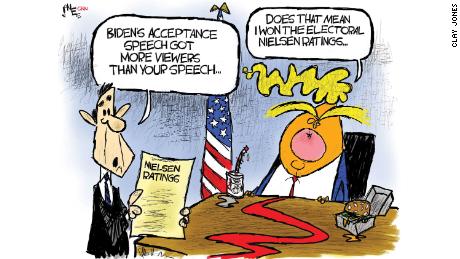
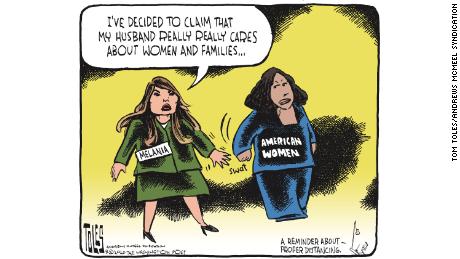
With relentless discipline, wrapped in flag-draped videos, the convention hammered home President Donald Trump's message: that behind closed doors and contrary to all outward signs, he is an ardent feminist who cares deeply about the problems confronted by Black Americans, that Joe Biden is a "Trojan horse" for radical activists and that a Democratic victory in November would spell the end of the American dream. The fact that in his acceptance speech Trump mostly stuck to the teleprompter script vetted by his advisers suggested to Sarah Isgur that "he believes he is losing this race."
Covid-19 is under control, Trump asserted, and America is reopening. As if to punctuate that message, he assembled 2,000 people on the White House's South Lawn with few precautions to prevent it from becoming a super spreader event.
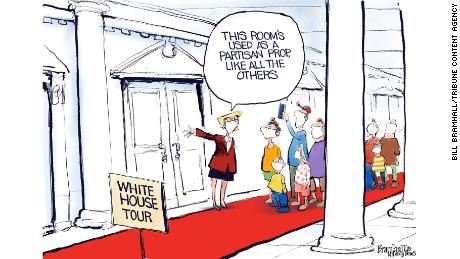
David Gergen called the political use of the historic grounds owned by all Americans "an abomination" and urged: "never again should a sitting president be able to commandeer one of the most sacred sites of our democracy and turn it into a political prop."
It also presented a dangerous image to viewers, he wrote. "At a time when public health experts are trying to persuade Americans to wear masks and practice social distancing, they saw hundreds upon hundreds without masks and jostling close together."
The convention's narrative was jarring, wrote Frida Ghitis: "As America's 2020 dystopia barreled ahead, the Republican National Convention offered its version of alternative facts, a bubble containing a phony reality where President Donald Trump is a champion of women's equality, a protector of health care benefits, a defender of pre-existing conditions coverage, and a man of immeasurable compassion."
Twelve Black speakers were featured on the main stage in support of Trump, noted John Avlon. "Contrast that stat with the number of African Americans who are senior level White House staffers. That would be one -- Ja'Ron Smith, a deputy assistant to the President...What about Black Trump cabinet secretaries? That would be one as well: Secretary of Housing and Urban Development Ben Carson." Trump was lauded at the RNC for backing the careers of women too, but here also his record isn't strong -- it significantly lags presidents such as Barack Obama and Bill Clinton, Avlon wrote.

'Quite a show'

In reality show fashion, Trump disrupted the tradition of political conventions by bestowing a presidential pardon, meeting with freed American hostages and staging a naturalization ceremony for prime-time viewers. These segments were designed to depict Trump as a man of empathy, wrote Jamie Poniewozik in The New York Times. "They also smear Vaseline on the lens of his policy positions," he noted. "His administration has been boldly putting restrictions on legal, not just illegal, immigration -- but just look at these five lucky winners!" Which raises the question: "After four years of belligerence, insults and Twitter rages, can you suddenly remake him as Oprah?"
Maybe, wrote Jill Filipovic: "It was quite a show. The Republican Party seems to understand that liberal ideas -- racial justice, women's rights, health care access, diversity, welcoming immigrants -- are actually pretty popular in the United States. But in practice they are also often antagonistic to these same ideals... they want to give the appearance of embracing them without actually having to live them."

It just may work

Americans have seen Donald Trump up close as President for nearly four years and as a reality show star for a lot longer. Their view of him seems unlikely to change in the 70 days before the election. But branding -- and rebranding -- is what he does.
He particularly needed to after recordings of his sister, retired federal judge Maryanne Trump Barry, speaking damningly about her brother, surfaced a week ago, on the eve of the convention. Dean Obeidallah summed them up: "When a sibling says in confidence that her brother is cruel, lies, and is misleading his base with his phoniness, people should take notice."
Nonetheless, the RNC featured a parade of people vouching for Trump's magnificence. It "painted a picture of an administration that had completely eradicated myriad scourges, including Covid-19, ISIS, the Middle East conflict, unemployment, the opioid crisis, criminal over-sentencing, sexism, racism and a swamp that needed draining -- and Trump alone deserves all the credit," wrote SE Cupp. None of it was true, she noted, "nor does it tell the story of Trump's corruption, incompetence, nepotism, cronyism, abuses of power and lawlessness."
But many people don't follow politics closely, and if they're just tuning in, "they also would have heard speakers paying lip service to issues they care about...bad trade deals, disappearing manufacturing jobs, overregulation, endless wars, violence," Cupp wrote. "And fear is a powerful motivator -- sometimes more than the truth."
Julian Zelizer pointed out that "much of the country has been worn down by the impact of the pandemic, and many voters may want a leader who can either assuage their fears that the virus still looms or who can divert their attention to other issues altogether."
Republican strategist Doug Heye agreed: "Anyone who looks at the polls and says he can't win despite being down a large margin, would be making a foolish mistake... we are divided into nearly equal tribes, with a small advantage to the Democrats, and as we see increasing violence win our streets, Trump knows that he, as President, is given a longer leash and benefit of the doubt if he quells the fiery images. His campaign is keenly aware that many of the voters most likely to respond to Trump's message on this are the suburban voters he needs."
To Keith Boykin, Trump's acceptance speech "may have been the most overtly racist convention speech since Pat Buchanan's infamous culture war speech at the 1992 Republican National Convention." Boykin wrote, "Trump amplified the decibel level of what had once been quiet dog whistles into a loud and aggressive bullhorn, warning fearful white Americans that radical left socialists, anarchists, agitators, rioters, looters and flag burners are coming to get you."
For more on the campaign:
Karthick Ramakrishnan: Nikki Haley's 'American dream'

Search for a vaccine

In his acceptance speech at the RNC, President Trump promised to "produce a vaccine before the end of the year, or maybe even sooner." And the Financial Times reported that the administration may bypass normal procedures to fast track the Oxford Covid-19 vaccine, noted infectious disease expert Dr. Kent Sepkowitz.
"This tough-guy approach of pushing aside regulations to introduce an incompletely studied vaccine is an enormous mistake," Sepkowitz wrote. "The Oxford vaccine, while promising, is still in the early stages of clinical development." Possible side effects need more investigation, and we don't yet know how the vaccine would affect the most vulnerable parts of the population, he said.
The stakes are huge: "Given the already vaccine-skittish nature of some in the US (including Trump himself not so long ago) a few stories of possible toxicity could sink the entire program, leaving us both unvaccinated and more vaccine-averse for the next promising product that comes along," Sepkowitz warned.
On Sunday, a police officer in Kenosha, Wisconsin, shot Jacob Blake in the back seven times. The tense days that followed didn't surprise Denise Lockwood, who has covered the southeastern part of the state for more than 20 years. The city -- and region -- "has struggled with issues of systemic racism... mass incarceration, high infant mortality, lack of mental health care access, unequal education, unemployment and drugs."
"When I covered Wilson Heights, where the shooting of Jacob Blake happened, I remember reporting on a gang-related shooting where an apartment building got shot up, and a bullet went through a wall, through the leg of a mother and into her daughter's leg," Lockwood wrote.
"They survived. But how do you live with that? Who pays for that untreated trauma?

The next 100 years

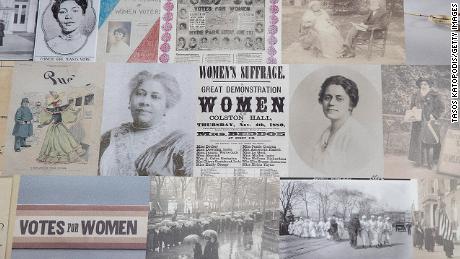
Wednesday was "Women's Equality Day" and the 100th anniversary of the 19th Amendment's certification. A century after women gained the vote, many prominent voices answered Marianne Schnall's question about what needs to be achieved by 2120.
"We must recognize gender violence as the national crisis that it is and use the franchise to ensure both our political and personal equality," wrote Anita Hill.
Melinda Gates had sobering words about what happens if progress continues at its slow pace: "it will take another 208 years to reach gender equality in the United States. That means you won't see it, I won't see it and even a little girl born a century from today won't see it in her lifetime either."
One thing is for sure: "money equals power," Billie Jean King said. "Women have not been taught to follow the money. We need to fix that and fix it now...With money comes choices and mobilization. With money comes freedom and equality."
Swanee Hunt and A'shanti F. Gholar: In the next 100 years, women may dominate US politics

Big Friendship

Authors Aminatou Sow and Ann Friedman
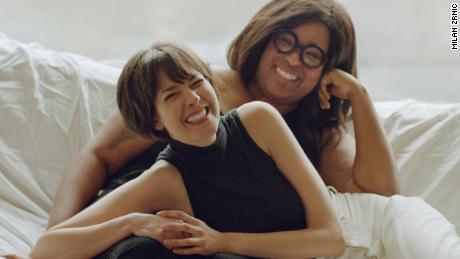
Since 2014, Aminatou Sow and Ann Friedman have hosted the popular "Call Your Girlfriend" podcast, and now they've published a book drawn from their own lives: "Big Friendship: How We Keep Each Other Close." Jane Carr spoke with the authors. "The core truth their book reveals is how none of this comes easy -- to them or to anyone else," she wrote.
A popular view is that friendship "should be effortless" and that "the grit and striving of emotional relationships is most applicable to the work of marriage, siblings and child-rearing," Carr wrote. But the authors have a more realistic approach: "Key to sustaining big friendships...is the 'stretch,' Sow and Friedman's extended metaphor for the ways that both members of a 'big friendship' have to recognize that no friendship lasts on autopilot."

Don't miss

New York City, dead or alive?

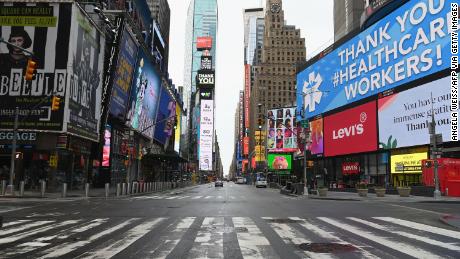
Broadway theaters are closed. Many Manhattan skyscrapers are mostly empty. Restaurants and small businesses can't pay the rent. So, it's no surprise that a piece on LinkedIn by James Altucher titled, "NYC is dead forever. Here's why," drew a lot of interest.
Jerry Seinfeld pushed back in an article for The New York Times. He disputed the idea that "New York is over because everybody will 'remote everything.' Guess what: Everyone hates to do this. Everyone. Hates... Energy, attitude and personality cannot be 'remoted' through even the best fiber optic lines. That's the whole reason many of us moved to New York in the first place."
We asked economist Jeffrey Sachs, a New Yorker, who's right.
"NYC will survive the Covid-19 pandemic, as it did the 1918-19 flu epidemic, 9/11, and other calamities," Sachs wrote. "And as Seinfeld rightly notes, so too will other great cities such as Rome, which after all first became known as the Eternal City (Roma Aeterna) in the 1st century BC."
It may take several years, but Covid-19 will subside. The world is becoming increasingly urbanized, as farms have grown more productive and need fewer workers. People prefer cities: "The services are far better, the entertainment is far more varied (Seinfeld and all), and the violent crime rates in US cities have plummeted, though with a spike this year," Sachs wrote.
That doesn't mean things will be easy for New York over the next few years, he added. The number of empty storefronts "will be staggering, indeed depressing." To keep public services running, New York will have to turn to its super-wealthy -- there were 111 billionaires living there last year.
But a drop in the cost of living will lure young people back. "Rents will go down, property prices will go down, commercial space will be converted. NYC is the place where meatpacking plants became high-end art galleries, garment factories became chic hotels, and a former railway spur became the much-beloved High Line outdoor walkway, residential and shopping area."

Let's block ads! (Why?)


"Opinion" - Google News
August 30, 2020 at 09:02PM
https://ift.tt/34M10Rx

Trump can still win this election - CNN
"Opinion" - Google News
https://ift.tt/2FkSo6m
Shoes Man Tutorial
Pos News Update
Meme Update
Korean Entertainment News
Japan News Update

Opinion: Rosenblum must end persisting injustice of nonunanimous juries - oregonlive.com

Calvin Duncan

Duncan is a first-year law student at Lewis & Clark Law School. He was on the legal team that brought Ramos v. Louisiana challenging the constitutionality of nonunanimous jury verdicts to the U.S. Supreme Court. He lives in Portland.

When I was lying on my bunk in Angola prison, the maximum-security facility in Louisiana, my dream of coming back to Oregon sustained me. I missed the parks, the hiking trails and the friendly people.

In 1982, I was 19 years old and learning the welding trade at the Job Corps program at Mt. Hood. I was planning to join the military. But someone called an anonymous tip line in New Orleans, my hometown, and said that a “negro male” with my name had committed a murder the previous year.

I spent 28 ½ years in prison for a crime I didn’t commit. When lawyers with the Innocence Project New Orleans uncovered exculpatory evidence that the prosecutors hid from my lawyers, the Louisiana Supreme Court sent the case back to the trial court. The prosecutor then offered me a deal in exchange for my release. Now, I’m back in Oregon as a first-year law student at Lewis & Clark Law School.

While I was in prison, I was paid 20 cents an hour to help other men with their legal cases. Decades ago, I spotted a legal issue that put a lot of people behind bars unfairly. Louisiana allowed defendants to be sent to prison, sometimes for life, based on jury verdicts of 10-2 or 11-1. The only other state to recognize guilty verdicts by nonunanimous juries was Oregon. I knew plenty of guys who were innocent, but had been convicted by nonunanimous juries. In any other state or the federal system, they would not have been convicted because the government failed to meet its burden of proof.

In Louisiana, the split-jury rule was adopted by a Jim Crow era constitutional convention in order to “perpetuate the supremacy of the Anglo-Saxon race,” according to official state records. In Oregon, as the U.S. Supreme Court recently observed, the “rule permitting non-unanimous verdicts can similarly be traced to the rise of the Ku Klux Klan and efforts to dilute the influence of racial, ethnic and religious minorities on Oregon juries.” As Justice Brett Kavanaugh wrote, the rule had just that effect in both states: allowing 10 jurors to “simply ignore the views of their fellow panel members of a different race or class.”

As a “jailhouse lawyer,” I filed petition after petition challenging nonunanimous juries. I lost and lost. Even after I was released, I continued trying. Finally, on my 23rd attempt, the U.S. Supreme Court agreed to address the issue, and on April 20, in Ramos v. Louisiana, the court struck down Oregon and Louisiana’s split-jury rule and said that from now on, jury verdicts must be unanimous.

The ruling was an incredible victory. But it’s incomplete. The Supreme Court ruling entitles people convicted by nonunanimous juries to a new trial untainted by racism if their case is on direct appeal – those cases in which convictions are under initial reviews by an appellate court. But when it comes to people whose cases are older, the law is murkier.

Oregon Attorney General Ellen Rosenblum appears to be taking the stance that those people are out of luck. Her office has already fought a Marion County man’s attempt to challenge his 2016 conviction by a nonunanimous jury, arguing that the Ramos decision should not apply retroactively to older cases like his. And there’s little to suggest her office will act any differently for the hundreds of other defendants in prison due to split jury verdicts who are filing their cases now.

Rosenblum’s decision means that people will languish in prison based on an unconstitutional rule that Justice Sonia Sotomayor called “racially biased” and Justice Kavanaugh called an “engine of discrimination.”

Rosenblum has the power to make this right. She can acknowledge the injustice of maintaining the nonunanimous jury verdict standard for older cases just as she has already acknowledged its injustice for cases still in the direct appeals process. As Justice Neil Gorsuch wrote in striking down nonunanimous juries, it is wrong to “perpetuate something we all know to be wrong only because we fear the consequences of being right.” If Black lives – and the lives of other minorities – matter to the attorney general, she will do the right thing and give the benefit of Ramos v. Louisiana -- a new trial -- to all of those convicted by racially tainted nonunanimous juries, even those whose cases are beyond direct appeal.

Share your opinion

Submit your essay of 500-700 words on a highly topical issue or a theme of particular relevance to the Pacific Northwest, Oregon and the Portland area to commentary@oregonian.com. Please include your email and phone number for verification.

Let's block ads! (Why?)


"Opinion" - Google News
August 30, 2020 at 08:15PM
https://ift.tt/3hGkTwM

Opinion: Rosenblum must end persisting injustice of nonunanimous juries - oregonlive.com
"Opinion" - Google News
https://ift.tt/2FkSo6m
Shoes Man Tutorial
Pos News Update
Meme Update
Korean Entertainment News
Japan News Update

Opinion: Eliminating single-family home zoning in San Jose is a bad idea - The Mercury News

San Jose Planning Commissioner Pierluigi Oliverio, makes a comment during a Planning Commission public comment session. (Nhat V. Meyer/Bay Area News Group File Photo)

The San Jose General Plan 2040 (GP2040) is the blueprint of how San Jose will grow in the future. One of the ambitious goals of GP2040 is to achieve financial solvency for the city by balancing job growth with housing growth.

For decades, San Jose has done the heavy lifting by building the majority of housing for the entire region, while neighboring cities enjoyed the benefits of this imbalance and offered little in return. This created a significant inequity between San Jose and other cities in terms of tax dollars per resident and produced a reality where San Jose struggles to provide basic city services while neighboring cities are able to provide superior services for their residents.

The current general plan has a smart growth strategy of locating new infill housing adjacent to transit and along major boulevards. San Jose consistently approves thousands of housing units, both market rate and low income, designated for these strategic parcels. The other goal of the balanced equation, job creation, necessitates we reserve commercial and industrial parcels for future development, so San Jose has a sufficient tax base without having to constantly raise taxes every two years (or in the case of 2020, twice in the same year).

While GP2040 allows for higher density development in strategic locations, it also pledges to protect single-family-home neighborhoods. When I served on the GP2040 task force for five years, I advocated for protecting established neighborhoods so higher density housing would be created where it most made sense, namely along densely populated transit corridors. This policy was supported by the former planning director, Joe Horwedel.

The current GP2040 task force has decided to renege on this pledge, however, and voted Aug. 21 to start the process of converting single-family houses into fourplexes “by right,” meaning no community meetings or hearings would be required, and a house could simply be demolished and a fourplex could be constructed in its place. This proposal would be citywide and encompass all San Jose neighborhoods. Taken a step further, allowing a four-unit complex to replace a single-family home could have an even broader impact on neighborhoods, as the same property may also have two ADU’s on site, creating six units instead of one.

Access to these units will be car dependent, since the bus system will never reach far-flung cul-de-sacs. State law does not allow cities to limit the number of cars per dwelling, thus automobiles associated with these six units would be competing for available street parking. Density where it was not planned creates chaos and conflict. Once implemented, how would we fix it? Answer: The impact would be irreversible.

When a family saved up to buy a single-family home, there was a promise made by the city in the zoning that their block would remain intact, even if San Jose continued to grow around them. These buyers did their due diligence prior to purchase and should not be forced to swallow such a drastic change to their neighborhood. This policy would result in a family being outbid on a house by a profit-motivated buyer who would stand to make significantly more money with four or six units than with a single-family house.

Instead of hurting San Jose homeowners, we should stick with the existing GP2040, which will produce housing units at a lower per-unit cost and not denigrate the unique character of single-family home neighborhoods. If proponents are confident that this is truly beneficial for a majority of city residents, then the issue should appear on a future ballot for a citywide vote.

Pierluigi Oliverio is a former San Jose City Councilman and a current San Jose Planning Commissioner. 

Let's block ads! (Why?)


"Opinion" - Google News
August 30, 2020 at 08:10PM
https://ift.tt/2G1UoUz

Opinion: Eliminating single-family home zoning in San Jose is a bad idea - The Mercury News
"Opinion" - Google News
https://ift.tt/2FkSo6m
Shoes Man Tutorial
Pos News Update
Meme Update
Korean Entertainment News
Japan News Update

OPINION: Public Health Leaders Deserve More Respect - KPBS

As a veteran who served back-to-back tours in Iraq, I initially cringed when commentators compared the COVID-19 crisis to wartime — no bullets, no blood and no one volunteered for this.

But after my months of reporting on the pandemic, it has become painfully clear this is like war. People are dying every day as a result of government decisions — and indecision — and the death toll is climbing with no end in sight.

Less than six months into the pandemic, COVID-19 has already killed at least 181,000 Americans, more than triple the number who died in the Vietnam War, and far more than the wars in Iraq and Afghanistan combined.

We are all being asked to make sacrifices for the good of our country. And we're experiencing, as a nation, a deeply traumatic event. Like war, the toll will be felt for a long time.

In California, where I live, local public health officials are leading the front lines in this battle against COVID-19, dictating strategy, issuing orders and developing tactics to carry out that strategy. Every day, they make gut-wrenching calls to protect our health and livelihoods, even if those decisions may inflict initial harm on the economy or contradict politicians and popular opinion.

But instead of being celebrated for their difficult and dangerous work, as I was, they are now facing violent threats and political attacks from those who disagree with their tactics — such as requiring masks in public and ordering businesses and parks closed to prevent the spread of infection.

When I interview them, often late at night, I hear in their voices that familiar mix of emotions that often come with war: exhaustion, anxiety and devotion to duty.

"We've become easy scapegoats for people's fear and anxiety during COVID-19," said Dr. Gail Newel, the health officer for Santa Cruz County, who continues to face threats for issuing public health orders.

The latest — a menacing email sent to her in late July calling her a "communist bitch" — prompted local law enforcement to recommend she get a guard dog and firearm to protect herself. "That weighs very heavily," she said.

I can't imagine the burden. Although many of us serving in Iraq disagreed with the war, we remained dedicated to our mission and enjoyed broad support at home.

I joined the military as a U.S. Army reservist in 1999 and was deployed on active duty to Iraq in early 2003, when it truly was like the Wild West.

Serving first as logistics clerk and then the acting supply sergeant for a military police company out of San Jose, Calif., I helped ensure my military brothers and sisters had proper equipment. When the George W. Bush administration sent us to Iraq, for example, it did so without armoring our Humvees — a major failure that elevated our risk of being blown up by roadside explosives.

I returned home in July 2004 and spent years putting the battlefield behind me as I transitioned to a career in journalism. But living through COVID-19 has resurrected those feelings of being at war.

Now, just like then, there is an overall sense of fear and uncertainty because we don't know when the crisis will end. We aren't free to go about our lives as we once did and we yearn for the comforts we took for granted. We miss our loved ones we can't see.

We must remain hypervigilant to potential threats, and even make sure to don our "armor" when we leave our homes — except now it's masks and gloves instead of helmets and flak jackets.

There's something that happens when you're in a conflict zone — the air feels heavier. You can feel threats all around you, just waiting to strike. There's deep anxiety for what the future holds, and you wonder whether you'll be alive next week or next month.

Public health officers are shouldering the added anxiety that duty brings. For much of the pandemic, elected leaders have pushed responsibility — and blame — of reopening largely onto health officers in counties and states, who have worked for months without days off, giving up time with their families to attack this crisis head-on.

I have interviewed dozens of these local and county health officers in California. Some have broken into tears while talking with me, and worry chokes their voices as they lament problems with testing or explain how they don't have enough supplies or contact tracers to safely reopen. They felt rushed into lifting stay-at-home restrictions in May and June, yet they had no choice in the face of pressure from politicians and suffering residents and businesses. After years of severe underfunding, public health agencies don't have the money or resources to deploy an adequate response.

They're also wrestling with the guilt and trauma that come with making decisions that affect people's lives and livelihoods.

"It has been hard on all of us," acknowledged Sacramento County's health officer, Dr. Olivia Kasirye. "We're getting phone calls daily from people saying they're going bankrupt and they can't pay their rent and they have loved ones who are dying that they can't see."

I know how that feels, having been conflicted about our long-term strategy in the Middle East and the harm we inadvertently inflicted on innocent civilians. But I can't imagine being afraid of the people I signed up to protect.

Public health officials have become targets of aggressive and personal attacks. Some have seen their photos smeared with Hitler mustaches, while others have had their personal phone numbers and home addresses circulated publicly, prompting the need for round-the-clock security.

"Imagine treating American soldiers and military families with the kind of hatred and disrespect that local health officers are facing," said Dr. Charity Dean, unprompted, a day after she left her job as one of the top public health officials in Gov. Gavin Newsom's administration. "They're the ones taking all the risk, and it makes me angry to see how they've been treated."

Since the start of the pandemic, at least eight career public health officials in California have resigned, and more are considering it. But most are soldiering on.

Mimi Hall, Newel's boss and Santa Cruz County's top public health official, told me law enforcement is investigating a threatening letter addressed to her that was allegedly signed by a far-right anti-government extremist group.

In response, Hall considered retiring early. But she didn't want to abandon her troops and wasn't going to let fear stop her from doing her job. So she had a perimeter fence and home security system installed over the weekend — and reported for work promptly Monday morning.

Yes, we are waging a life-or-death battle in which innocent people are hurt, but it's these battle-scarred public health officers who are making deeply personal sacrifices to steer us to safety.

We commemorate military leaders with medals and parades. Why not treat our public health officials with the same level of appreciation?

This story was produced by Kaiser Health News, which publishes California Healthline, an editorially independent service of the California Health Care Foundation. KHN is not affiliated with Kaiser Permanente.

Angela Hart, correspondent for California Healthline, covers California health politics and policy in Sacramento and around the state.

Copyright 2020 Kaiser Health News. To see more, visit Kaiser Health News.

FEATURED PODCAST

San Diego News Matters podcast branding

KPBS' daily news podcast covering local politics, education, health, environment, the border and more. New episodes are ready weekday mornings so you can listen on your morning commute.

Curious San Diego banner

To view PDF documents, Download Acrobat Reader.

Let's block ads! (Why?)


"Opinion" - Google News
August 30, 2020 at 06:08PM
https://ift.tt/2QyO3lI

OPINION: Public Health Leaders Deserve More Respect - KPBS
"Opinion" - Google News
https://ift.tt/2FkSo6m
Shoes Man Tutorial
Pos News Update
Meme Update
Korean Entertainment News
Japan News Update

OUR OPINION: Youth in the region benefit from event's success - Northeast Mississippi Daily Journal

This year has been challenging on so many levels, but we are encouraged to see the efforts and donations made to Boys & Girls Clubs of North Mississippi.

The annual Dance Like the Stars event has become popular in its 15 years. Even with a global pandemic, fewer participants and the switch to a virtual event, this year’s seven dancers raised over $259,000 dollars for clubs across the region. This year’s grand champion, Lisa Settlemires of Ripley, raised $54,608 alone, and runner-up Lindsey Chaney of Tupelo wasn’t far behind, raising $54,265.

The decision was made to have fewer participants in this year’s event because of COVID-19 and to limit the number of people at the BancorpSouth Arena. This year’s event had a smaller pool of volunteers and less time to prepare. Despite all of this, six of the seven dancers raised over $20,000.

This money will go a long way to help Boys & Girls Clubs with its summer programs and help purchase extra supplies needed because of COVID-19.

The clubs in our region serve over 2,000 youth with locations in Tupelo, Oxford, Ripley and New Albany. We applaud the efforts of everyone involved to step up and continue to support this organization. It is important to remember these groups, even in the toughest of times, because this is when they need our support the most.

It’s clear from the success of this year’s event, this will continue to benefit children in our region for years to come.

Let's block ads! (Why?)


"Opinion" - Google News
August 30, 2020 at 04:00PM
https://ift.tt/3gGvKWq

OUR OPINION: Youth in the region benefit from event's success - Northeast Mississippi Daily Journal
"Opinion" - Google News
https://ift.tt/2FkSo6m
Shoes Man Tutorial
Pos News Update
Meme Update
Korean Entertainment News
Japan News Update

Search

Featured Post

I just paid $9.99 for a carton of 18 eggs. Will prices ever drop? | Opinion - Sacramento Bee

[unable to retrieve full-text content] I just paid $9.99 for a carton of 18 eggs. Will prices ever drop? | Opinion    Sacramento Bee ...

Postingan Populer