Rechercher dans ce blog

Thursday, November 26, 2020

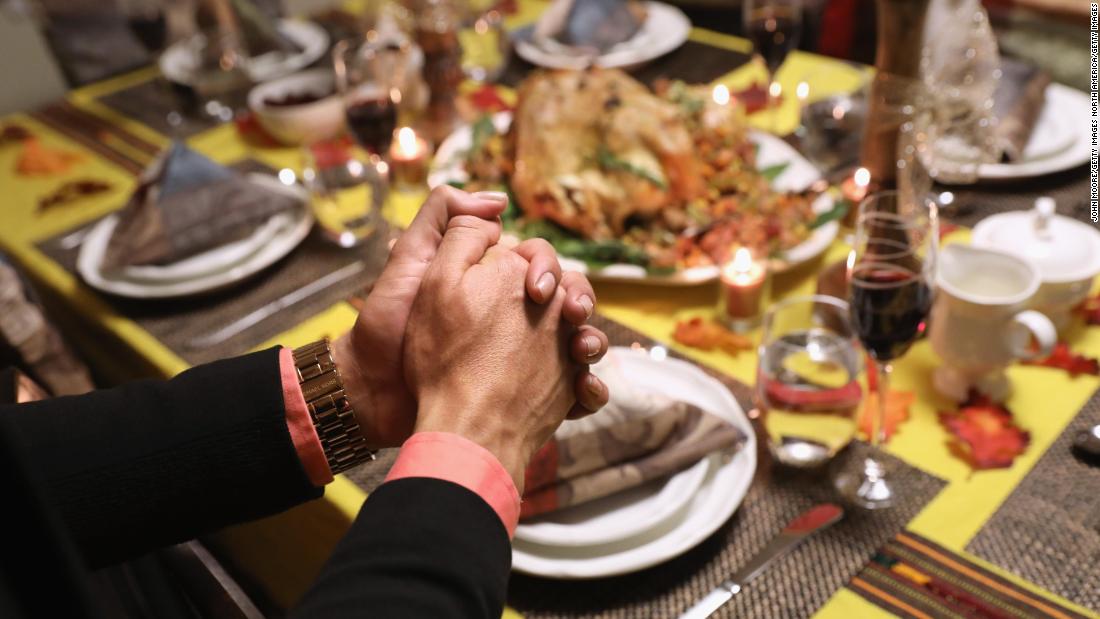
Here's a cheat sheet for Thanksgiving's inevitable politics talk - CNN

Let's face it: There is a lot of lingering bad blood between family members and friends after four years of President Donald Trump. When we should be turning the page after a hard-fought political contest, some 68% of Republicans roughly a fifth of all Americans -- seem to have bought into the baseless lie that the election was "rigged." Now, Thanksgiving itself has been turned into a culture war battle cry against the backdrop of an escalating pandemic.
Good people can, of course, disagree about politics. But refusing to recognize the results of a not particularly close democratic election is well beyond politics as usual in America. In some conversations with friends and family, finding common ground rooted in shared facts requires the civic equivalent of landing a triple axel at the Olympics. After all, how do you reason someone out of something that they weren't reasoned into?
For the sake of your loved ones and society, I'd hope that most of you are choosing to follow CDC guidelines and spend the holiday at home with few, if any, extended family members. But even that's no guarantee of a politics-free holiday -- and family Zooms can also degenerate quickly. So, as a cheat sheet to counter deeply held disinformation, here are some baseline facts that could come in handy:
Joe Biden won the election with more than 80 million votes -- the most ever. His 306 electoral vote total is the same number that Donald Trump declared a "landslide" four years ago, when he lost the popular vote by a then-unprecedented nearly 2.9 million votes. This time, he lost the popular vote by more than 6 million.
As for conspiracy theories about stolen votes, national, state and private election officials, including Trump administration security staffers, stated that the "election was the most secure in American history" with "no evidence that any voting system deleted or lost votes, changed votes, or was in any way compromised."
When it comes to evidence, the Trump legal team has lost or withdrawn from at least 30 court cases since the election, with one Republican federal judge in Pennsylvania dismissing the campaign's claims stating: "(T)his Court has been presented with strained legal arguments without merit and speculative accusations, unpled in the operative complaint and unsupported by evidence." If that sounds harsh, consider that eight of Trump's biggest lies have been verified when submitted to investigation by Republicans in Congress or the Trump Justice Department.
But facts only go so far with folks who believe that Trump -- who's been caught in more than 20,000 "false or misleading claims," according to the Washington Post -- is the only person telling the truth. Polarization and conflict increase groupthink. What we're dealing with in some cases is a belief system that is beyond reason -- and what are you supposed to do with that in conversation? It's hard to just nod along when the subject is QAnon.
In search for answers, I spoke to Steve Hassan, a leading cult-deprogrammer and author of "The Cult of Trump." Before you get up in arms, I'm not saying that Trump supporters are members of a cult -- but Hassan does have some insights from his work that could be useful in finding a way to reason together when arguments seem beyond reason.
As a young honors student, Hassan fell under the sway of the Moonies, formally called the Unification Church that many critics liken to a cult, and was convinced to fast during Watergate because God wanted Richard Nixon to remain President. Hassan counsels that his work is not focused on "people who are just stone-cold pragmatists" about Trump but "people who are actually true believers." Among those folks, "what doesn't work is a direct attack on the leader, the doctrine, or the group ... that digs people's heels in."
Extreme political polarization amounts to indoctrination, but Hassan believes that "the cure to unethical influence is ethical influence" -- and that involves a process of listening to a person respectfully and gently reminding them of once deep-seated values and principles, drawing out implicit parallels where indoctrination has obscured objective truth.
In Hassan's practice, this process takes days -- there is not a single conversation quick fix. For the purposes of this exercise, let's use members of Trump's legal team as examples.
Rudy Giuliani used to say that "to be locked into partisan politics doesn't permit you to think clearly." He used to condemn Pat Buchanan's paleo-conservative populism as dangerous, which is the closest analogue to what Donald Trump advances in the political arena. And as a one-time legendary US attorney, he deeply believes in the law as a search for the truth. Discussing those principles -- with respect and separate from the current controversies -- might help depolarize the conversation.
In the case of Trump lawyer Jenna Ellis, who is very vocal about her Christian faith, a conversation about the Sermon on the Mount might eventually cause her to reflect on whether accusing Republican pollster Frank Luntz of having a "micro-penis" is what Jesus would have done. Or you could work toward asking her what she meant when she called Trump an "idiot" in 2016 and slammed his base for not caring about "facts or logic."
A key point of depolarizing conversations is to help folks feel heard while finding common ground. The goal is not to achieve an instant conversion but instead to begin communication that breaks down the walls that keep people in separate realities buffeted by "alternative facts."
"If I had one bullhorn," says Hassan, "I'd say to everybody, 'Reach out to your loved ones who believe in Trump, your friends and family members, and stop calling them names and stop trying to win arguments, and remember the good old days and even agree not to talk politics for a while until you rekindle the warmth in your relationship.'"
That's good advice for any Thanksgiving, consistent with the civic purposes of the holiday as proclaimed by President Abraham Lincoln during the Civil War: "(T)o heal the wounds of the nation and to restore it as soon as may be consistent with the Divine purposes to the full enjoyment of peace, harmony, tranquility and Union."

Let's block ads! (Why?)


"Opinion" - Google News
November 26, 2020 at 11:38PM
https://ift.tt/3mgc3bC

Here's a cheat sheet for Thanksgiving's inevitable politics talk - CNN
"Opinion" - Google News
https://ift.tt/2FkSo6m
Shoes Man Tutorial
Pos News Update
Meme Update
Korean Entertainment News
Japan News Update

Opinion: A better COVID-19 prevention strategy - The Detroit News

The reason we know it's about to get better - CNN

Optimism has long been one of the distinguishing features of the United States and its people. That sunny disposition clouded over for at least half the country after Donald Trump won the presidency four years ago. That era is now coming to an end, but not before converging with the most catastrophic public health crisis in a century.
Is it reasonable now for those of us who found the Trump presidency abhorrent to rekindle our optimism?
First, a confession: as much as I have written about the dangers posed by Trump, I spent the past four years telling my most pessimistic friends that I remained convinced American democracy, with its deep roots, would survive Trump's onslaught. Another confession: I had more doubts than I let on.
Now, like so many others, I find it exhilarating to hear President-elect Joe Biden address the country's challenges with the seriousness they deserve. Undoubtedly, he and his team will make mistakes. But the essence of those errors will be different. We're getting rid of a President who entered the office drenched in conflicts of interest; who surrounded himself with figures of questionable competence and brittle ethics.
Biden's first cabinet choices bring qualified, decent, respected public servants back into government. After an administration that slammed America's door to refugees, that separated migrant children from their parents and put them in cages, we will have a Department of Homeland Security, responsible for guarding the borders, led by a man who came to the United States as a refugee. Alejandro Mayorkas, a Cuban-born Jew, fled the communist dictatorship as an infant with his family. His mother's family had fled the Holocaust.
The President who became an idol to White supremacists, who found "very fine people on both sides" in clashes between protesters flashing Nazi salutes and chanting "Jews will not replace us" and those declaring that America stands against prejudice, is being succeeded by one who is bringing in capable public servants of all ethnicities and backgrounds into government. While Trump once made a cringeworthy spectacle of having his cabinet, one at a time, praise him on live television, Biden is nominating a director of national intelligence, Avril Haines, who announced to him and the world, that she will disagree with him and "speak truth to power."
After turning its back on much of the world and seeing America's standing collapse, the Biden team is telling US allies, "America is back!"
From Trump's inaugural "American carnage" speech, and his relentless attacks on anyone who disagreed with him, we're transitioning to Biden's faith in America, his "There's nothing we can't do if we do it together" creed, with his focus on bringing the country together. "We have to stop treating our opponents as enemies," he insists, urging Americans to listen to each other.
Biden's choices are causing celebration even on Wall Street, where Trump's reluctant decision to let the transition proceed sparked a huge market rally.
But it's too soon for Champagne. The Dow Jones hitting a record 30,000 (a "sacred number" Trump called it as he tried to take credit for it) is occurring at the same time that Americans wait in endless lines for food donations. Hunger is spreading in America.
Have we ever had good news and bad mix in such a swirl of tragedy and optimism?
As the pandemic rages out of control -- almost 13 million cases in the United States, thousands dying day after day -- three vaccines hold the promise of easing the pandemic. The virus is expected to kill hundreds of thousands more Americans before that day arrives, it will break millions of hearts before this pandemic nightmare, so outrageously mishandled by this President, finally moves into history.
Yet, Trump and his accomplices continue to spread the poison of disinformation, even as Biden responds with an almost superhuman lack of rancor. The payoff remains elusive. Republican Sen. Marco Rubio already disparaged Biden's cabinet choices as "caretakers of America's decline." There's no Kumbaya moment on the cards.
American democracy survived four years of Trump. It survived Trump's attempt to overturn the election results, but the battle is not over. As former President Barack Obama told The Atlantic, Trump is a symptom. "I'm not surprised that somebody like Trump could get traction in our political life."
The hostility could make the environment ripe for another right-wing populist. Trump himself may try to make a comeback in 2024. When we can't agree on facts, when lies and disinformation are so hard to tell apart, it's all but impossible to agree on a path forward. Obama called it "an epistemological crisis."
Yes, Biden won. But he will govern a deeply divided country; one flooded with weapons, drowning in lies, riled by a self-serving master manipulator of public opinion with a cultlike hold on millions of followers.
Does that make it too soon to be optimistic? No. The worst is almost over.
American democracy just survived what is arguably the most vicious attack it has ever faced. The American system held up. The American people, voters, patriotic public servants, made it happen. What could be a greater cause for optimism about the future?

Let's block ads! (Why?)


"Opinion" - Google News
November 26, 2020 at 10:34AM
https://ift.tt/2Ji8u68

The reason we know it's about to get better - CNN
"Opinion" - Google News
https://ift.tt/2FkSo6m
Shoes Man Tutorial
Pos News Update
Meme Update
Korean Entertainment News
Japan News Update

Wednesday, November 25, 2020

Mark Franke: What happened to political discourse? - Daily Journal

israelob.blogspot.com

When did we as Americans plunge into the abyss of demonizing everyone with whom we disagree?

It wasn’t this way for the first 30 years of my life. Some of the most fulfilling times of my undergraduate days were spent debating philosophy, religion and politics with friends of what was then the left wing. At least that beat spending time at the library.

We would fight it out at student government meetings and then repair to a local establishment with a rather casual attitude about Indiana liquor laws. We never thought of each other as evil or stupid, just misguided, and well worth the time spent in intensive debate.

Not so anymore.

Looking backward, my best guess as to when we began this descent into intolerance was the Robert Bork confirmation hearings for the Supreme Court. He was opposed, and they made no secret about it, purely on political lines. The man was brilliant and would have left an intellectual mark on the Court as no one since, except possibly for Clarence Thomas. Yet the Senate Democrats “borked” him, as this maneuver came to be known. Most court nominees since then, and certainly all put forth by Republican presidents, have faced either the threat of or the experience of being borked. Witness Brett Kavanaugh.

I’ve noticed this trend even among friends who otherwise are kind, reasonable people. This developed in my conservative circle of friends during the Obama years as his initiatives and pronouncements were judged based on the man without serious examination of their value. His motivation could never be pure so his proposals were to be opposed.

And then came Donald Trump.

It never seemed to matter what he said; it had to be opposed vociferously. After all he was “illegitimate” and totally evil. I’m not speaking only of the Washington politicians or East coast media, who have lost all credibility with most of us in fly-over land.

It was the opinion of progressives everywhere who preached this as an article of faith. The irony of this rabid opposition was that someone as personally despicable as Donald Trump could garner so many votes. If the elitists are reduced to slavering rage at the merest mention of his name, we deplorables conclude there must be something good hidden behind the bluster and verbal bullying.

Just look at the recent Pfizer announcement of an effective antidote to COVID. Immediately its efficacy was challenged by some of the usual suspects just because Trump trumpeted it (pun intended). Gov. Andrew Cuomo of New York, at once both the darling of the media for his non-Trump pandemic response while being the governor with about the worst virus track record in the nation, is against it for reasons that are at best obscure. If Trump says it is good, then it is perforce bad. Period.

What is it that has so corrupted us?

An op-ed in the Wall Street Journal instructs us that this phenomenon was first popularized by an inter-war psychoanalyst named Melanie Klein. In layman’s terms, Klein described how we humans “split off” intolerable thoughts inconsistent with our prejudices. If we view someone as evil, he or she must be thoroughly evil and any redeeming qualities must be split off. Likewise, those we adore must have any deficiencies split off so as to not affect their pure goodness.

Klein posited that this keeps the world neat in the short term but leads to distorted reality and warps responses to the real world. To quote the article’s author Andrew Hartz: “It makes conversation difficult [and] impairs relationships.”

No kidding.

So the next time you are enduring a rant by someone from the other side, first take the time to do an honest introspection of any rants you may have delivered previously. If conscience gives you a pass, feel free to tell them they are “splitting.”

And then you probably should split, in the hippie sense of the word. The discussion won’t be getting friendlier any time soon.

Let's block ads! (Why?)


"discourse" - Google News
November 25, 2020 at 01:43PM
https://ift.tt/37bGLfB

Mark Franke: What happened to political discourse? - Daily Journal
"discourse" - Google News
https://ift.tt/2KZL2bm
https://ift.tt/2z7DUH4

Tuesday, November 24, 2020

What Facebook Fed the Baby Boomers - The New York Times

In mid-October I asked two people I’d never met to give me their Facebook account passwords for three weeks leading up to and after Election Day. I wanted to immerse myself in the feeds of a type of person who has become a trope of sorts in our national discussion about politics and disinformation: baby boomers with an attachment to polarizing social media.

I went looking for older Americans — not full-blown conspiracy theorists, trolls or partisan activists — whose news consumption has increased sharply in the last few years on Facebook. Neither of the two people I settled on described themselves as partisans. Both used to identify as conservatives slowly drifting leftward until Donald Trump’s takeover of the Republican Party offered a final push. Both voted for Joe Biden this year in part because of his promise to reach across the aisle. Both bemoaned the toxicity of our current politics.

Every day, Jim Young, 62, opens up his Facebook app and heads into an information hellscape. His news feed is a dizzying mix of mundane middle-class American life and high-octane propaganda. Here’s a sample:

A set of adoring grandparents posing with rosy-cheeked babies. “Mimi and Pop Pop’s first visit since March,” the post reads.

Next, a meme of Joe Biden next to a photoshopped “for sale” sign. “For more information contact Hunter,” the sign reads.

After that is a post advertising a “Funny rude” metal sign displaying a unicorn in a tutu giving the middle finger. “Thought of you,” the post reads.

Below that is a screenshot of a meme created by the pro-Trump group Turning Points USA. “Your city on socialism,” the post reads, displaying a series of photos of abandoned buildings, empty grocery store shelves and bleeding men in makeshift, dirty hospital beds.

Note: Names and images have been blurred. Some photographs have been replaced to protect the user’s privacy. Photos: Getty Images

The feed goes on like this — an infinite scroll of content without context. Touching family moments are interspersed with Bible quotes that look like Hallmark cards, hyperpartisan fearmongering and conspiratorial misinformation. Mr. Young’s news feed is, in a word, a nightmare. I know because I spent the last three weeks living inside it.

Despite Facebook’s reputation as a leading source for conspiracy theories and misinformation, what goes on in most average Americans’ news feeds is nearly impossible for outsiders to observe. Tools like CrowdTangle, which track “engagements” with social media posts, are the best available means to understand what is popular on the platform, though Facebook (which owns the CrowdTangle) argues that CrowdTangle is not a reliable indicator for how many people saw a post.

After years of reading about the ways that Facebook is radicalizing and polarizing people I wanted to see it for myself — not in the aggregate, but up close and over time. What I observed is a platform that gathered our past and present friendships, colleagues, acquaintances and hobbies and slowly turned them into primary news sources. And made us miserable in the process.

In February, Mr. Young sold his small business and moved from Missouri to just outside Phoenix. The plan was to ease his way into semiretirement. A week later, the coronavirus pandemic ground his life to a halt. That’s when his time on Facebook began to skyrocket.

“It got to the point where I literally had to start leaving my phone in the other room,” he told me recently. “The problem is mostly that I don’t have anything to do.”

Mr. Young joined Facebook in 2008 as a way to reconnect with his high school classmates from Illinois. He reunited quickly with old friends and neighbors. It was exciting to see how people had changed. Occasionally, he’d get tagged in an old photo or his news feed would surface an old memory from his classic rock cover band, Archive.

It was a little voyeuristic, nostalgic and harmless fun. Before 2016, Mr. Young told me, he’d see the occasional heated disagreement. It wasn’t until the last few years that his feed really started to turn divisive.

He first noticed it in the comments, where discussions that would usually end in some version of “agree to disagree” exploded into drawn-out, conspiratorial comment threads. Political disagreements started to read like dispatches from an alternate reality. He didn’t enjoy fact-checking his friends or picking fights, but when a post appeared obviously untrue he had to say something.

His time on the site ticked upward.

“It’s like going by a car wreck. You don’t want to look, but you have to,” he said. He believes his feed is a perfect storm for conflict in part because he’s lived in both liberal and conservative areas of the country and throughout his life he’s lived, worked with and befriended all manner of liberals and conservatives. “I started referring to Facebook as my Hatfield and McCoy feed and laughed it off,” he told me, referencing the infamous family feud.

But then he noticed some of his friends start to post more political memes, often with no link or citation. When he’d try to verify one, he’d realize the post was fake or debunked by a news site. “Most times there’s no real debate. Just anger. They’re so closed-minded. Sometimes, it scares me.”

Scrolling through Mr. Young’s feed after Election Day, I found a number of these posts.

Many examples of misinformation came from Facebook text posts created and shared by Mr. Young’s friends repeating baseless voter-fraud claims. This one claims the number of votes in Wisconsin exceeded the number of registered voters (with no links to these numbers or any authoritative news source).

On Nov. 5, one of Mr. Young’s friends posted about “something fishy” alongside a link to a Bing search. The link returned a page of information about voters having ballots thrown out after using Sharpies to fill them out, including a link to a Facebook post on #Sharpiegate with over 137,000 shares.

One featured a screenshot from a Fox 2 Detroit news broadcast with the banner “Detroit Voter Roll Lawsuit.” The screenshot alleged potential voter fraud. “And so it begins!” the friend wrote.According to a Snopes debunk, the segment actually aired in December 2019 and had nothing to do with the 2020 election.

Another text post suggested that people shouldn’t trust Facebook’s fact checkers. “When the fact checkers are controlled by the same people doing the lying, what do you call it?” the post read. Below, commenters sounded off. “Democrats,” one exclaimed. “Satan,” another offered.

Note: Names and images have been blurred.

Mr. Young’s feed stood in stark contrast to the other Facebook account I spent time in. That feed belongs to Karen Pierce, a 55-year-old schoolteacher from Virginia. Ms. Pierce described herself to me as a “middle-child peacekeeper who is uncomfortable with politics.”

Unlike Mr. Young, she is not politically active on Facebook and never intervenes, even when she sees things she thinks might be conspiratorial or fake. As a result, her feed surfaced less politically charged content. The day after the election, the first post I noticed from a friend in her feed was a simple, apolitical exclamation: “It’s official! I make a damn good pot of stew!”

The political posts that appeared in Ms. Pierce’s feed were mostly anodyne statements of support for the Biden-Harris campaign peppered in between comments from fellow teachers frustrated by remote learning and an avalanche of cute dog photos and memes. Occasionally, a meme popped up mentioning Hunter Biden’s laptop, but most lacked the vitriol or the contentious commenter debates of Mr. Young’s feed.

Yet, in my conversations with Ms. Pierce over the last month, she expressed just as much frustration with her experience on Facebook as Mr. Young. “It’s so extreme,” she told me in mid-October. “I’ve watched people go from debating the issue to coming up with the craziest thing they can say to get attention. Take the whole anti-abortion debate. People started talking, then started saying ‘if you vote for Biden you’re a murderer.’ Now there’s people posting graphic pictures of fetuses.”

Credit...Aaron Wojack for The New York Times

When I told her I hadn’t seen anything that extreme on her page, she suggested it was because of a three-month break she took from the platform this summer. “It got to be too much with the pandemic and the politics,” she said. The final straw was seeing people in her feed post QAnon adjacent memes and content. “There was a lot of calling Biden a pedophile. Or Trump voters posting pictures with assault rifles. It made me very uncomfortable.”

Like millions of Americans, Ms. Pierce logs onto Facebook to feel more connected. “I use it to see how people are doing,” she said. “I believe in prayer and sometimes I check to see who is struggling and to see who to pray for. And then, of course, you see some news and read some articles.”

It was when she was using the platform for news that she started seeing disturbing, conspiracy posts from people in her network. “It was so disappointing to realize the hate that’s out there,” she said. “I think that, whatever you believe is your right. I hate the negativity and meanness. Even worse is seeing somebody you think you know say something they wouldn’t normally say.”

She’s worried about the long-term effects of such a toxic environment. “I think it’s affecting the mood of everybody.”


Living inside the Facebook account of strangers — even with their permission — feels invasive, like poking around in their medicine cabinet. But it offered me a unique perspective. Two things stood out. The first is the problem of comments, where strangers, even in the most mundane of articles, launched into intense, acrimonious infighting. In most cases, commenters bypassed argumentation for convenient name-calling or escalated a civil discussion by posting contextless claims with no links or source. In many cases, it appeared that a post from one user would get shared by a friend into his or her network, where it would be brigaded by strangers.

The more I scrolled through them, the more comments felt like a central and intractable issue. Unlike links to outside articles, comments aren’t subject to third-party fact checks or outside moderation. They are largely invisible to those people who study or attempt to police the platform.

Yet in my experience they were a primary source of debunked claims, harassment and divisive rhetoric. I showed one comment thread to a colleague who doesn’t use Facebook and my colleague found it shocking. “Facebook created a town hall for fighting,” they said. “It’s almost like if you were building a machine to make a country divisive and extreme — if you were to sit down and plan what that would look like —- it would be this.”

But Facebook wasn’t originally built this way, it evolved intentionally. And that evolution, from a friendly social networking site into the world’s largest information platform, is the source of its biggest problems.

Sifting through Mr. Young and Ms. Pierce’s feeds and talking to them about what I saw, it became clear that the two found themselves tormented as a result of decisions they made in their early days on the platform. Both explained that they joined to reconnect with old friends.

Like most of us, they gave little thought to the connections they made. Mr. Young added friends he hadn’t spoken to in decades. When Ms. Pierce joined a nonprofit organization she accepted dozens of friend requests — some from people she’d met only in passing. “I meet people on airplanes all the time and we exchange Facebook handles,” she told me.

But as Facebook evolved, these weak connections became unlikely information nodes. Mr. Young and Ms. Pierce were now getting their commentary from people they hardly knew, whose politics had once been unknown or illegible.

“When Facebook first started it made me feel so good. It feels like I signed up for one thing and it’s become something totally different,” Ms. Pierce said.

It’s a detail that’s often lost in the discussion around baby boomers and Facebook, which can sometimes unfairly malign the generation as clueless dupes and vectors for disinformation.

Joan Donovan, the research director of the Shorenstein Center on Media, Politics and Public Policy at Harvard’s Kennedy School, described this phenomenon as what happens when “social-networking sites transformed into social media,” creating “a digital economy built on engagement.” Dr. Donovan argues that this decision spawned the algorithmic echo chambers we now live in and created a fertile environment for our information crisis.

For Mr. Young, the fallout of these decisions is painful. After weeks of watching his feed, I presented him with some of the most notorious posters in his feed. When I read aloud the name of one Facebook friend who constantly shared debunked claims, often with language intended to provoke, he sighed. He described the person as a longtime friend and neighbor who was once so close they practically lived at each other’s houses. Now, he spends his time debating whether it’s worth the energy to stop the friend from sharing conspiracy theories.

“I still love this person,” he said. “We could get together, I hope, and tip back a few drinks. But almost overnight I was like, ‘what happened to them? Who is this person?’ It’s made me so sad for the last year or two. They’ve fallen into almost a trance. I’m so disappointed by it.”

The psychological toll of watching friends lose touch with reality has both Mr. Young and Ms. Pierce re-evaluating their choice to spend so much time on the platform. Mr. Young, for his part, tried to stay off during election week; Ms. Pierce is heartened that her feed has become less toxic after her Facebook sabbatical and is planning another. “My emotional and mental state improves greatly the further away I get from this place,” she told me.

Even if both manage to stay away from Facebook for good, their stories are just two in a sea of billions. No story is the same because no feed is the same. And yet these same dynamics that tortured my two participants — a sea of contextless news and acrimonious comments revealing their neighbors’ worst selves — are on display for millions of Americans every day.

That thought bounced around my head this month as the election returns trickled in, revealing in unmistakable detail the footprint of a divided nation. For those expecting or at least hoping to see broad consensus, the results were a gut punch. It's difficult to imagine that a significant number of Americans see the world through different eyes and, in many cases, are constructing an alternate reality. It’s confounding to pundits, pollsters and our neighbors alike.

But seen through the lens of our online lives, such an outcome makes perfect sense. While it is uniquely difficult to map or quantify, what is impossible to ignore is that how we behave on platforms like Facebook shapes and reflects a core expression of our identities.

Ben Collins, an NBC News reporter who covers disinformation and online extremism, argued recently that one takeaway from our recent election ought to be that it’s “well past the time to start realizing that what people say on Facebook and in comments sections is what they actually mean.” The fights, the jokes and the memes are all an expression of legitimate feelings — all the more authentic because, unlike getting a call from a pollster or talking to a reporter, we often feel as though nobody’s watching.

Despite spending years studying these toxic dynamics and the better part of a month watching them up close in strangers’ feeds, I was still, like so many, surprised to see it all reflected at the ballot box. We shouldn’t have been surprised; our divisions have been in front of our faces and inside our feeds this whole time.

The Times is committed to publishing a diversity of letters to the editor. We’d like to hear what you think about this or any of our articles. Here are some tips. And here’s our email: letters@nytimes.com.

Follow The New York Times Opinion section on Facebook, Twitter (@NYTopinion) and Instagram.

Let's block ads! (Why?)


"Opinion" - Google News
November 25, 2020 at 05:53AM
https://ift.tt/3pUUIad

What Facebook Fed the Baby Boomers - The New York Times
"Opinion" - Google News
https://ift.tt/2FkSo6m
Shoes Man Tutorial
Pos News Update
Meme Update
Korean Entertainment News
Japan News Update

Political Discourse and the 2020 US Election - Harvard Law Today - Harvard Law School News

israelob.blogspot.com

More than a year before the U.S. presidential election, a team of researchers from the Berkman Klein Center for Internet & Society joined forces to study and map political media coverage. In the months leading up to the election, they tracked and analyzed significant topics, including the politicization of the pandemic and false claims about mail-in voter fraud. 

Led by Yochai Benkler and Rob Faris, the team followed political discourse online, uncovering media strategies and shedding light on the media ecosystem in the United States. Benkler, the Berkman Professor of Entrepreneurial Legal Studies and co-director of BKC, and Faris, a senior researcher at the Shorenstein Center on Media, Politics, and Public Policy, spoke about their work at a recent event moderated by Jasmine McNealy, a faculty associate at BKC and associate professor at the University of Florida‘s College of Journalism and Communications.

The team’s studies are grounded in their previous work on the 2016 election, which showed using linking patterns between online news sources that media sources from the right exist in a cluster, isolated from the media outlets from the center and left. The resulting network structure illustrates asymmetric polarization in the U.S. media ecosystem. Their book, “Network Propaganda,” written with Hal Roberts, highlighted how the outlets from the center and left follow traditional journalistic norms and fact-checking, but outlets from the right do not follow those same norms. 

Network map with different colored dots representing media outlets.

Network map based on links between media outlets. Red dots represent outlets from the right; pink is center-right; green is center; light blue is center-left; and dark blue is left.

Using more recent data from Media Cloud, an open-source tool for media analysis, and data from Facebook and Twitter, they show that this dynamic persisted and formed the backdrop of the 2020 election. They also found that mainstream media continue to play an important role in political discourse. Their reports thus far provide a comprehensive analysis of political discourse starting in January and running through May, and a separate study on disinformation about mail-in voting fraud.

Mail-in voter fraud propaganda is elite-driven through mainstream media. It’s not just Trump. It is a partisan strategy designed to prevent and suppress the vote.

Yochai Benkler

Faris summarized some of the main strategies from the right-wing media during the early months of the year: “One is to divert attention to news that is more favorable to your side in the face of bad news. Another is to rebut and reframe negative coverage coming from the center and center-left. Another is to discredit sources of negative information, whether it be individuals or institutions,” he said.

One difference between the 2020 election and the 2016 election is the mainstream media‘s response to efforts from the right to spread and frame narratives, Faris explained. “In 2016, as we documented in ‘Network Propaganda,’ the right-wing media and conservative activists had a lot of success in setting the agenda across the media ecosystem. First looks—particularly related to impeachment and Hunter Biden and the Ukraine conspiracy—suggest this is no longer true, at least not to the same extent in 2020, that mainstream media was much more wary of picking up the talking points coming from the right.” 

In their analysis of media coverage specifically about mail-in voter fraud, they showed that the spread of disinformation was primarily top-down and was abetted by mainstream media and Republican elites. 

“Mail-in voter fraud propaganda is elite-driven through mainstream media. It’s not just Trump,” Benkler said. “It is a partisan strategy designed to prevent and suppress the vote. It is supported on the most highly trusted news media; Sean Hannity on the right, by the chair of the Senate Judiciary Committee, by the Senate Majority Leader. What we’re seeing is a much more traditional propaganda system where a major party is engaged in false disinformation, combining it with institutional actions to suppress and depress the vote in critical states in order to overcome their basic electoral limitation.”

Since mainstream media plays such a central role in their findings, McNealy asked Faris and Benkler, “What does it mean for the mainstream media—and particularly for newsroom patterns or newsroom culture—and professional journalists working in this space covering all of the related campaign and extra campaign kinds of information and possible propaganda?”

“It turns out to be extremely difficult for newsrooms to adapt their behavior. They’re used to following the flashy headline. They’re used to trying to attract people to read them. They’re used to being balanced. It’s much easier to say, ‘it’s a partisan debate’ than to say ‘this side is lying, that isn’t and we’re not being partisan, we’re just telling you the truth,’” said Benkler, who also wrote an op-ed for NiemanLab about responsible reporting. “There’s a real need for reassessing the role of the editor for not separating out fact-checking from the main reporting but actually putting the fact-checking in the headline, in the lead, in order to educate the audience from the very start that what you’re hearing is a lie. It’s an intentional propaganda campaign.” 

Faris agreed, highlighting the challenges of operating within an asymmetric media ecosystem. “I think in these studies, we see both the strengths and the limitations of elite media,” he said. “We see the limitations in that it’s almost impossible to pierce the armor of loyal partisans, not that we shouldn’t try and continue to hold the truth, but I don’t think that’s going to be where we’re going to see a big impact.” 

But, he said, “I do think that we’ve seen progress in avoiding the foibles being played by political operatives,” pointing again to the right‘s narratives about Hunter Biden, including their attempt in October to push another false story. “It was clearly a chapter out of the 2016 playbook that [the right] wanted to repeat, and mainstream media largely said, ‘no thank you, we’re not playing that game again.’”

Let's block ads! (Why?)


"discourse" - Google News
November 25, 2020 at 03:18AM
https://ift.tt/360R1rr

Political Discourse and the 2020 US Election - Harvard Law Today - Harvard Law School News
"discourse" - Google News
https://ift.tt/2KZL2bm
https://ift.tt/2z7DUH4

Opinion: Trump and the GSA recognize reality, finally - Los Angeles Times

Finally.

On Monday, Emily Murphy, the administrator of the General Services Administration, authorized the release of funds for the transition from the Trump administration to the incoming administration of Joe Biden.

In a grudging and self-pitying letter (Murphy said her pets had been subjected to threats!), the administrator told Biden that she was activating the transition “because of recent developments involving legal challenges and certifications of election results.”

Murphy insisted that “I was never directly or indirectly pressured by any Executive Branch official — including those who work at the White House or GSA — with regard to the substance or timing of my decision.”

But on Monday evening President Trump tweeted that “in the best interest of our country, I am recommending that Emily and her team do what needs to be done with regard to initial protocols, and have told my team to do the same.”

Whatever.

Trump has continued to insist that there is election fraud and that “we will prevail” in legal challenges to Biden’s victory. On Tuesday he retweeted a post from Randy Quaid in which the Trump-besotted actor wrote: “I just don’t see Americans rolling over for this election fraud. Do you?” Trump replied: “No!”

Coupled with Biden’s confident rollout of some of his Cabinet choices, the GSA action indicated that, whatever Trump says, the transition is taking place. Trump can continue to mount frivolous court challenges, but they will be a pathetic postscript to that fact.

Still, Trump’s continued insistence that he was robbed of a legitimate victory makes trouble for Biden. So does the craven refusal of some prominent Republicans — especially Senate Majority Leader Mitch McConnell of Kentucky and House Minority Leader Kevin McCarthy of Bakersfield — to acknowledge Biden’s victory promptly and denounce Trump’s distortions.

As long as Trump sulks and sows confusion about his defeat, this is not a case of “all’s well that ends well.”

As the ubiquitous election-law expert Richard L. Hasen noted in an op-ed column in the New York Times: “Mr. Trump’s wildly unsubstantiated claims of a vast voter fraud conspiracy and the litigation he has brought against voting rights have done — and will increasingly do — serious damage to our democracy” including by fostering “a voter-hostile jurisprudence in the federal courts.”

Republicans who continue to indulge Trump in his tantrum must share responsibility for the corrosive consequences of his refusal to admit defeat.

Let's block ads! (Why?)


"Opinion" - Google News
November 25, 2020 at 12:11AM
https://ift.tt/3pWWrMc

Opinion: Trump and the GSA recognize reality, finally - Los Angeles Times
"Opinion" - Google News
https://ift.tt/2FkSo6m
Shoes Man Tutorial
Pos News Update
Meme Update
Korean Entertainment News
Japan News Update

Search

Featured Post

I just paid $9.99 for a carton of 18 eggs. Will prices ever drop? | Opinion - Sacramento Bee

[unable to retrieve full-text content] I just paid $9.99 for a carton of 18 eggs. Will prices ever drop? | Opinion    Sacramento Bee ...

Postingan Populer