Rechercher dans ce blog

Thursday, September 30, 2021

Opinion | Why Public Officials Should Invest in the Index Mutual Fund - The New York Times

Friends, I’m here to tell you about a simple product that could help to restore public confidence in government officials: the index mutual fund.

A surprising number of the people who run the country can’t seem to separate their private investments from their public responsibilities. They own shares in companies that they oversee; they make public policy decisions that increase the value of their private portfolios. They dance in the borderlands of illegality, and even when it’s impossible to prove they’ve broken the law, they are clearly trampling on the public trust.

Earlier this week, two members of the Federal Reserve’s policymaking committee announced their resignations following the disclosure that they traded last year in assets whose values were affected by the Fed’s response to the pandemic/recession.

That echoed earlier revelations that a number of senators executed well-timed stock market maneuvers in the pandemic’s early days, a period during which the Trump administration was issuing dire forecasts in private while smiling brightly in public.

Former Senator Kelly Loeffler of Georgia, for example, sold around $20 million in stock starting on the day she attended a private Covid briefing for senators in late January 2020. She also invested between $100,000 and $250,000 in Citrix, a company that offers teleworking software.

There are troubling examples in every branch of the government. To take just one of the most glaring instances from the Trump years, Wilbur Ross, the former commerce secretary, broke a promise to divest some of his stock holdings and then lied about it.

Neither the Fed officials nor the senators nor Mr. Ross have been charged with breaking the law, though that may say more about the state of the law than about their behavior. But a new investigation by The Wall Street Journal found that 131 federal judges did break the law between 2010 and 2018 by presiding over cases involving companies in which they or their families also happened to be shareholders. In a significant minority of those instances, the judges or their families bought and sold shares while the case was before the court.

The current system, by relying on the integrity of public officials, is undermining confidence in the integrity of those officials. Americans shouldn’t be asked to trust that public officials are only reaping profits from policy decisions by coincidence — a claim that beggars belief.

Fortunately, there’s a straightforward solution: Public officials should be restricted to passive investments like index mutual funds, which invest in broad categories of companies or assets. Anything else, like a family business, should have to go in a blind trust.

Improved disclosure requirements are helping to expose conflicts of interest, but that is only serving to highlight the inadequate, inconsistent and poorly enforced state of current law.

When caught, officials tend to insist that the conflicts are unwitting.

R. Brooke Jackson, a federal judge in Colorado who oversaw 36 cases involving companies in which he and his wife happened to hold shares, told The Journal he doesn’t pay attention to his investments. “I have preferred to stay unknowledgeable,” he said.

Ms. Loeffler, one of the wealthiest people ever to serve in the Senate, similarly insisted that the trades were made “without our input, direction or knowledge.”

Given that the alternative is confessing to malfeasance, the emphasis on ignorance is not surprising. It may even be true. But that’s not nearly good enough.

Robert Kaplan, president of the Federal Reserve Bank of Dallas, bought shares of Apple stock while the Fed was buying the company’s bonds as part of its wide-ranging campaign to prop up financial markets. Mr. Kaplan says he didn’t break any rules and that he’s resigning because the public uproar is a “distraction” from the Fed’s mission. But the point is that Fed officials shouldn’t be allowed to engage in this kind of distraction. If Mr. Kaplan didn’t break any laws, that’s only because the laws are far too accommodating.

Senator Sherrod Brown of Ohio, the Democrat who chairs the Senate Banking Committee, which oversees the Fed, said this week that he planned to introduce legislation barring senior Fed officials from owning shares of stock in individual companies.

That ban should apply to Mr. Brown and his colleagues, too. It should apply to judges. It should apply to the executive branch. There is no good reason to let public officials trade securities. Indeed, such a law might have financial benefits for honest public officials. Putting money into an index fund is generally a better investment than buying individual assets — unless, of course, one is trading on the basis of insider information.

One concern is that investment restrictions might discourage some rich people from seeking office. But take a moment to chew on that: Wouldn’t we all be better off if public service was limited to people who were willing to subordinate their private interests to the public good?

The Times is committed to publishing a diversity of letters to the editor. We’d like to hear what you think about this or any of our articles. Here are some tips. And here’s our email: letters@nytimes.com.

Follow The New York Times Opinion section on Facebook, Twitter (@NYTopinion) and Instagram.

Adblock test (Why?)


"Opinion" - Google News
September 30, 2021 at 06:00AM
https://ift.tt/2ZJXAhF

Opinion | Why Public Officials Should Invest in the Index Mutual Fund - The New York Times
"Opinion" - Google News
https://ift.tt/2FkSo6m
Shoes Man Tutorial
Pos News Update
Meme Update
Korean Entertainment News
Japan News Update

ASUN passes one bill, supports political discourse | Asun | dailynebraskan.com - Daily Nebraskan

israelob.blogspot.com

[unable to retrieve full-text content]

ASUN passes one bill, supports political discourse | Asun | dailynebraskan.com  Daily Nebraskan

"discourse" - Google News
September 30, 2021 at 09:13AM
https://ift.tt/3okoJSl

ASUN passes one bill, supports political discourse | Asun | dailynebraskan.com - Daily Nebraskan
"discourse" - Google News
https://ift.tt/2KZL2bm
https://ift.tt/2z7DUH4

Wednesday, September 29, 2021

Opinion | The Supreme Court has a chance to shed light on a secretive judicial process - The Washington Post

[unable to retrieve full-text content]

Opinion | The Supreme Court has a chance to shed light on a secretive judicial process  The Washington Post

"Opinion" - Google News
September 29, 2021 at 09:20PM
https://ift.tt/3ox2kBJ

Opinion | The Supreme Court has a chance to shed light on a secretive judicial process - The Washington Post
"Opinion" - Google News
https://ift.tt/2FkSo6m
Shoes Man Tutorial
Pos News Update
Meme Update
Korean Entertainment News
Japan News Update

Opinion | I’m One of Biden’s Economic Advisers. Here’s How We Should Think About Work. - The New York Times

Even in normal times, the nation’s economic policies can often feel detached from the daily lives of millions of Americans who get up and go to work each day, terrified that they might slip out of the middle class — or never make it in — but for me, an economist advising President Biden, the struggle to achieve economic security is deeply personal.

In the early 1980s, when interest rates hit almost 20 percent, my father was “pink slipped” from his machinist job building 747s at Boeing, an event that upended our family finances. It wasn’t just my family. All the kids on my cul-de-sac watched as our parents worried about health insurance and the mortgage. We were lucky; the recession was relatively short, and between my mom’s paycheck and my dad’s benefits, we got by until the orders for planes resumed.

But I recall being shocked by how much power Boeing had over our lives. When my dad was laid off, the economic security my parents had long worked for disappeared overnight. It got me thinking about the question that would come to animate my career: How can what social scientists call countervailing forces — things like unions and democratic governments that respond to crises affecting communities through no fault of their own — cushion individual families against the whims of the marketplace?

Millions of Americans don’t trust the government or its ability to improve their lives, and it’s not hard to see why. For decades, politicians of both parties have allowed corporations to grow into vast monopolies. They gave tax breaks to companies that shifted jobs overseas while promoting the use of fossil fuels that are destroying our planet and poisoning our communities. And they offered huge tax cuts to the very wealthy while refusing to support working families.

In doing so, these politicians led people to believe that government was the problem. But it is now abundantly clear that the problem lies with a government that rewards wealth over work, that serves big corporate interests over working families.

Both during and after the presidential campaign, Mr. Biden pushed us — his economic advisers — to lay out how the policies we were proposing would help everyday workers get through the economic crisis wrought by the pandemic. We all knew that we couldn’t just tinker around the edges; we needed a government that actually addressed the challenges that have held back families, and in turn our economy, for decades.

Parents trying to provide for their families should not have to choose between paying for quality child care and home care for an aging loved one. They shouldn’t be bankrupted by prescription drug costs or other health care bills. Towns built on manufacturing should be sustained and rebuilt by the industries of the future, like clean energy.

Mr. Biden’s economic agenda to “build back better” is grounded in the idea that our government isn’t at the service of big corporations and the wealthy. It’s an idea that together we can create an economy that serves people like my father, that we can do the obvious things that allow working families to get ahead, instead of leaving them behind.

The past year and a half has been a hard lesson in the power and promise of a strong public sector. As millions of Americans fell ill, what did we do? Time and again, we looked to government for help. For vaccine distribution, critical unemployment support and small business relief, Americans continued to turn to their government.

The pandemic underscored flaws in the way that the United States thinks about work. For most of the past century, Social Security, unemployment insurance, the minimum wage, 40-hour workweeks and the right to collectively bargain have made it possible to earn a fair wage and protected us when jobs weren’t available or we grew too old or too sick to work. But many Americans also do the unpaid work of caring for a loved one — work the government has never particularly valued or sought to protect.

That is why Mr. Biden has proposed paid family and medical leave, so people can be home when their families need care. These proposals also include significant investments in child care and home care for the aging and disabled — with better pay for care workers — so that families can afford these services. We all have stories of struggling to care for the people we love; my mother-in-law had to quit her job to care for her aging mother, and my father, protected by his union, was able to use unpaid leave and vacation time so he could care for his. They could both have used more help from the government.

Americans also need a government that can bring essentials, like food and education, within reach for families whose wages just haven’t kept up. Middle-class tax cuts like the child tax credit, nutritional programs and free community college help families afford the basics.

The government can also help communities cope with the damage wrought by extreme weather. Over the course of just three months this past summer, nearly a third of Americans lived somewhere that experienced a federally declared disaster, making them eligible for various kinds of federal aid, including deducting the cost of repairs on their taxes. The transition to clean energy can — and should — enhance American competitiveness and create good jobs. But it requires sustained government support.

The president’s vision for the economy — for shoring up the middle class and addressing climate challenges — has culminated in two bills currently making their way through Congress: the bipartisan infrastructure deal and the reconciliation package. For those who are worried about the price tag for such an ambitious reimagining of the social contract: We can lay down the tracks for meaningful reforms and pay for them. The president has put forth a robust tax agenda that rewards work, not wealth, one that will ensure companies pay their fair share and encourage them to keep jobs in America.

Some have raised concerns that today’s pandemic-related price increases will continue, arguing that we should pare back support to families and businesses. However, as 17 Nobel laureates in economics and countless other leading economists have said, Mr. Biden’s plan would have no significant effect on prices for two reasons. The first is that the plan would invest in the physical and human infrastructure necessary for business to thrive down the line. The second is that when these investments were paid for — and they would be; those who benefited the most from economic growth would start paying their fair share — inflationary pressure would be minimized.

This is not an emergency measure, or a quick fix. It is a plan to improve the productive capacity of the United States by enhancing and increasing labor supply; supporting economic competitiveness; and delivering strong, stable and broadly shared growth, which would moderate pressure on prices over time.

In the White House, we always knew that recovering from a historic pandemic would not be easy. We put the face-to-face services of a $21.5 trillion economy on ice. As the economy recovers, any hiccup can create problems that might increase costs in some sectors — from the parent who can’t go back to work because her day care center isn’t open yet, to the shop floor that isn’t functioning at full capacity because the semiconductors haven’t arrived.

Mr. Biden has set out to mend broken supply chains as aggressively as he tackled other challenges with the American Rescue Plan. But getting back to where we were is not enough. We need to emerge stronger and more resilient. And that’s why we need a more robust government, capable of actually extending a helping hand to those who need it — families like my own who have realized that the beneficence of a private company won’t ever provide the economic security we all want.

Congress has a choice to make. Does it want to grow our economy by investing in the middle class and the public sector, and fundamentally recalibrating the relationship between government and the people it represents, or continue giving billions in tax handouts to the wealthiest Americans and multinational corporations? It’s time to build back better.

Heather Boushey (@hboushey46) is a member of President Biden’s Council of Economic Advisers.

The Times is committed to publishing a diversity of letters to the editor. We’d like to hear what you think about this or any of our articles. Here are some tips. And here’s our email: letters@nytimes.com.

Follow The New York Times Opinion section on Facebook, Twitter (@NYTopinion) and Instagram.

Adblock test (Why?)


"Opinion" - Google News
September 29, 2021 at 04:00PM
https://ift.tt/3m7yxwo

Opinion | I’m One of Biden’s Economic Advisers. Here’s How We Should Think About Work. - The New York Times
"Opinion" - Google News
https://ift.tt/2FkSo6m
Shoes Man Tutorial
Pos News Update
Meme Update
Korean Entertainment News
Japan News Update
Edina Letter: Gabler values civil discourse | Free | hometownsource.com - ECM Publishers

israelob.blogspot.com

[unable to retrieve full-text content]

Edina Letter: Gabler values civil discourse | Free | hometownsource.com  ECM Publishers

"discourse" - Google News
September 30, 2021 at 01:24AM
https://ift.tt/3iDf5H9

Edina Letter: Gabler values civil discourse | Free | hometownsource.com - ECM Publishers
"discourse" - Google News
https://ift.tt/2KZL2bm
https://ift.tt/2z7DUH4

Congestion Pricing Is Coming to New York. Everyone Has an Opinion. - The New York Times

At a series of hearings, New Yorkers argued over who should be exempt, who is bearing most of the burden and who should get a seat at the decision-making table.

More than two years after New York State lawmakers approved a congestion pricing plan that would toll drivers entering the busiest parts of Manhattan — the first such program in the country — New Yorkers and those who travel alongside them are getting a chance to voice their opinions.

Public hearings, which started last week, kick off an extensive review process that federal officials are requiring the Metropolitan Transportation Authority to complete before the agency can begin charging vehicles that enter Manhattan between 60th Street and the Battery.

Congestion pricing is meant to discourage drivers and address the city’s gridlocked streets. The fees raised will help the M.T.A., which runs the city’s subway, buses and two commuter rails, improve and modernize public transit.

All told, the review — which also includes a specific focus on environmental justice, exploring how congestion pricing might affect low-income communities and people of color — is scheduled to last 16 months, running into 2023.

There are 10 public meetings — seven remain — dedicated to the various geographic areas most likely to be affected by the congestion pricing plan.

More than 150 people spoke at the first three meetings, which focused on the boroughs outside Manhattan, the section of Manhattan within the proposed tolling zone and New Jersey. They included politicians, leaders of civic groups, business owners and residents.

Because the meetings are being held online, either during the typical workday or immediately after it, the group of speakers may not have been fully representative of the city, as some pointed out.

“I’m waiting for everyone else who looks like me on this meeting,” said Andrea Haynes, a Black woman who moved to Midtown Manhattan more than a decade ago from Co-Op City in the Bronx. “But guess what: They’re not home yet.”

Three additional meetings in October will focus on low-income and minority communities in New York, New Jersey and Connecticut.

Still, among those who spoke, several clear debates emerged that are likely to shape the implementation of congestion pricing.

During the three meetings last week, speakers who favored a congestion pricing plan appeared to outnumber those who did not.

Still, even some supporters did so conditionally, arguing that certain exemptions be added.

Under the congestion pricing plan approved by the state legislature, vehicles entering the tolling zone would be charged once per day. Toll prices have not been set; those will be determined later by a six-person board.

But Allison C. de Cerreño, the M.T.A.’s deputy chief operating officer, has said at public meetings that rates were expected to range from $9 to $23 for passenger vehicles using the E-ZPass toll system, with possible discounts overnight or during off-peak hours. If there are more exemptions, officials said, the base rate would likely be higher.

Currently, emergency vehicles and those transporting people with disabilities are exempt from fees, as are vehicles that travel on the F.D.R. Drive or West Side Highway but do not exit onto city streets. Residents who live in the tolling zone and earn less than $60,000 would also qualify for a tax credit.

But at the hearings many argued that those exemptions and credits did not go far enough.

People who live within the tolling zone in Manhattan wanted an exemption, arguing that because they used their cars infrequently and only to make trips outside the tolling zone, they were not contributing to the congestion targeted by the tolling plan.

“We don’t feel that we should visit family on holidays outside the district, and have to pay what is basically a ransom to get home,” said Howard Babich, who lives in Chelsea.

Paige Allen, an actor who lives in Hell’s Kitchen, said she relied on her 25-year-old car to leave the city for work. The additional congestion fee would be unfairly burdensome to her and lower-income residents, she said.

“I already pay for a garage,” Ms. Allen said. “I don’t have a choice of when I’m driving in and out of this zone — I live in this zone. And I do feel that the residents would be unfairly taxed.”

Assemblywoman Deborah J. Glick, a Democrat who represents parts of Lower Manhattan, said that she wanted a higher income threshold for the tax credit, arguing that $60,000 might be too low to help some working-class families in the congestion zone.

Vaylateena Jones, who lives on the Lower East Side, wanted an exemption for trucks bringing medication, food and household supplies. She worried that tolls paid by those trucks would end up being transferred to residents through inflated prices.

“I’m a retired registered nurse, and I really would not like to see people come into the hospital because they have not been taking their medication because they cannot afford it,” Ms. Jones said.

Still, some inside the tolling area rejected these arguments, saying that any car trips inside the congestion zone contributed to traffic problems.

“You’re making the same trip as commuters, just in reverse,” said Kirk Rotger, who lives in Midtown Manhattan. “You are part of the problem and you should pay.”

Sasha Maslov for The New York Times

At a meeting focused on the boroughs outside Manhattan, several residents argued that they were being asked to shoulder a heavier financial burden for the rest of the city.

Schinae Wilson, a Bronx resident who commutes by subway, said the plan would be an “unfair burden” to her borough, the poorest in the city, where she said the subway had been particularly unreliable.

She noted that while Bronx residents might pay extra costs, the most immediate benefits brought by reduced traffic — cleaner air, less noise, emptier streets — would be focused on Manhattan.

Phil Konigsberg, who lives in Northeast Queens, said that the plan would unfairly target “the motorists from the outer boroughs” who were forced to travel by car because the subway system was not accessible to them.

But many Manhattan residents said they would be forced to spend more to help finance transit system improvements that would benefit the entire city.

“Living in Manhattan is expensive enough,” said Vicky Muller, who lives within the tolling zone. “I feel like we’re being discriminated against.”

At a hearing focused on New Jersey, residents expressed concern that they were being asked to unfairly subsidize New York’s infrastructure but they and their representatives were not given a vote on the plan or guaranteed participation on the board that will set tolls or exemptions.

Some argued that they would effectively be “double-tolled” to work or play in Manhattan: first by paying to cross a bridge or tunnel, then again to enter the congestion zone.

U.S. Representative Josh Gottheimer, a New Jersey Democrat who has been a vocal opponent of congestion pricing, said that “when New Jersey commuters drive across the G.W. Bridge and into Midtown, they’ll get whacked” with tolls.

He has urged New York officials to withdraw their congestion pricing proposal in favor of a more cooperative effort that would also benefit New Jersey’s public transportation.

Many who opposed congestion pricing argued that it would do little to alleviate the city’s traffic problems.

One frequent refrain from city residents was that regular drivers were not causing problems, but that congestion was largely coming from on-demand car services like Uber and Lyft.

“Reducing for-hire vehicles should be the primary focus of any attempts to de-congest the central business district,” said Philip Papaelias of the Bronx.

Rosa Chang, who lives near Gramercy Park in Manhattan, said that congestion pricing “should be assessed on the Uber cars and the like that are responsible for the unregulated number of cars endlessly circling our blocks.”

But Ruth Fasoldt, a senior policy manager at Lyft who lives in the tolling zone, noted that for-hire vehicles have been paying a per-ride congestion fee since early 2019.

City officials have also restricted the number of new for-hire vehicle licenses they will issue and have sought to limit the time that drivers can circle around Manhattan waiting for pickups.

Joseph Bergmann, a resident of Hell’s Kitchen in Manhattan who vehemently opposed congestion pricing, argued that the city had failed to address other sources of traffic: bus lanes that were constantly blocked by delivery trucks and construction, bike lanes that took up street space and double-parked vehicles.

Even ardent supporters of congestion pricing had a bone to pick: the entire review process was taking too long. They argued that there was an urgent need to ease car-choked streets, improve subway service and mitigate the worsening effects of climate change.

“This review is abetting politicians who are just scared of doing anything about traffic,” said Steven Bodzin, who lives in western Queens.

Some of those who spoke at the meeting also said they were willing to pay an extra cost if it meant larger gains.

Sara Clugage, a Brooklyn resident, said she bought a car during the pandemic after an injury made it harder for her to use the subway. But she said she hoped the tolling program would help fix or install elevators and improve service, reducing her reliance on an automobile.

“Paying that fee will benefit me in the long run and will also benefit my neighbors and all New Yorkers,” Ms. Clugage said. “So, please take my money.”

Adblock test (Why?)


"Opinion" - Google News
September 29, 2021 at 04:00PM
https://ift.tt/39PueQy

Congestion Pricing Is Coming to New York. Everyone Has an Opinion. - The New York Times
"Opinion" - Google News
https://ift.tt/2FkSo6m
Shoes Man Tutorial
Pos News Update
Meme Update
Korean Entertainment News
Japan News Update

Top US generals punch holes in Joe Biden's defense of Afghanistan withdrawal - CNN

Peter Bergen is CNN's national security analyst, a vice president at New America and a professor of practice at Arizona State University. Bergen has reported from Afghanistan since 1993. His new book is "The Rise and Fall of Osama bin Laden." The views expressed in this commentary are his own. View more opinion on CNN.

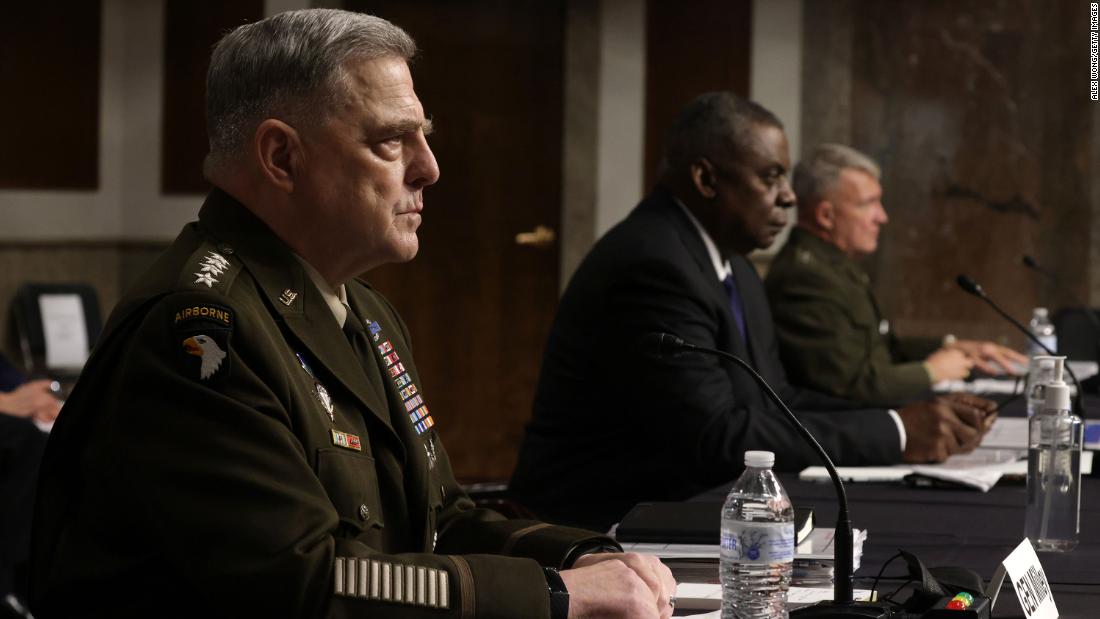
(CNN)Top American generals warned President Joe Biden that the Afghan military would collapse. Gen. Mark Milley, chairman of the Joint Chiefs, said in essence on Tuesday that both former President Donald Trump and Biden had botched negotiations with the Taliban -- and the net result of the US actions was a "logistical success but a strategic failure."

If the old joke is true -- that in Washington, the definition of a gaffe is telling the truth in public -- then Milley and the other military leaders who testified Tuesday on Capitol Hill committed many gaffes.
At a televised hearing of the US Senate Armed Services Committee featuring Milley, CENTCOM commander Gen. Kenneth McKenzie, and the Secretary of Defense Lloyd Austin -- himself a retired four-star general and former CENTCOM commander -- all told a great deal of truth.
Generals Milley and McKenzie said that they advised the Biden administration that unless the US kept 2,500 troops in Afghanistan, the Afghan military would collapse. They also said that the ground commander in Afghanistan, Gen. Austin "Scott" Miller, provided the same advice.
This clearly contradicts what President Biden told ABC News anchor George Stephanopoulos last month -- that the US military didn't advise him to keep 2,500 troops in Afghanistan.
In answer to a question from a senator, Gen. Milley conceded that the abrupt and complete US withdrawal had "damaged" US credibility around the world.
Milley also said that both the Trump and Biden administrations made a mistake by putting specific dates on the US withdrawal rather them making it a conditions-based withdrawal.
Relatedly, McKenzie and Austin both agreed that the Doha agreement with the Taliban that was negotiated by the Trump administration and signed in February 2020, and which laid out the timeline for a total US withdrawal, significantly undercut the morale of the Afghan military.
Milley blamed the US intelligence community for missing the "scale and scope, plus the speed" of the collapse of Afghan government, testifying, "All the intel assessments, all of us got that wrong. There's no question about it. That was a swing and a miss on the intel assessment of 11 days in August, there's nobody that called that."
In fact, according to CNN's reporting before the fall of Kabul, the US intelligence community was predicting in early August that the Taliban could take Kabul within a month to three months, which at the time seemed like a reasonably accurate assessment of how dire the situation was becoming.
Milley described the US airlift of more than 120,000 Afghans, US citizens and other nationals from Kabul as a "logistical success," but he called the overall policy in Afghanistan a "strategic failure."
The fruits of that failure have been starkly clear from the actions of the Taliban during just the past month.
In a highly symbolic move on September 17, the Taliban's feared religious police commandeered the building that once housed the Ministry of Women's Affairs.
The next day, the Taliban ministry of education summoned only teenage boys back to school, but no female teens. They remain at home, unschooled.
The following day, the mayor of Kabul decreed that women can work for the city, but only in jobs that could not be done by men, such as cleaning toilets used by women.
Then Mullah Nooruddin Turabi, a founder of the Taliban, told the Associated Press that the regime would resume the practice of amputating the hands of thieves.
And earlier this month, the Taliban appointed Siraj Haqqani, who the UN has identified as part of the leadership council of al Qaeda, as the acting Minister of the Interior.
Get our free weekly newsletter

Sign up for CNN Opinion's new newsletter.

Join us on Twitter and Facebook

No wonder then that Gen. McKenzie testified he was not confident that al-Qaeda and ISIS wouldn't regroup in Afghanistan now that the US has withdrawn from the country.
The upshot of Tuesday's hearing was that even the most senior US generals couldn't defend the debacle that has unfolded in Afghanistan during the past several weeks, a disaster owned by President Biden, even if it was teed up by President Trump's ill-fated "peace" negotiations with the Taliban that culminated in the Doha agreement.

Adblock test (Why?)


"Opinion" - Google News
September 29, 2021 at 10:14AM
https://ift.tt/3AQmZDZ

Top US generals punch holes in Joe Biden's defense of Afghanistan withdrawal - CNN
"Opinion" - Google News
https://ift.tt/2FkSo6m
Shoes Man Tutorial
Pos News Update
Meme Update
Korean Entertainment News
Japan News Update

Search

Featured Post

I just paid $9.99 for a carton of 18 eggs. Will prices ever drop? | Opinion - Sacramento Bee

[unable to retrieve full-text content] I just paid $9.99 for a carton of 18 eggs. Will prices ever drop? | Opinion    Sacramento Bee ...

Postingan Populer