Rechercher dans ce blog

Sunday, April 24, 2022

Search Attorney General Opinions - Michigan (.gov)

The Attorney General Opinions are presented online for informational use only and do not replace the official versions.

NOTE: Attorney General Opinions issued for the period 1/01/1963 through 12/31/1976 are in Adobe Acrobat format, and may be searched by the opinion number and headnote search functions.

Opinions issued from 1977 forward may be searched by the opinion number, keywords, subjects, headnotes, and text search functions. All Opinions are included in the numerical and chronological Lists of Opinions.

NOTICE: The Attorney General opinions spanning the 1977-1996 period, numbering nearly 1,800, were prepared for publication on this website by automated processes. If you encounter an error in the opinions text, or the keyword or subject lists (such as garbled text, missing keywords, incorrect subject text, etc.), please make us aware of the error so that we may correct it. Send us the opinion number and a brief description of the error by email.

Can I obtain an Attorney General's Opinion on a legal matter?

CLICK HERE TO SEARCH OPINIONS

CLICK HERE TO RECEIVE ATTORNEY GENERAL OPINIONS

Adblock test (Why?)


"Opinion" - Google News
April 24, 2022 at 11:59PM
https://ift.tt/7yiLSvb

Search Attorney General Opinions - Michigan (.gov)
"Opinion" - Google News
https://ift.tt/HxJa2YP
Shoes Man Tutorial
Pos News Update
Meme Update
Korean Entertainment News
Japan News Update

Opinion: Why Macron's win is a big blow to Putin - CNN

David A. Andelman, a contributor to CNN, twice winner of the Deadline Club Award, is a chevalier of the French Legion of Honor, author of "A Red Line in the Sand: Diplomacy, Strategy, and the History of Wars That Might Still Happen" and blogs at Andelman Unleashed. He formerly was a correspondent for The New York Times and CBS News in Europe and Asia. The views expressed in this commentary belong solely to the author. View more opinion at CNN.

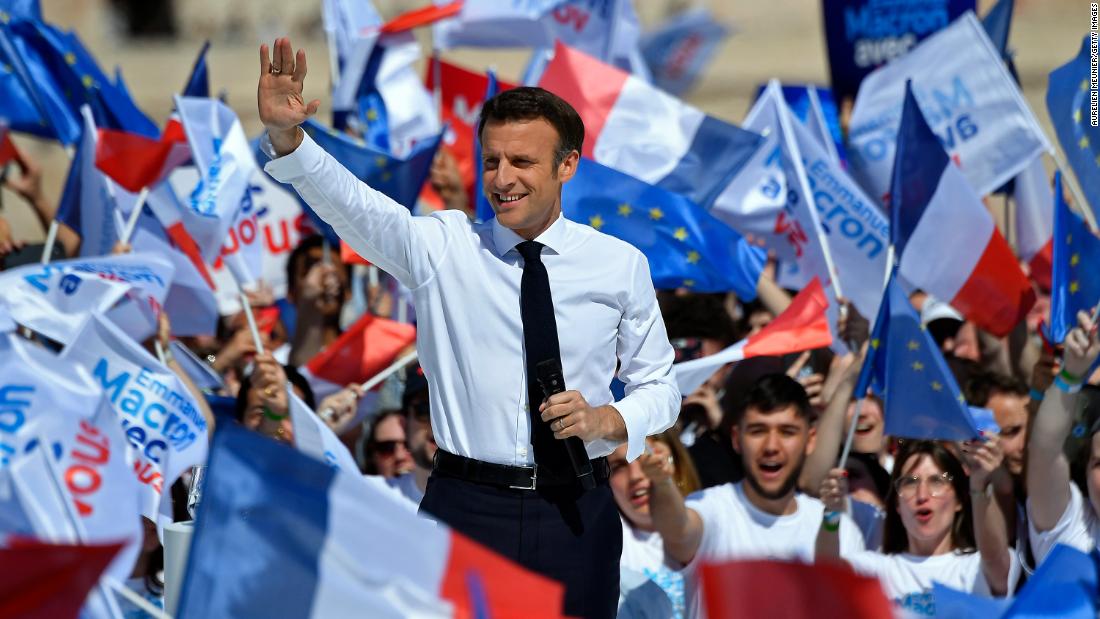
Paris (CNN)France, Europe and the free world have survived a substantial challenge to their collective well-being. While some 1,200 miles away, Russian President Vladimir Putin suffered a profound blow as Emmanuel Macron defeated far-right challenger Marine Le Pen, a Putin ally, to become the first French President in a generation to win reelection.

The outcome of the contest between the two -- France's youngest leader since Napoleon and the three-time aspirant to become the nation's first female President -- was never a lock for either candidate. After a hard-fought first round among 12 candidates two weeks ago, the top two faced off in the runoff Sunday.
Shortly after the majority of polls had closed across the country, pollsters projected Macron to take 58.2% of the vote to Le Pen's 41.8%.
Voters simply opted, in these challenging times, for a safe middle ground rather than a firebrand far-right candidate who promised to rip up the economy and society and pivot France ever closer to Russia -- all in the interest of change that the French have never truly embraced. What Le Pen did do for most of her determined supporters was to demonstrate that she could be "presidential" -- but president of a France where a majority of the French people are unlikely to aspire to living.
The size of Macron's margin, despite the high abstention rate -- the highest in at least two decades -- could give him a substantial boost toward a definitive majority in the National Assembly when elections to fill its 577 seats are held in June.
Above all, Sunday's election effectively did resolve, at least for the moment, the biggest question raised during the campaign: Do most French people really want to change all that much about their country and especially a government that has served them so well for the entirety of the Fifth Republic that has endured for nearly three-quarters of a century? Especially now that Macron is in the position of assuming the de facto leadership of Europe, filling the vacuum left by last year's departure of longtime German Chancellor Angela Merkel.
Throughout the campaign, Macron defined what his second and final five-year term will look like with a passion equal to the attacks of his challenger, Le Pen, who painted France with a single-color palette. Her campaign manifesto included amending the French Constitution to restrict immigration she deemed a threat to France's identity.
Macron observed that he wants a rainbow France, a nation receptive to new ideas at home or abroad, one that is comfortable as a leader of the European Union, NATO and the free world, that is prepared to stand up resolutely at any cost to tyranny abroad and at home.
Le Pen's France would have sought a path toward accommodation with a Russia that is a pariah to much of the free world, and looked inward, pulling back from Europe. At the same time, she would have enforced a ban on headscarves for women or yarmulkes for men and staged referendums to disempower a legislature and judiciary she has never succeeded in dominating.
She outlined at the same time a tempting prospect of lower taxes and broad social expenditures -- all most appealing to many in a nation where inflation has soared to levels not seen since 1985. But as Macron pointed out repeatedly, you have to find a way to pay for all of this.
Once the victory celebrations are over, the reelected President will have a full plate -- and much of the world will be looking to him to set an agenda. Macron still has two more months as the titular leader of Europe in the rotating system that allows each EU country a six-month term. Hopefully, he will use that term wisely, continuing to rally the continent to stand up to Putin.
At the same time there will be challenges and opportunities: Finland and perhaps Sweden on the verge of seeking entry into NATO, Ukraine seeking a fast track for its own entry into the EU.
And at home, Macron will continue struggling with escalating inflation -- matched across Europe -- that is already requiring the continent's leaders to find some path through the impact of any new energy sanctions that may be levied on Russia.
Then, there's the growing refugee issue, some 5 million people having fled Ukraine in two months. The flow will continue, first to front-line EU members such as Poland, which has taken in 3 million already, as well as Romania and the Czech Republic, all of whom are anxious to see other nations assume some of the burden, particularly France and Germany. So far barely 30,000 have arrived in France, which has agreed to accept just 100,000 -- a trickle in the face of a tsunami for which Macron may be forced to answer.
Beyond Europe, Macron will play a central role in navigating France's widely heralded influence on the world stage. In Africa, there have been multiplying coups lately from Mali to Chad and Burkina Faso, accompanied by expanding terrorist activities in former French colonies, Macron was finally forced to withdraw military forces this year following scores of deaths in West Africa. France will continue to seek a path forward, working with like-minded African leaders to prevent Russian mercenaries from filling the vacuum.
And in the Middle East, Macron has already sought a reset with a host of countries where France has growing commercial interests, particularly Gulf nations that have become major purchasers of French military equipment and in the former French colony of Lebanon, which is suffering through a massive political and economic crisis. Macron has sought to position France in the Middle East and broadly across the world as a staunch and reliable partner, in places where a realignment away from traditional allies, particularly the United States, is underway.
In Asia, Macron will certainly seek to play a leadership role in steadying the increasingly fraught relationship between the EU and China. Both sides' eagerness to expand trade has fallen afoul of human rights abuses and China's continued support of Russia during its war with Ukraine.
At the same time, Macron was left bruised and infuriated by a Biden administration security pact with the UK and Australia (known as AUKUS), that in turn torpedoed a major submarine contract between France and Australia. The United States saw the trilateral pact as its new bulwark against China. That's just now come into sharp relief since China signed a mutual-security pact with the nearby Solomon Islands, fueling fears Beijing may be seeking a major naval base in the region -- all met with just a dollop of schadenfreude in some quarters of the Elysée.
Fresh from presidential victory, Macron is still faced with his greatest challenge if he is to be able to move forward with his broad menu of initiatives -- another national election in June when voters will choose a new National Assembly. Many of those arrayed against Macron in the presidential contest will be seeking to unseat the comfortable legislative majority he has enjoyed. In many respects, this vote could be of greater long-term significance for Macron, France and its place in the world than the presidential race.
Get our free weekly newsletter

Sign up for CNN Opinion's newsletter.

Join us on Twitter and Facebook

For the moment, however, the West still has a staunch and loyal ally with democratic aspirations and principles to play an anchor role in the future of Europe -- one the White House will doubtless find appealing, as worried as the Biden administration was that Le Pen might find her way to the Élysée presidential palace.
The United States would do well, then, to cherish this victory.

Adblock test (Why?)


"Opinion" - Google News
April 25, 2022 at 02:12AM
https://ift.tt/5L1fW8d

Opinion: Why Macron's win is a big blow to Putin - CNN
"Opinion" - Google News
https://ift.tt/HxJa2YP
Shoes Man Tutorial
Pos News Update
Meme Update
Korean Entertainment News
Japan News Update

Opinion: Fareed Zakaria: The only plausible path to keep the pressure on Russia - Boulder Daily Camera

Fareed Zakaria Washington Post

The next phase of the war in Ukraine is now apparent. Over the next weeks and months, Russian forces will try to expand control of their occupied territories in eastern Ukraine and dig in. The Ukrainian army and people will resist fiercely, and low-grade battles will likely persist in these areas, as they have in the Donbas region since 2014. That means the only way out of this conflict is to put enough pressure on Russia to force it to the negotiating table and seek sanctions relief in exchange for a peace deal.

To achieve this, the coalition against it needs the staying power to maintain and even ratchet up sanctions and embargoes against Moscow. And that is only conceivable in a scenario in which energy prices come down from their current highs. If oil prices remain over $100 a barrel – and they could easily go much higher – Europe will soon enter a recession, and the entire global economy will see a drop off of growth and political backlash against the sanctions. This would almost certainly mean the collapse of the coalition against Russia, as countries search for ways to gain cheaper energy. That is surely Vladimir’s Putin’s hope.

Read the full opinion at washingtonpost.com.

Adblock test (Why?)


"Opinion" - Google News
April 24, 2022 at 04:22AM
https://ift.tt/bBCOYA4

Opinion: Fareed Zakaria: The only plausible path to keep the pressure on Russia - Boulder Daily Camera
"Opinion" - Google News
https://ift.tt/HxJa2YP
Shoes Man Tutorial
Pos News Update
Meme Update
Korean Entertainment News
Japan News Update

Utah’s Orrin Hatch was a true original who got things done | Opinion - Deseret News

From a poverty stricken pugilist in Pittsburgh to a politician from Utah who served longer than any other Republican senator in history, Orrin Hatch was a true-to-life rags-to-riches Horatio Alger success story. 

Or maybe he is better described as the originator of the “Utah way,” a rock-ribbed conservative who not only had the courage to reach across the aisle but who could unabashedly forge steel-cable suspension bridges across it. 

Hatch.jpeg

Cheryl Diaz Meyer

Hatch, who died Saturday at the age of 88, not only co-sponsored groundbreaking legislation, such as the Children’s Health Insurance Program, with liberal icon Sen. Edward Kennedy of Massachusetts, he forged a genuine friendship with Kennedy. He helped Kennedy through a rough stretch in his life, then wrote a love song for Kennedy and his wife, Vickie; one Hatch told the Deseret News brought tears to the Massachusetts senator’s eyes.

Later, Kennedy spoke to about 200 missionaries for The Church of Jesus Christ of Latter-day Saints at Faneuil Hall in Boston. When Hatch’s mother passed away, Kennedy and his wife flew unannounced to Utah to attend the funeral. 

There was nothing fake about that friendship, nor about the principles Hatch espoused. The New York Times quoted Hatch as saying the two were a “legislative odd couple.” But together they forged deals on laws affecting “public health, biomedical research, AIDS, child care, summer job programs and civil rights for people who are disabled.”

It would be hard to imagine someone with that kind of political courage today — a Republican who would dare to partner with, say, Sen. Chuck Schumer, D-N.Y. Yes, Hatch served in an age before today’s ultra-partisan politics-as-bloodsport cynicism took hold of statehouses and the nation’s capital. But his proclivity to cross the aisle still required courage, and it was copied by few, if any. 

But it got things done. 

The compromises Hatch and Kennedy forged brought resolution to controversial issues. Today’s endless battles over things such as health care and immigration could use such a cooperative spirit. 

Hatch’s greatest legacy is not that he served 42 years in the U.S. Senate. It is that he was an effective lawmaker. 

But then, Hatch leaves many legacies. Among them was his work on behalf of religious liberty. He sponsored the Religious Freedom Restoration Act. That law, which prevents federal officials from interfering with religious practices without proper cause, has become more important in recent years as Washington has tried to intrude on the free exercise of religion. In 2020, the Becket Fund for Religious Liberty honored Hatch as its Canterbury Medalist.

At the time, Becket President Mark Rienzi said, “Hatch’s legacy of championing protections for people of all faiths — and working across partisan lines to do so — has greatly strengthened religious liberty in the United States.”

Hatch also knew how to have fun along the way. Among his other famous friends was boxing legend Muhammad Ali. News accounts said they met in 1988 when Ali came to Hatch’s office to thank him for helping a friend get a federal post. 

Older Utahns will remember how a spirited Ali came to Utah later that year to help Hatch campaign for reelection against Democrat Brian Moss. 

″I think he (Hatch) is the greatest, with greatest with a capital ‘G,’” Ali told The Associated Press in 1988. ″I don’t have enough words in my vocabulary to describe the respect I have for him as a human being.″ The two remained friends for decades, and Hatch spoke at Ali’s funeral

As unlikely as that friendship may have seemed to the world, it was a natural for Hatch, who had been an amateur boxer. 

Hatch was born into poverty. As the Deseret News described it in 2003, he grew up in Pittsburgh “in a ramshackle house that used a billboard for one wall.” He learned how to fight to survive against the bullies who made fun of his poverty. But, obviously, he learned how to make friends, as well, and he learned how to rise above.

It’s safe to say Utah, and the United States, have never seen a leader like Orrin Hatch before, and are unlikely to see one quite like him again. Whether they agreed with his politics or not, Americans could not argue against his sincerity, his tenacity and his determination. 

Nor can it be denied that he left this world a lot better than he found it.

Adblock test (Why?)


"Opinion" - Google News
April 24, 2022 at 10:14AM
https://ift.tt/jaDW8fd

Utah’s Orrin Hatch was a true original who got things done | Opinion - Deseret News
"Opinion" - Google News
https://ift.tt/HxJa2YP
Shoes Man Tutorial
Pos News Update
Meme Update
Korean Entertainment News
Japan News Update

Saturday, April 23, 2022

Opinion: The surprising solution to gun violence - CNN

Jens Ludwig is the Edwin A. and Betty L. Bergman Distinguished Service Professor at the University of Chicago, Pritzker Director of the University of Chicago Crime Lab, and an elected member of the National Academy of Medicine of the National Academies of Science. The views expressed in this commentary are his own. View more opinion on CNN.

(CNN)In 1973, two psychologists came up with a clever experiment. They took a group of Princeton Theological Seminary students and asked them to walk across campus to give a lecture on the parable of the "Good Samaritan." Along their route, the psychologists positioned someone in a doorway, not moving, eyes closed, coughing and groaning as the study subjects went by -- someone, in other words, clearly in need of a Good Samaritan's help.

There was a twist: Before the students left to give their lecture, some were told they were late. Others weren't told anything at all. That little variation in their situation made all the difference in their behavior.
Only 10% of the students who were "late" stopped to help the slumping man, whereas nearly two-thirds of those who were "on time" stopped to offer help. As the psychologists put it, "On several occasions, a seminary student going to give his talk on the parable of the Good Samaritan literally stepped over the victim as he hurried on his way."
The two psychologists didn't know it then -- and it certainly wasn't their intent -- but through their study, they demonstrated something unexpected: a key driver of gun violence in America.
Today, as gun violence is surging in American cities, we see growing concern about what, if anything, can be done. For 50 years, America's policies were motivated by the idea that bad behavior is caused by bad people, which led to calls to be "tough on crime," which in turn led to the construction of the largest prison system in the world.
Those policies left us with a homicide rate that is still higher than that of any other rich country while exacting a ruinous cost to society -- in Black and brown communities in particular. It's clear that hasn't solved the problem.
But the Good Samaritan study shows us that our behaviors are often not due to anything about us as people, but to our situations. To the extent to which that idea has had purchase in the debate about crime, the focus has tended to be on fundamental root causes -- poverty, segregation or widespread availability of guns to people who shouldn't have them.
For good reason -- these are indeed critical. It is remarkable that over 50 years ago President Lyndon Johnson could call for dramatic change to address root causes, yet not nearly enough has actually changed.
Solving these problems would seem to be -- unfortunately -- a long-term project.
The current conventional wisdoms, then, would seem to leave us with the choice between repeating the past or trying the impossible. But there is another way to address gun violence that has not received nearly enough public attention.
New insights from behavioral science suggest there's more to situations than root causes -- as the Good Samaritan example itself suggests -- and help us see that progress on the gun violence crisis is much more possible than we've thought.

Crime is not what you think

The crime problem in America is really about gun violence, which devastates families, communities and -- by driving out people and businesses -- even cities themselves. Nearly eight of every 10 murders in America was committed with a gun in 2020, according to data from Pew Research Center.
But gun violence is also not what you think. Unlike what we see in the movies or on television, gun violence in America is not wholly driven by wars between gangs over drug-selling turf. It's not clear that our mental image of murders being due to a sort of rational benefit-cost type analysis, in which shootings are pre-planned and thought through, is right.
They often start with something else entirely. Words -- or arguments, to be more specific -- are often the primary circumstance that leads to murders.
A neighbor won't turn down their music. A landlord and tenant argue over unpaid rent. A group of teens think some other teens stole a bike. Someone gets cut off in traffic. All arguments that could have been de-escalated but weren't -- and they end in tragedy because someone has a gun.
What we really have is an arguments-with-guns problem. Knowing that changes how we should think about whether preventing violence is possible, and how.

A new perspective

Behavioral science helps us see why we so often make mistakes in arguments, and how our situations can make mistakes more likely.
Imagine we played a game where I quickly flashed a word and asked you to name the color of the ink in which the word was printed. I first show you "blue," displayed in blue ink. You say blue. Then I show you "pink," in pink ink. Great. Finally, I flash the word "green" printed in red ink. Your first instinct would be to say "green" because reading words presented before you is almost always the most helpful way to interact with words. You do it automatically.
This experiment -- known as the "Stroop test" -- reveals something fundamental about how the mind works: Conscious, deliberate thought is taxing, so our minds try to avoid it as much as possible. Instead, we tend to rely on automatic responses that work well for ordinary situations we see over and over.
The Stroop test shows us that those automatic responses can get us into trouble when they're over-generalized into uncommon situations. We make a mistake because we confuse an out-of-the-ordinary situation ("identify the ink color of the words in front of you") for an ordinary one ("read the words in front of you") and default to our automatic response.

Behavioral science and gun violence

This insight from behavioral science helps us understand why gun violence is higher in some neighborhoods than in others. In disadvantaged areas, a large body of research from sociology suggests young people unfortunately learn they're on their own in terms of keeping themselves safe.
In many of these neighborhoods, large numbers of local adults are incarcerated in the justice system, which overwhelms the adults and institutions that remain, and leaves the young people who live there vulnerable to the intimidation, aggression or violence of others.
When challenged, they need to develop an automatic response to fight back so they're not seen as an easy target. A friend of mine who grew up on Chicago's high-violence West Side put it this way: to not fight back would "open the flood gates to victimization."
But the same mental shortcut that may allow young people to avoid being repeatedly harassed, picked on or beaten up outside of school puts them in danger when relied upon in an out-of-the-ordinary situation, like when someone has a gun.
In contrast, in the economically and racially diverse neighborhood of Hyde Park (home to the University of Chicago), young people never have to develop a fight-back reflex. The university puts a security guard or an emergency phone on almost every corner, and there are lots of other teachers, shopkeepers and other adults around as well.
Young people in these areas learn the right automatic response to being challenged is to not resist, then go tell a security guard. That's also the right response to out-of-the-ordinary situations like when someone's got a gun. Relying on automatic responses is not a big deal when the same behavior works in both ordinary and out-of-the-ordinary situations.
It's also the case that stress makes people more likely to rely on default responses like the fight-back reflex, and that levels of stress and trauma are much higher in some neighborhoods than others.
As researchers Sendhil Mullainathan and Eldar Shafir note in their book, "Scarcity: Why Having Too Little Means So Much", stress depletes mental bandwidth and leads us to default more to our automatic responses. In the most disadvantaged neighborhoods that are most challenging to navigate, stress makes that navigation even more difficult.
The key lesson is that criminal behavior is not fundamentally different from human behavior. Teens in affluent neighborhoods with lower instances of street violence are no more moral or thoughtful than teens anywhere else; it's that their lives demand less deliberate thinking to navigate because their situations are more forgiving.
I saw this in one of the first research studies I was involved in, the federal government's Moving to Opportunity (MTO) initiative. Starting in 1994, MTO helped families from economically distressed neighborhoods move to less distressed areas. Moving a few miles presumably didn't alter a participant's character, and the income of MTO families also didn't change when they moved. Yet, violent crime arrests of MTO teens plummeted by almost 40%. What changed? The difficulty of the situations they faced.

Ten minutes

A few years ago, I was visiting the Juvenile Temporary Detention Center in Chicago, which is where the teenagers deemed "highest risk" are held while their cases go through court. A staff supervisor told me he always tells the kids they're not bad people, they're just people who made bad decisions during enormously difficult situations. Or, as he puts it to them: "If I could give you back just 10 minutes of your lives, none of you would be in here."
This suggests one way to reduce gun violence is to make the difficult situations young people are forced to navigate -- those 10-minute windows -- more forgiving. In the context of America's traditional approach to violent crime, that's a radical idea. It runs directly counter to the notion that incapacitating people is the only way to reduce gun violence. Instead, it tells us to focus our policy efforts on changing the situations people face and the tools they have for navigating those situations.
As the MTO study shows us, perhaps the most important structural change we could make in this regard is to reduce the segregation that plagues our cities and leaves too many neighborhoods under-resourced and over-stressed. Another would be to limit the widespread availability of illegal guns on our streets, which makes crimes much more deadly. But progress on either of these fronts, while critical, has proven to be very slow.
In the meantime, there are tangible steps we can take right now to make difficult situations more forgiving. For one, we can make it more likely that there are adults around who can step in and help de-escalate arguments before they spiral out of control. This is the logic behind street outreach and violence interrupter organizations, which for the first time is targeted for substantial funding in next year's proposed federal budget.
The potential for this approach to help prevent gun violence is not wishful thinking. Research from a series of randomized controlled trials of the sort that provide "gold standard" evidence in medicine, as well as studies of naturally-occurring "policy experiments," show almost anything that gets more people out on the streets, from installing better street lighting to turning vacant lots into parks, reduces crime.
A second, complementary approach that has historically not been part of the public debate is to help young people navigate the difficult situations that our past policies have failed to fix.
Consider an exercise practiced in one of Chicago's most effective violence intervention programs, Becoming a Man (BAM). Teens are paired up; one is given a rubber ball, and the other is given 30 seconds to get the ball out of his partner's fist. Inevitably, the two teens end up on the ground, wrestling and fighting to get -- or keep -- the ball.
After the teens switch roles and the same struggle occurs, the BAM counselor asks why no one just asked their partner for the ball. They usually look surprised and say something along the lines of, "The other guy would have thought I'm a wuss." The counselor asks the partner if that's true. The usual answer: "No, I would have given it to him. It's just a stupid ball."
This exercise, called "the fist," doesn't teach participants to be better people. Instead, it gives them the tools they need to address the actual problem: the situation. By teaching young people to slow down during stressful situations, it helps them navigate in-the-moment decisions that could otherwise lead to violence.
Get our free weekly newsletter

Sign up for CNN Opinion's newsletter.

Join us on Twitter and Facebook

Essentially, they learn to evaluate their automatic responses, and in some situations, just ask for the ball -- or stop to help a person coughing in a doorway. Research including several randomized controlled trials by my research center, the University of Chicago Crime Lab, found BAM reduces violent crime arrests by nearly 50%. While scaling social programs is often a challenge, it is encouraging that we see similarly beneficial effects from related programs, like Choose To Change and programs delivered in other settings like juvenile detention centers.
The tragedy is that the conventional wisdom that crime is a product of bad people led America to focus on a narrow set of policy responses that created the world's largest prison system. You don't throw someone in prison for life if you think they can change.
The good news is that our improved understanding of human behavior helps us see that preventing gun violence isn't about dealing with bad people. It's about creating the situations that give young people those key 10 minutes back.

Adblock test (Why?)


"Opinion" - Google News
April 24, 2022 at 04:39AM
https://ift.tt/wHzrUls

Opinion: The surprising solution to gun violence - CNN
"Opinion" - Google News
https://ift.tt/HxJa2YP
Shoes Man Tutorial
Pos News Update
Meme Update
Korean Entertainment News
Japan News Update

Guest opinion: Charles Sisk: What happens after the Redtail vote? - Boulder Daily Camera

By Charles Sisk

I am writing this to inform all Louisville citizens. As a former member of the City Council and mayor of Louisville for over 20 years, I have experience with the process that will follow the Redtail Ridge vote.

Chuck Sisk

I feel this is important context because several current city councilmembers and members of both campaigns have been quite vocal about the public process following the referendum.

The discussions have become very contentious and sometimes not factual. I feel compelled to write an opinion that clarifies the issues as I understand them.

First, people must understand that this property is not open space and will not be open space.

Let’s look at the actual authority that the City Council will have when Brue Bakol Capital Partners presents the already-approved 2010 general development plan.

The Louisville City Council has somewhat limited decision-making authority on any redevelopment of what was the StorageTek site under an approved GDP. While I respect the right of our officials to weigh in with their personal opinions, it’s equally important that they share facts and the law, recognizing that this property is privately owned.

Why do I say the Council will have limited input? Because our laws and municipal code say so. The approved 2010 ConocoPhillips GDP serves as the codified foundation for the process.

It establishes the proposed use of all lands within the subject property, the type or character of development, the proposed location of school sites, parks, open spaces, recreation facilities and other public and quasi-public facilities and the proposed location of all streets.

With this existing GDP approved, the next step in the process is a public review to consider and approve redevelopment on a narrowly defined, per-subdivision basis.

The Council’s very narrow review would approve road configurations and building heights, but couldn’t be used to increase open space requirements, rezone for a hospital or mandate on-site renewable energy. In other words, the many significant advantages to the Redtail plan cannot be added into the Conoco plan under the public review process.

So, what happens now that we have voted?

The 2010 ConocoPhillips GDP will go forward. A commercial metropolitan district will be established with the Council’s approval, to underwrite the improvements to public infrastructure and the road networks.

The only other steps left to build on the site are approval of the subdivision plat and approval of the planned unit development. Those will be submitted to Louisville Planning & Zoning and reviewed under the objective standards set forth in the ordinance the Council already passed, the approved 2010 GDP and our municipal code.

Other requirements are already established in the municipal code, and in the GDP ordinance that has already been approved.

It is actually pretty black and white: Either the applicant’s subdivision plat and PUD submission meet the standards, or they do not. The decision is governed by the literal provisions of the 2010 ordinance, that GDP and municipal codes.

If the applicant meets the standards, they have a right to build and, if necessary, may seek a court order to require the city to grant the property rights it has already acquired.

Don’t take my word for it — the city’s website features the planning guidelines and the municipal code.

The business and development communities will be watching these processes very carefully. They need to know if it is worth investing time and capital in redevelopment of the empty buildings and land in Louisville.

The city’s mayor and City Council need to act consistently and fairly. Louisville’s integrity is at stake.

The City should avoid at all costs the perception that “Louisville is closed for business.”

Charles Sisk lives in Louisville and is a former mayor and city councilmember.

Adblock test (Why?)


"Opinion" - Google News
April 24, 2022 at 05:02AM
https://ift.tt/3MCiref

Guest opinion: Charles Sisk: What happens after the Redtail vote? - Boulder Daily Camera
"Opinion" - Google News
https://ift.tt/HxJa2YP
Shoes Man Tutorial
Pos News Update
Meme Update
Korean Entertainment News
Japan News Update

Opinion: The anti-LGBTQ backlash could have deadly consequences - CNN

Allison Hope is a writer whose work has been featured in The New York Times, The Washington Post, CNN, Slate and elsewhere. The views expressed here are the author's. Read more opinion on CNN.

(CNN)It's every parent's worst nightmare to have their child's safety or well-being threatened. That's what two gay parents, Robbie Pierce and Neal Broverman, experienced this week when a man accosted them and their two small children on an Amtrak train from Los Angeles to San Francisco.

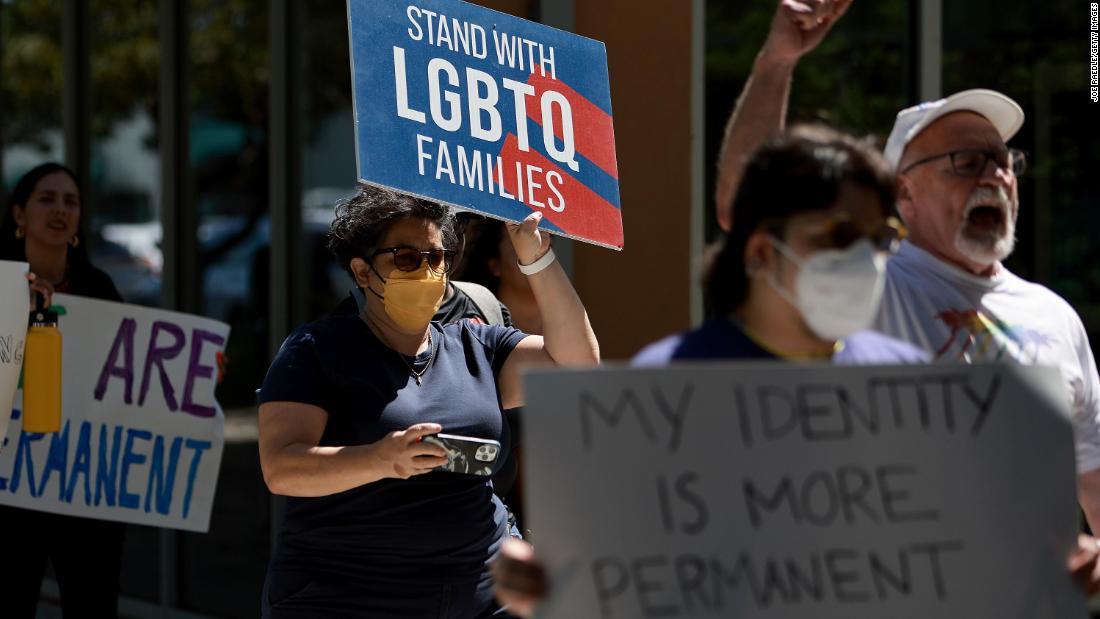
The man screamed at them for simply being a family, using anti-LGBTQ language and homophobic tropes that date back decades. The attack, which was uniquely horrifying because it involved the couple's two young children, makes me fear for my own family's safety at a time when the LGBTQ community is already facing a string of violence.
Take the three people who were attacked as they were leaving a drag show in Old Town Pasadena, or the gay club in Brooklyn that was set on fire, or the deaths of two Black, transgender women in Chicago, at least one of which was ruled a murder (the other is still under investigation). This was all in the past month, and it doesn't capture the full scope of heinous acts.
While attacks on our community are sadly nothing new, this current environment, in which public officials use dangerous rhetoric while peddling bills that discriminate against us, feels ever more fraught. It doesn't help that some Republicans are increasingly perpetuating the harmful myth that liberals and members of the LGBTQ community are grooming children -- a move that shatters any illusions that the US has become fully understanding and accepting of our LGBTQ lives and experiences.
Pierce, who shared his experience on Twitter, wrote that while his family had encountered homophobia before, characterizations like "pedophiles" and "rapists" were new. He laid the blame on people who were eager to "stir up their lucrative culture war" -- a cause taken up by Republican lawmakers like Florida Gov. Ron DeSantis, who signed the "Don't Say Gay" law that bans any mention of sexual orientation or gender identity from kindergarten to third grade.
The bill is written so broadly that critics fear it could create an environment where teachers could be fired for mentioning a spouse, and kids could be barred from talking about LGBTQ family members. And now DeSantis has gone after Disney World's status as an "independent special district," after the company's CEO said he'd support the repeal of the "Don't Say Gay" law.
That's just one bill. In all, more than 250 bills have been introduced in state legislatures this year with the aim of stripping away the rights of LGBTQ Americans, including in sports, libraries, schools and other facets of civic life. There was even a recent attempt in Tennessee to define common law marriage as one between one man and one woman. Thankfully, the bill died before it made it out of the general assembly, but I fear the fight to undo marriage equality may only be beginning.
And let's not forget, there is a correlation between hateful political rhetoric and a rise in hate crimes, acts of discrimination or violence. The Brookings Institute analyzed this last year and found research that "suggests the incendiary rhetoric of political leaders can make political violence more likely, gives violence direction, complicates the law enforcement response, and increases fear in vulnerable communities." In 2018, a right-wing party in Germany that shared anti-immigration sentiments on Facebook predicted violent crimes against refugees, according to researchers at the University of Warwick. And a 2020 analysis conducted by ABC found at least 54 criminal cases that invoked President Donald Trump, who launched numerous verbal attacks on minorities and other groups, in connection with an act of violence, threats or alleged assault.
The current anti-LGBTQ climate even made the tough-as-nails White House Press Secretary Jen Psaki cry during a podcast interview that was released this week. "I'm going to get emotional about this issue because it's horrible. But it's kids who are bullied, and all these leaders are taking steps to hurt them, and hurt their lives and hurt their families," she said.
As Psaki pointed out, right-wing legislators are strangely fixated on LGBTQ bills that marginalize those who are already vulnerable, instead of focusing on policies that would actually help their constituents. It's certainly easier for lawmakers to exploit hot-button issues like denying trans kids healthcare than, say, lower healthcare costs for all. But elected officials are exploiting the ignorance of their constituents, firing up their base and throwing LGBTQ Americans under the bus -- all while skirting over the actual responsibilities that come with civil service.
Bills like The Equality Act would provide more universal protections from discrimination for LGBTQ Americans at the federal level and, perhaps more poignantly, send a message across all levels of government that we deserve equal protection. This would help prevent the state level attacks against the LGBTQ community that we're now seeing across the country.
This backlash may be in response to the great progress and representation we've realized in recent decades. More people are identifying as LGBTQ than ever before. More kids have queer parents. We're seeing ourselves reflected in media and culture and more public figures are out and proud. For reasons that I will never fully understand, the visibility and inclusivity that allows some people to step more fully into who they are makes others frightened or angry.
Get our free weekly newsletter

Sign up for CNN Opinion's newsletter.

Join us on Twitter and Facebook

In this moment of heightened urgency, to remain silent is to be complicit. Together, the full power of the LGBTQ community and our allies can help to push back against this onslaught of hate.
My message to these politicians: You are stoking violence against your most marginalized citizens. Focus on issues like renewable energy or living wage jobs and make it easier for all people to live safe and fulfilling lives. Lay down your swords in these so-called culture wars and go pick on somebody your own size!

Adblock test (Why?)


"Opinion" - Google News
April 23, 2022 at 08:17PM
https://ift.tt/Z5QNvwS

Opinion: The anti-LGBTQ backlash could have deadly consequences - CNN
"Opinion" - Google News
https://ift.tt/q2seZ78
Shoes Man Tutorial
Pos News Update
Meme Update
Korean Entertainment News
Japan News Update

Search

Featured Post

I just paid $9.99 for a carton of 18 eggs. Will prices ever drop? | Opinion - Sacramento Bee

[unable to retrieve full-text content] I just paid $9.99 for a carton of 18 eggs. Will prices ever drop? | Opinion    Sacramento Bee ...

Postingan Populer