Rechercher dans ce blog

Wednesday, September 28, 2022

Substance use disorder summit jumpstarts the discourse on stigma reduction - Pennsylvania State University

israelob.blogspot.com

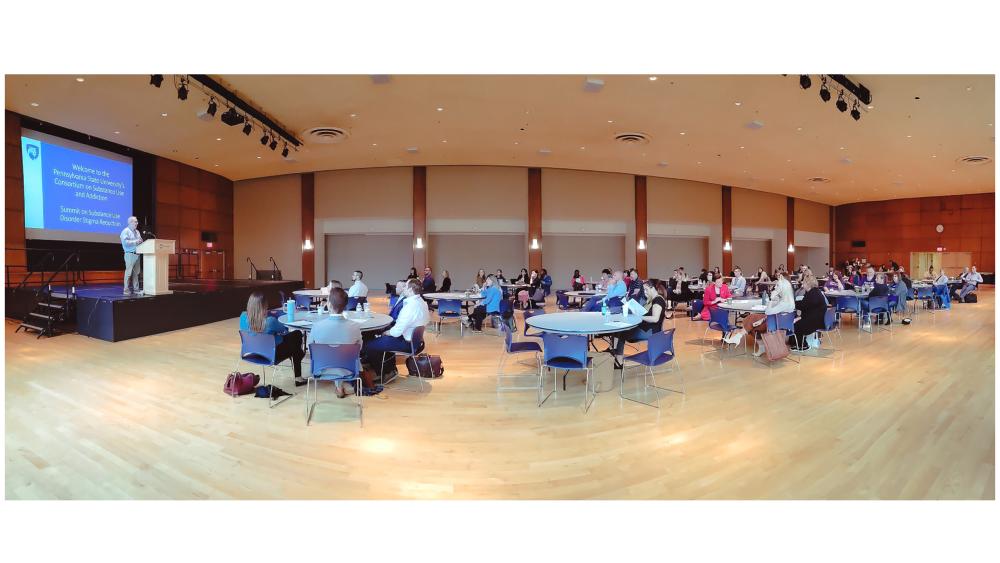
UNIVERSITY PARK, Pa. — The Consortium on Substance Use and Addiction’s (CSUA) hosted the first annual Substance Use Disorder Stigma Reduction Summit recently at the HUB-Robeson Center in University Park. Organized by the Substance Use Stigma Reduction Collaborative, the event brought in researchers, practitioners and government partners from across Pennsylvania and the nation to consider research, policy and practice around the issue of stigma reduction in numerous fields like criminal justice and healthcare. 

The summit’s keynote speaker, Alex Elswick, assistant professor and extension specialist for substance use prevention and recovery at the University of Kentucky, spoke about his own recovery experience. Elswick is a trained researcher, recovery coach, and mental health therapist, as well as the co-founder of Voices of Hope, a peer-driven recovery community organization. 

Elswick discussed the concept of recovery capital, natural recovery, and how language matters when it comes to destigmatizing the disease of addiction. In particular, he noted that many people in recovery hold the self-limiting belief that they "don’t deserve a better job” and end up working in retail or food service, and that is something that Elswick believes needs to change. 

“I was homeless for a while, and the people I met while I was homeless were some of the most helpful, non-judgmental people I have ever met. They told me where to get a free hot meal and a free shower,” Elswick said. “But I was suffering, wanted to quit [substance use], and I couldn’t quit.” 

Following the keynote speaker’s speech, there were three rounds of presentations from researchers, practitioners and government partners about their work around stigma reduction efforts. The presentations covered a wide variety of topics and audiences from training programs for first responders, recovery-friendly workplaces, using storytelling to reduce stigma, and many more.  

Established in 2018 and housed in the Social Science Research Institute, CSUA is a multidisciplinary network of researchers, educators and practitioners that work together to address the systemic problems of the opioid epidemic, substance use and addiction.  

The Substance Use Stigma Reduction Collaborative is a working group established by Consortium on Substance Use and Addiction consisting of academic scholars, professionals, and practitioners throughout Penn State University. The mission of the collaborative is to examine and understand stigma toward substance use to identify ways to reduce its impacts.

Adblock test (Why?)


"discourse" - Google News
September 29, 2022 at 01:23AM
https://ift.tt/q9tabP0

Substance use disorder summit jumpstarts the discourse on stigma reduction - Pennsylvania State University
"discourse" - Google News
https://ift.tt/qsCbTwh
https://ift.tt/EiyfWFz

Tuesday, September 27, 2022

Opinion | A long time ago in a state right now - Alabama Political Reporter

A long time ago – 1990 to give an exact year – two colleagues and I wrote a series for The Birmingham News titled “What They Won’t Tell You About Your Taxes.”

I know, it’s not a very sexy title. But the title has an important point. Under then-Gov. Guy Hunt, a special legislative committee was looking at Alabama’s terrible tax system and trying to come up with ways to make it fairer. Alabama’s tax system, overall, is among the most regressive tax systems in the nation.

We not only looked at the problems with Alabama’s business taxes, sales taxes, property taxes, income taxes and other issues with the tax system, but we also offered solutions. We did the series because in their infinite stupidity, Hunt and lawmakers decided to wait until after that year’s elections to tell voters what was wrong with the tax system in our state. So, we told them ourselves.

The series won the 1991 Pulitzer Prize in Editorial Writing for Ron Casey, Harold Jackson, and me, a first for The News. But a journalism prize, even the most prestigious for writers and journalists, is little more than a beauty contest. Lots of entries (87 for our category in 1991), all of them good. Ours eventually rose to the top and we received the Pulitzer. It is a great honor, and I’m not trying to belittle it. It is, however, just an award, albeit the Big One.

The result of that tax series that won, however, was underwhelming. Other than a few adjustments in how much money a poor person had to earn before paying state income taxes, Alabama’s tax system today, 32 years later, is basically the same: Horrible and, arguably, getting worse.

So, the “suggestion” the Alabama Policy Institute made earlier this month, urging state lawmakers to look at Missouri’s “bold tax reforms” as a model, is typically incorrect. Of course, the Alabama Policy Institute is a far-right conservative organization mainly looking out for rich people and the MAGA crowd. I remember when the Policy Institute (at the time, the Alabama Family Alliance) led then by now-U.S. Rep. Gary Palmer, R-Birmingham, fought in the backrooms in the State House against a program that would have helped Alabama’s most vulnerable residents – children living in poverty who often are targets of abuse, by their caretakers and the state of Alabama.

That program for children eventually passed, but the money earmarked for it has been steadily stolen by lawmakers for other purposes.

The Alabama Policy Institute believes offering tax cuts or rebates is the way to go. Typically, such a move would be a big bonus to the state’s richest citizens and have a much lesser impact on the middle class and very little on the poor.

Instead, lawmakers need to remove the state and local sales taxes on necessary groceries. See, what the Alabama Policy Institute doesn’t tell you is that Missouri did take most of its sales taxes off food. And Missouri citizens voted to expand Medicaid under the Affordable Care Act.

Now that truly does help less fortunate residents. Sales taxes costs the middle class and working poor families much more than it does wealthy families. The income tax creeps up disproportionately for the working poor and middle class than it does the rich.

Why isn’t the API advocating for real tax reform? Because API is like so many far-right-wing organizations that care only for the rich and weird: They pick and choose the “tax reform” they want, and if it requires too much offset, then they don’t want that – it will cost their rich supporters.

How about blunting the tax burden on middle and lower-class families than offering a one-time rebate or tax cut across the board, especially when that board does so much more holding up the rich than it does the poor, who more often than not are told by the state to just walk the plank? Because real tax reform is hard, and it requires tradeoffs the rich aren’t going to support.

Let them eat cake. And potted meat, crappy TV dinners, stale bread.

If Alabama wants to help its marginalized citizens, expanding Medicaid would really help. If Alabama wants to help the working poor, erase the sales tax on food and over-the-counter medicines. But Alabama leaders don’t want to take those bold measures. It’ll piss off their rich friends, and we know who owns the governor and Alabama lawmakers: It’s not you or me.

Truth is, most of Alabama’s elected representatives don’t want to help the middle class and poor. You can tell that by simply looking at the policies that work against them: the tax system, underfunded agencies from mental health and child welfare to education and prisons. It’s always our intentionally marginalized population – African-Americans, immigrants, members of the LGBT community, and, yes, women – who suffer the bigotry of inequality.

API wants their friends to get a tax cut. The couple raising a couple children on little income and having to pay an unfair share of that sales and income taxes, well, they’re left behind. They’re always left behind.

They were being left behind in 1990 when we wrote that Pulitzer Prize-winning series on tax reform, and they’re being left behind today.

There is one simple reason for that, too: Most of our elected leaders just don’t give a damn.

Adblock test (Why?)


"Opinion" - Google News
September 27, 2022 at 07:29PM
https://ift.tt/8Wjkbls

Opinion | A long time ago in a state right now - Alabama Political Reporter
"Opinion" - Google News
https://ift.tt/0A91gap
Shoes Man Tutorial
Pos News Update
Meme Update
Korean Entertainment News
Japan News Update

Opinion: Scale keeps food accessible, affordable - Agri-Pulse

In 1968, the CBS News TV documentary “Hunger in America” shocked the country, reporting that 10 million Americans out of a U.S. population of 200 million were hungry and that government efforts to feed those who needed help fell short.

The news prompted the White House to convene a Conference on Food, Nutrition and Health the following year to “put an end to hunger in America for all time.” The conference made 1,800 recommendations, leading to improvements in nutrition and ingredient labeling, expansions of the federal food stamp and school lunch programs, authorization of the WIC program and changes to other food policies.

While farmers and food companies have always been indispensable to government feeding programs, in the early years they simply supplied the food products, which largely were surplus commodities.

Since that 1969 conference, though, the role of America’s food providers in feeding the hungry has grown, with companies of all sizes now making donations of food to local, regional and national food bank networks, giving and investing funds in the infrastructure of food distribution, and offering more healthy and nutritious food choices.

Smithfield Foods has taken this responsibility to heart and has been at the forefront of providing food assistance to people in need for decades. Ever since we were founded in Smithfield, Va., more than 80 years ago, we have been donating food, money and volunteer hours to the communities in which we live and work. We launched our Helping Hungry Homes® initiative in 2008, providing millions of servings of protein to food banks, and have invested in key disaster relief and community outreach programs. In 2020 and 2021, during the height of the COVID-19 pandemic when food banks were responding to unprecedented demand, we donated more than 107 million protein servings valued at more than $100 million.

The support from food companies coupled with the resources and programs of the federal government have made a significant dent in food insecurity. But there’s still a long way to go.

Many in the richest country on earth still go to bed hungry. In fact, in the wake of the pandemic, with its adverse effects on our economy and supply chains, the number ticked up. U.S. Census Bureau data show that at the end of last year, 21 million people didn’t have enough to eat, up from 18 million last summer.

That’s one reason the White House is holding a second Conference on Food, Nutrition and Health on Wednesday.

Smithfield is honored to participate in this conference and to be part of the solution to the continuing problems of hunger and food insecurity. We are committed to donating 200 million servings of protein by 2025, double our initial goal of 100 million servings, which we reached three years ahead of schedule. And to ensure a consistent supply of affordable high-quality and nutrient-dense protein, we’re driving operational efficiencies throughout our integrated value chain to produce more with less.

We also have committed to reducing added sugars and sodium by 10% across our product lines, providing consumers with even more healthful protein, and increasing transparency through cleaner labeling on 100% of our products, by 2025.

Smithfield’s nationwide network of facilities and our 40,000 U.S. team members stand ready and able to provide safe, wholesome, and nutritious protein to our country’s less fortunate, particularly in underserved rural communities.

Other food companies small and large have made similar pledges to the White House conference, and USDA recently bolstered its commitment with an infusion of $2 billion for food banks and schools for their breakfast and lunch programs.

It will take a concerted effort from the federal government and from all private-sector food producers and processors to take on this task. But it’s hard to beat the economies of scale the nation’s larger food producers bring to make food widely accessible and affordable.

The White House conferees would do well to take a holistic approach to tackling the issue of hunger in America, making sure to capitalize on the scale and scope of companies like Smithfield that can produce safe, nutritious, and affordable food in a responsible and sustainable way that makes a difference for our fellow Americans who need help.

Stewart Leeth is chief sustainability officer for Smithfield Foods, Inc. Leeth leads the company’s global sustainability program, which focuses on seven core pillars: animal welfare; diversity, equity and inclusion; environmental stewardship; food safety and quality; health and wellness; helping local communities and worker health and safety.

For more ag news and opinions, visit www.Agri-Pulse.com.

Adblock test (Why?)


"Opinion" - Google News
September 27, 2022 at 09:21PM
https://ift.tt/OpwBGL0

Opinion: Scale keeps food accessible, affordable - Agri-Pulse
"Opinion" - Google News
https://ift.tt/0A91gap
Shoes Man Tutorial
Pos News Update
Meme Update
Korean Entertainment News
Japan News Update

Utah passed bipartisan climate action on greenhouse gas | Opinion - Deseret News

The recent divisive partisan fight in Washington over the Democrats’ controversial $369 billion climate legislation was disappointing to watch. 

Equally troubling is how the climate and energy provisions in the bill are being “scored” as a “zero-sum game.” Renewable energy provisions are deemed a “win” for climate, while provisions supporting fossil fuel use are viewed as a “loss.”

A much better public policy approach is to develop the broadest bipartisan consensus on as many issues as possible. Utah has shown that on important climate questions not only can we achieve this but that unanimity is even possible. 

In the last legislative session, we unanimously passed and Gov. Cox signed HCR 1, “Concurrent Resolution to Work Together to Address the Climate, Public Lands, and Carbon Sequestration,” which lays out a win-win strategy for protecting and improving our natural resources and the environment while also significantly controlling greenhouse gases

The underlying approach in HCR 1’s is to protect the atmospheric carbon now being stored in natural systems like forests and rangeland soils while also sequestering additional CO2 by better harnessing the processes nature has perfected and proven throughout the ages.

Everyone understands how forest fires massively contribute to air pollution and produce greenhouse gases. Less well understood is the importance of rangeland and soil health, and HCR 1 also highlights this.       

The proven potential here is enormous, as several examples illustrate. Dr. Fred Provenza, world-renowned emeritus professor at Utah State University, and several colleagues have estimated that simply restoring the soil health of the world’s historic grasslands could “lower greenhouse gas concentrations to pre-industrial levels in a matter of decades.” 

The Rodale Institute has done extensive surveys and conducted field trials of organic and regenerative agriculture practices in the U.S. and abroad. Based on this they conclude: “We have proven that organic agriculture and, specifically, regenerative organic agriculture can sequester carbon from the atmosphere and reverse climate change … With the use of cover crops, compost, crop rotation and reduced tillage, we can actually sequester more carbon than is currently emitted, tipping the needle past 100% to reverse climate change.”

This approach is also a win-win because these natural sequestration processes also generate many valuable “co-benefits.” These include improved water quality and quantity, better fish and wildlife habitat, increased biodiversity, improved food and commodity yields using far less chemicals, better drought resiliency, reduced flooding and danger of catastrophic wildfire, as well as stronger and more prosperous rural economies, among others.

HCR 1 focuses primarily on improving federal forest management to better prevent catastrophic wildfires but its basic principles are broadly applicable.   

While the federal government is beginning to incorporate some of its recommendations in managing forests and rangelands, these efforts are pitifully inadequate in light of the magnitude of both the problems and the potential for remediation. 

One of HCR 1’s most significant recommendations is that the federal government adopt a “social benefits of carbon control” test to rank climate policy options. Since many different policies can lower greenhouse gas levels, it is only common sense and responsible policy-making to choose the most co-beneficial ones. 

Applying this test would allow us to transition to the energy sources of the future more gradually, rationally, economically and responsibly while still addressing climate concerns. It would mean we could still provide the affordable, abundant and reliable energy that is so essential to improving and maintaining our quality of life. Rather than engaging in a zero-sum game, we could choose a win-win solution.

HCR 1 passed unanimously because it incorporates such a “climate-smart” approach. It teaches an important lesson that, sadly, Washington has yet to learn. 

Keven Stratton represents House District 48 in Utah County.

Adblock test (Why?)


"Opinion" - Google News
September 27, 2022 at 09:00PM
https://ift.tt/s2v6Pkl

Utah passed bipartisan climate action on greenhouse gas | Opinion - Deseret News
"Opinion" - Google News
https://ift.tt/0A91gap
Shoes Man Tutorial
Pos News Update
Meme Update
Korean Entertainment News
Japan News Update

Monday, September 26, 2022

Opinion: The 'shadow docket' further erodes the Supreme Court's legitimacy - CNN

Editor’s Note: Steve Vladeck is a CNN legal analyst and a professor at the University of Texas School of Law. He is the author of the upcoming book “The Shadow Docket: How the Supreme Court Uses Stealth Rulings to Amass Power and Undermine the Republic.” The opinions expressed in this commentary are his own. View more opinion at CNN.

CNN  — 

By a 5-4 vote, the Supreme Court cleared the way last week for Alabama to execute Alan Miller, who killed three men in a 1999 workplace rampage. The court ruling came around 9 p.m. Thursday, about three hours before Miller’s death warrant was set to expire. In a turn of events, the state wasn’t able to execute Miller before midnight because prison officials couldn’t access his vein to administer the lethal injection.

Steve Vladeck

Nonetheless, it was the third time in less than a year that the justices have granted a state’s emergency request to allow an execution that lower courts had blocked to go forward.

And like the first two (which divided the high court 5-3 and 5-4, respectively), the majority wrote … nothing. There was no explanation for why the District Court, which wrote a 61-page opinion explaining why Miller was likely to succeed on his challenge to his method of execution, was wrong. There was no explanation for why the conservative-leaning, Atlanta-based federal appeals court, which refused to undo the District Court’s ruling by a 2-1 vote in a 32-page decision, was wrong. There was no explanation for why Alabama was right. Chief Justice John Roberts and Justices Clarence Thomas, Samuel Alito, Neil Gorsuch and Brett Kavanaugh voted to send a man to his death – and they couldn’t be bothered to tell him why.

The Thursday ruling was, unfortunately, not an outlier. Time and again in recent years, the justices have relied on unsigned and unexplained orders, part of their so-called shadow docket, to grant requests for emergency relief – whether to clear the way for executions, to block state Covid-19 restrictions or to unblock lower court injunctions of federal policies.

Indeed, the ruling was the 17th of the current term (which began October 4, 2021) in which the justices used unsigned orders to undo lower court rulings – and the 14th of those 17 in which they provided no explanation. (During the court’s previous term, 20 of its 24 grants of emergency relief likewise came with no opinion.)

The Miller case highlights the costs of the justices’ refusal to explain themselves. Miller claimed that he had requested to be executed via nitrogen hypoxia rather than lethal injection (as is his right under Alabama law).

The state claimed that it had no record of receiving the form, and so it believed it was free to use its lethal injection protocol. The District Court, after conducting an evidentiary hearing, found that it was “substantially likely” that Miller had in fact submitted the form, and that the state had simply misplaced it.

That kind of factual finding by a trial court is typically given significant weight on appeal, and can only be overturned if an appellate court concludes that it was “clearly erroneous.” The idea is that the trial court is entitled to deference. The lower court is not only closer to the issues but has had the chance to hear from witnesses and to assess their credibility directly.

No one disputes that the Supreme Court has the power to overturn a lower court’s conclusions, whether as to law or fact. The problem is the impression that the justices leave when lower courts have gone to great lengths to explain and defend their rulings, and, as in Miller’s case, the court overrides them summarily. The court at least appears to be acting for political reasons rather than legal ones.

To take another example, consider the justices’ summary ruling in June in a challenge to Louisiana’s congressional redistricting. After a lengthy evidentiary hearing, a federal judge issued a 152-page ruling explaining in detail why the district maps adopted by the Louisiana Legislature impermissibly diluted the votes of Black Louisianans in violation of the Voting Rights Act. The District Court ordered the Legislature to try again, specifically concluding that there was plenty of time to draw lawful maps before the 2022 midterm cycle.

The 5th US Circuit Court of Appeals – which legal experts consider to be the most conservative appellate court in the country – refused to undo that ruling, issuing a unanimous, 33-page ruling of its own that explained not only why the District Court’s decision was likely correct, but also why the Supreme Court’s skepticism of voting-related injunctions as elections approached didn’t apply to the Louisiana dispute.

Undeterred, Louisiana asked the Supreme Court to put its unlawful maps back into effect for the 2022 midterms. And in an unsigned, unexplained order, the justices once again obliged – this time over public dissents from Justices Stephen Breyer, Sonia Sotomayor and Elena Kagan.

There is no serious argument to be made that the Supreme Court should be required to explain all its actions. The justices receive more than 5,000 appeals every year and quite obviously can’t provide a detailed explanation of their decision not to take up most of those cases. One might even defend the practice of not typically providing an explanation when denying a request for emergency relief, including when a death row inmate asks the justices to block an execution that lower courts have allowed to go forward.

But whatever one thinks of the underlying merits in each of these cases, it ought not to be a controversial proposition that, when the Supreme Court acts in a way that upsets the status quo – clearing the way for an execution that lower courts had blocked, staying a lower court ruling that had blocked a state from using an unlawful congressional district map, blocking state Covid-19 restrictions that were challenged on religious liberty grounds – it owes an explanation, not just to the parties who are directly affected by the justices’ action, but to the lower courts whose own (often exhaustive) efforts were thus put to naught and to the public at large.

Get our free weekly newsletter

For decades, the Supreme Court has tied its legitimacy at least in part to its ability to offer principled explanations for its decision-making. The idea is not that the court’s legitimacy flows from whether it’s getting these cases “right”; it’s that it flows from public acceptance that its decision-making is informed by principles – even principles with which many of us might disagree. Justice Amy Coney Barrett succinctly summarized this idea in an April speech at the Ronald Reagan Presidential Library: Before we become too critical of the court for handing down decisions that we think are wrong, we all need to “read the opinion.

That’s all well and good, but before we can read the Supreme Court’s opinion, the justices have to write one.

Adblock test (Why?)


"Opinion" - Google News
September 27, 2022 at 05:19AM
https://ift.tt/K6U7ZLI

Opinion: The 'shadow docket' further erodes the Supreme Court's legitimacy - CNN
"Opinion" - Google News
https://ift.tt/9bTykqD
Shoes Man Tutorial
Pos News Update
Meme Update
Korean Entertainment News
Japan News Update
Opinion | MAGA Mo no mo’? - Alabama Political Reporter

As Alabama Republican Congressman Mo Brooks exits politics, it seems evident that he is intent on burning every bridge and salting the fields of every enemy — real and imagined.

In recent Twitter posts and radio interviews, Brooks suggested that ex-president Donald Trump is dishonest and may have committed tax fraud. He says Republicans are as bad as Democrats and that, in general, voters are dumb.

For a man who has spent his life in politics, Brooks is setting himself up for a lonely retirement.

But Brooks’ story, on the whole, is a tragic comedy that also serves as a cautionary tale of a man who sacrificed principle, integrity and his legacy on the altar of ambition. His illusion of grandeur never settled on his graying head, and now all he has left is his rage and bitterness.

So what has Brooks been talking about as he leaves the political arena?

In an Aug. 30 tweet, Brooks called into question Trump’s honesty for denying calling on Brooks to help reinstate him as president.

“#DonaldTrump denied demanding I, in 2021 & 2022, call for rescinding the 2020 election (or risk losing Trump’s endorsement).

Truth revealed: TRUMP demands reinstating him as president or hold new election, VIOLATING U.S. Constitution.

Honesty matters.”

So, here it appears Brooks accuses Trump of a willingness to violate the law to retain the presidency.

Perhaps the irony is lost on Duke University-educated Brooks. He was the first member of Congress to say he would use the 1887 law known as the Electoral Count Act to deny Joe Biden the presidency, an action for which Brooks asked for a pardon to avoid potential criminal prosecution.

Brooks also left open the possibility that Trump might have committed a crime by hoarding classified documents at his country club in August.

“Mar-a-Lago #FBI raid: Someone in BAD trouble:

Donald #Trump?

FBI agents?

Magistrate/judge who issued warrant?

Witness(es) who gave statement(s) on which warrant based?

Time will tell who criminal(s) are. This is SERIOUS, unprecedented conduct.”

Lately, Brooks may be siding with New York Attorney General Letitia James, who has charged Trump and three of his adult children with long-running bank, tax and insurance fraud.

“New York sues #DonaldTrump for hundreds of millions in fraud damages & refers matter to IRS for criminal prosecution.

No one should be surprised by this suit. I am not.

I ask one thing: that justice prevail, whatever that justice may be.”

None of these social media posts should surprise anyone because Brooks made his true feelings about Trump known in 2016, when he was running for president, first accusing him of “Serial adultery.”

“That is one of hundreds of things that are disconcerting about Donald Trump,” Brooks told AL.com’s Howard Koplowitz. “If the voters knew Donald Trump’s background, what he intends to do as president, I am very confident you would have a mass exodus from Donald Trump’s support base. And it might be his gutter-mouth tendencies. I don’t want in the White House someone who in front of little children on national television uses the kind of profanity that Donald Trump uses.”

Of course, that was then, and by 2020, Brooks had transformed from Never Trumper to MAGA Mo.

What changed Brooks’ mind? Power.

After Trump became president, Brooks saw that the only path to real power in the Republican Party was to become a Trump loyalist. He fulfilled his ultimate act of fealty to Trump when he waved a bloody shirt at the crowd gathered at the Ellipsis on Jan. 6 as he encouraged Trump’s supporters, saying: “Today is the day American patriots start taking down names and kicking ass.”

The mob heeded his call and stormed the Capitol in what is now known as an act of insurrection.

But now Brooks seems to see only Trump as the one who is a danger to the Constitution when he also risked upending the peaceful transfer of presidential power by his acts on Jan. 6 with his scam ploy to challenge Biden’s electors and use violent rhetoric to a heated gang of Trump followers.

These days Brooks doesn’t have the fervent regard for Trump he once feigned nor does he seem to have respect for his fellow Republican lawmakers. 

In a recent radio interview he said: “And quite frankly, the only difference between the Republicans and the Democrats is who their special interest masters are. We have very, very, very few congressmen and senators who truly serve the public and seek to do it in the public’s interest.”

In the same interview, he also blamed uninformed voters for his loss and the mess that is in Washington: “They made a bad decision, and now we’ll see how it plays out, much like it’s playing out all over the United States of America. A lot of people get mad at what’s going on in Washington, D.C. Unfortunately, they don’t connect the dots quite often. Those people who are angry about our bad governance from Washington, D.C. are the very ones who sent our senators, congressmen and senators there that do these bad things.” 

In another, he accused Republicans and Trump of being weak on border control claiming they want migrants and a steady stream of cheap labor.  

Brooks’s 180-degree turn on Trump is not shocking. Slamming Republicans is not a surprise, either. Brooks has always seen himself as the lone champion of conservatism.

So as he storms off into the sunset, let’s wish Brooks well and send a farewell with a paraphrase of an old Southern expression: “Good riddance to you and the horse you rode in on.” (Okay, so I sanitized it.)

And now we know it’s MAGA Mo no mo’.

Adblock test (Why?)


"Opinion" - Google News
September 26, 2022 at 07:46PM
https://ift.tt/gUrOjw9

Opinion | MAGA Mo no mo’? - Alabama Political Reporter
"Opinion" - Google News
https://ift.tt/9bTykqD
Shoes Man Tutorial
Pos News Update
Meme Update
Korean Entertainment News
Japan News Update
OPINION: Facebook Fascism? Part One - Pagosa Daily Post

“The plot thickens” is an expression that “comes from a satirical play called The Rehearsal, written by the poet George Villiers, in the year 1671. It refers to the plot, or storyline, of a play becoming more exciting.”

It appears that in the ongoing COVID-19 melodrama, “the clot thickens!”

There have been various reports by morticians finding evidence of blood clotting in cadavers of those who received COVID vaccinations… (pause the narrative, and think about cadavers in the same sentence as COVID vaccinations).

These observations by morticians are what is known in medical context as “anecdotal evidence” suggesting there may be a “blood clotting side effect” of the COVID vaccines.  Anecdotal evidence is defined as “evidence in the form of stories that people tell about what has happened to them”, and is considered to be of little clinical significance.

The usual suspects in the regime propaganda media, of course, try to debunk any such suggestions about COVID vaccines causing blood clots. In March 2021, Politifact concluded such mortician claims are “mostly false”, though how Politifact could reach that conclusion without examining every cadaver the morticians did is unclear.

Similarly, in April 2021, PBS reported on findings that one vaccine (developed by AstraZenica) was possibly causing clotting as a side effect, but that there was no conclusive evidence the clots would not have developed in the patients independent of the vaccine, or that vaccines from other big pharma companies had the same issue.

Well, now it appears there is clinical evidence.

In March of this year, a study by a team of Korean doctors “found certain foreign materials and moving parasite-like entities in the Pfizer and Moderna mRNA COVID-19 vaccines”, and that “similar foreign materials found in samples of centrifuged blood from 8 COVID-19 vaccine recipients as contrasted with 2 individuals who did not receive any COVID-19 vaccine and who had none of the foreign materials in their blood plasma.”

That study “revealed various shapes and sizes of foreign materials which were probably introduced into their bodies through one or more doses of the [Moderna and Pfizer] COVID-19 vaccine injections.” The researchers suggested additional studies be undertaken to confirm their findings.

There is additional evidence.

The Korean study was subsequently replicated, in Italy, with a larger sample group. The Italian study reached the same conclusion. “In our collective experience , and in our shared professional opinion, the large quantity of particles in the blood of mRNA injection recipients is incompatible with normal blood flow…”

The Italian researchers went on to conclude, “As far as we know, such self-aggregation phenomena have only been documented after the COVID-19 mRNA injections were first authorized, then mandated in some countries.”

So what does all that mean?  For anti-vaxxers, it is manna from heaven which they claim confirms their suspicions about all vaccines. One, an osteopathic physician from Ohio (Dr Shari Tenpenny) says the finding of such metallic substances in confirms her warnings about the COVID vaccines.

Upon reviewing the studies’ results, Tenpenny said, “Whatever is actually found to be in the shots, whether the components are graphene, aluminum, crystalline amyloid, disintegrated fibrin, highly charged nanotech particles, or something else, the disruption in the blood demonstrated on these slides is devastating and irrefutable, as are the corresponding histories of the patients involved …. [T]he rouleaux formations seen, for example, in figures 8, 16, and 22, represent widespread ‘sticky red blood cells’ which can lead to clots anywhere in the body. Figure 22 is especially frightening as this sample was taken only two days after the second Moderna jab…”

But Tenpenny has also previously claimed that COVID vaccines “magnetize” people, a claim that has been debunked in a three-part report.  However, the principal author of that three-part conclusion (James Thorp) does believe the presence of graphene oxide-like substances in vaccines “could be the cause of the strange clots that embalmers have been finding”.

Another researcher, Brazilian biologist Felipe Reitz, conducted CT studies of blood samples from vaccinated versus unvaccinated people.  He concluded, “I have observed that vaccinated individuals present some particular changes in their blood and in their peripheral circulation with more frequency than non-vaccinated.”

This clinical evidence that COVID vaccines contain compounds that have been shown to cause blood clots is significant. It would mitigate against universal vaccine mandates, at the least, and certainly for anyone already on anti-coagulant therapy (like me).

I’m not a denizen of Facebook, or other social media, but I forwarded the studies to a couple of folks who frequent Facebook and asked if they could find any reference to them there. They couldn’t.

I wonder if the Biden administration is suppressing that information because it undermines vaccine mandates?

My question isn’t conspiracy theory paranoia. It’s based on recent testimony, under oath, in a Senate hearing, which I’ll address in Part Two…

Gary Beatty
Gary Beatty

Gary Beatty lives between Florida and Pagosa Springs. He retired after 30 years as a prosecutor for the State of Florida, has a doctorate in law, is Board Certified in Criminal Trial law by the Florida Supreme Court, and is now a law professor.

Adblock test (Why?)


"Opinion" - Google News
September 26, 2022 at 06:08PM
https://ift.tt/eNZ8Odi

OPINION: Facebook Fascism? Part One - Pagosa Daily Post
"Opinion" - Google News
https://ift.tt/9bTykqD
Shoes Man Tutorial
Pos News Update
Meme Update
Korean Entertainment News
Japan News Update

Search

Featured Post

I just paid $9.99 for a carton of 18 eggs. Will prices ever drop? | Opinion - Sacramento Bee

[unable to retrieve full-text content] I just paid $9.99 for a carton of 18 eggs. Will prices ever drop? | Opinion    Sacramento Bee ...

Postingan Populer