Rechercher dans ce blog

Tuesday, November 22, 2022

Another leak of an Alito opinion? Senate investigation can help - The Hill

Public trust is the lifeblood of the Supreme Court. A damaging new revelation only adds to the speed with which trust in the court is diminishing. The Senate Judiciary Committee investigation that Sen. Dick Durbin (D-Ill.) announced late Saturday night could help stanch the hemorrhaging.

Earlier that day, the New York Times reported a bombshell — a second breach of Supreme Court confidentiality around an opinion on reproductive rights by Justice Samuel Alito. This one came in 2014, eight years before the one we already knew about — the May 2022 leak of Alito’s draft opinion in Dobbs, the decision that overturned Roe v. Wade.

The alleged 2014 leak was of Alito’s majority opinion in Burwell v. Hobby Lobby Stores, which weakened the right to contraception.

As one of us tweeted, “Fool me once…” In case you’ve forgotten, the rest of the saying goes, “…shame on you. Fool me twice, shame on me.”

The new report of chicanery came courtesy of whistle-blower Rev. Rob Schenck, a one-time anti-abortion leader.

Weeks before the Hobby Lobby decision was announced, Schenck says, he learned from a top donor — who had just eaten dinner with Alito and his wife — that it would come out against contraception. He used the inside information to jumpstart an anti-choice public relations campaign.

Schenck said that he had developed a multi-faceted strategy to obtain leaks “to stiffen the resolve of the court’s conservatives in taking uncompromising stances that could eventually lead to a reversal of Roe.” If true, this inside-outside partnership of corruption among conservatives is a torpedo to the court’s integrity.

Court observers have speculated that the purpose of the Dobbs leak was — like Schenck’s strategy — to keep the other conservative justices from abandoning Alito’s draft overturning Roe. Publicly, Alito called that leak a “grave betrayal.”

Justice Alito, his wife and the alleged donor, Gayle Wright, have all denied Schenck’s Hobby Lobby allegations. The Times was careful to cite gaps in Schenck’s ability to prove his claims, including his “lack of any written record of his conversation with Mrs. Wright.” Yet parts of Schenck’s claims have been corroborated. The Alitos and Wright confirmed the dinner happened. And the Times cites an email from Wright to Schenck the day after the gathering that reads: “Rob, if you want some interesting news please call. No emails.”

The Times also interviewed four people who confirmed Schenck sharing information with them about the leak years ago.

This evidence screamed for investigation — and by investigators outside the court. In May, Chief Justice John Roberts authorized the Supreme Court’s marshal to investigate the Dobbs leak. To date, however, it’s been mostly radio silence on that front. And it’s doubtful that a marshal could put justices under oath. Expect a dutiful report that the chickens were eaten but there were no befeathered foxes in sight.

Sen. Durbin’s committee to the rescue. Congressional investigators administer oaths. Hearings afford the public the opportunity to observe witnesses’ demeanor and judge their credibility. That’s called “transparency.”

In the year of Dobbs, of shadow docket decisions, and of Justice Clarence Thomas refusing to recuse himself in cases that may directly involve his wife, Ginni Thomas, Americans’ confidence in the Court has ebbed to the low water mark.

Just last week, Justice Thomas, joined by Justice Alito, voted unsuccessfully to enjoin the Jan. 6 committee’s subpoena for phone records of Arizona GOP leader Kelli Ward, who joined the Trump campaign’s post-2020 election fake elector scheme. Around that time, Ginni Thomas emailed Arizona Republican legislators, urging them to reverse President Biden’s victory in the state and name a “clean slate of electors.” One might wonder whether Kelli Ward’s phone records include any calls to or from Ginni Thomas.

Four decades ago, New York federal judge Irving Kaufman wrote that “the court’s only armor is the cloak of public trust … When, in the public mind, the court is functioning as an apolitical, wise and impartial tribunal, the people of our nation … even those citizens to whom the results may be anathema have evinced a willingness to abide by its decisions.”

Unfortunately, the converse is also true: If a court acts like what Justice Amy Coney Barrett referred to in September as “partisan hacks,” social order is in jeopardy because obedience to law is in doubt.

“Sunlight,” the future Justice Louis D. Brandeis wrote in 1913, “is said to be the best of disinfectants.” That memorable line appeared in an article entitled, “What Publicity Can Do.” A public hearing in the Senate on Rev. Schenck’s allegations can shed light on the truth, a needed step to restore trust in the Supreme Court.

Dennis Aftergut is a former federal prosecutor who has argued successfully in the Supreme Court.

Laurence H. Tribe is the Carl M. Loeb University Professor emeritus at Harvard University and a professor of constitutional law emeritus at Harvard Law School. He’s also a frequent Supreme Court advocate.

Adblock test (Why?)


"Opinion" - Google News
November 21, 2022 at 09:30PM
https://ift.tt/2LgRexM

Another leak of an Alito opinion? Senate investigation can help - The Hill
"Opinion" - Google News
https://ift.tt/Nv4VDOQ
Shoes Man Tutorial
Pos News Update
Meme Update
Korean Entertainment News
Japan News Update


Monday, November 21, 2022

Opinion: Hogan should set his sights on Andy Harris - Maryland Matters

Gov. Lawrence J. Hogan Jr. (R) and U.S. Rep. Andrew P. Harris (R) meet last summer on the Ocean City boardwalk. Now Harris appears to be trying to nudge Hogan to reopen the state’s economy. Photo by Danielle E. Gaines

By Johnathan “JJ” Smith 

The writer is a resident of Dorchester County.

The biggest lesson I’ve learned since becoming active in politics is, there is a very thin line between ego and stupidity. A perfect example of this blurred line is Governor Hogan‘s delusion that he can run and be elected president.

While Governor Hogan has remained popular as an individual, it has become increasingly clear that Hogan doesn’t have the coattails needed to reshape the Maryland Republican Party, let alone the national GOP.

Under Governor Hogan, the Maryland GOP’s “Drive for Five” state Senate seats in 2018 was a total failure, the Maryland GOP lost seats in the House of Delegates and state Senate this cycle, and his hand-picked replacement Kelly Schulz was overwhelmingly rejected by Republican voters in the state in the primary this year.

To make matters worse for Governor Hogan’s presidential ambition, he isn’t included as a contender for the 2024 Republican nomination in most national media outlets and polls. On the off-chance that he is included, the best he does is 1% of the vote in a crowded field. It is clear to me that Governor Hogan isn’t going to be taken seriously as a presidential contender.

However, if he genuinely wants to play a role in taking down the far right in the GOP, he would consider challenging Congressman Andy Harris in Maryland’s 1st District. Congressman Harris is a key piece in the fringe far-right Freedom Caucus, which has pushed the GOP to the extreme and has fueled the MAGA movement in our state.

In its current form, MD-01 will never elect a Democrat. However, Governor Hogan, with his popularity and ability to raise money, could be a serious challenger to Andy Harris. As a member of Congress, Larry Hogan would offer the conservative voters of the district a reliable vote without the baggage and ineffectiveness of Andy Harris. He would be able to get funding for the district and work with others to get legislation passed. The seat would be his as long as he wants it.

Chances are Governor Hogan’s ego will prevent him from running in MD-01, the only federal race he has a chance of winning. So let’s pull up a chair and watch Larry Hogan pass up a golden opportunity in order to chase a delusion in 2024.

Adblock test (Why?)


"Opinion" - Google News
November 21, 2022 at 06:32PM
https://ift.tt/n9rkSfa

Opinion: Hogan should set his sights on Andy Harris - Maryland Matters
"Opinion" - Google News
https://ift.tt/mT9isH7
Shoes Man Tutorial
Pos News Update
Meme Update
Korean Entertainment News
Japan News Update

Friday, November 18, 2022

Opinion: Honoring the last full measure of devotion - WSIU

The Gettysburg Address is the most well-known political speech ever written in the English language. This means almost everyone has heard it at least once, but it also means the speech is like a popular song that’s so overplayed it becomes background noise.

We can start rescuing the Gettysburg Address from the consequences of its ubiquity by considering its original context. Lincoln delivered his two-minute opus on November 19, 1863, at the dedication of the Gettysburg National Cemetery, and it reads best as an elegy for the soldiers who fought there.

Lincoln begins by invoking the Declaration of Independence through his famous “four score” opening. In so doing, he connects the war against the insurgent confederacy with the founding of America and its ideals, especially the maxim that “all men are created equal,” which he quotes directly.

This may seem like a given to us, but it carried some controversy, as both the United States and the confederacy claimed to represent the founders’ true vision. For Lincoln’s part, he had argued since at least the 1850s that the Declaration was a fundamental element of American political culture. By the time he gave the Gettysburg Address, he believed he’d brought the nation closer to that ideal by issuing the Emancipation Proclamation.

Lincoln then shifts from his broader examination of America’s ideals to “the brave men, living and dead, who struggled here.” He first wants us to appreciate the enormity of their sacrifice — conceding it is impossible for him or anyone else present on November 19 to “consecrate” or “hallow” the battlefield. “These honored dead” (about 3,100 U. S. soldiers) already did so by giving “the last full measure of devotion.”

Instead, Lincoln asks his audience to both preserve the memory of “what they did here” and dedicate themselves “to the great task remaining before us.” That task, Lincoln concludes, is to preserve the nation created by the Declaration — one committed to “government of the people, by the people, for the people.” Yet he goes further, suggesting America will also be refined through “a new birth of freedom” — perhaps anticipating a future without slavery.

We now know too that these words were not just political posturing but products of careful consideration and self-reflection. Contrary to popular myth, Lincoln did not write the Gettysburg Address on a scrap of paper during his train ride from Washington, but there is evidence he was still revising the speech the day he delivered it.

That morning, Lincoln had visited the landscape around the town where he saw scenes of valor and witnessed signs of carnage still evident four months after the battle. In his enlightening book “Writing the Gettysburg Address,” historian Martin P. Johnson speculates this visit inspired Lincoln to redraft the speech to focus more on the heroism and sacrifice of the soldiers fighting to preserve and expand American freedom.

The history of Gettysburg is full of such stories, and Lincoln heard some of them before and during his visit. For me, one of the most meaningful is that of the 1st Minnesota Infantry Regiment.

On the battle’s second day, Robert E. Lee’s Army of Northern Virginia attacked George Meade’s Army of the Potomac on both flanks to dislodge it from the high ground south of town. U. S. soldiers repulsed these assaults at now-famous places like Culp’s Hill, the Peach Orchard, Devil’s Den, and Little Round Top.

Nevertheless, by dusk about 1,700 Alabamians were approaching Cemetery Ridge. General Winfield Scott Hancock had been coordinating the U. S. defense and rode to see who stood to oppose the coming confederates. Finding only one battle-depleted regiment of about 260 soldiers — the veteran 1st Minnesota — he lamented “My God! Are these all the men we have here?”

The answer was yes, but time was on Hancock’s side. Knowing he had only to delay the confederates long enough for the sun to go down, but fearful they would quickly overwhelm the defending Minnesotans, he made an unconventional decision. Hancock ordered the Minnesotans not to stand their ground, but to march out toward the Alabamians, hoping this would surprise and slow the coming onslaught.

Hardened veterans who had been with the Army of the Potomac since the First Battle of Bull Run, the men of the 1st Minnesota obeyed the order without hesitation, even though they surely knew it was desperate and likely fatal.

The tactic worked, leaving the Alabamians too disorganized to continue the assault in time. The cost, however, was immense. Only about fifty members of the 1st Minnesota returned to Cemetery Ridge. All its officers were lost. The regiment suffered 68 percent casualties over three days of fighting—the largest percentage of any regiment.

The Gettysburg Address is a brief but powerful meditation on bravery and loss in defense of a higher ideal. It centers on Lincoln’s invocation of “the last full measure of devotion” from soldiers, like those of the 1st Minnesota, who helped save and redefine American freedom on that bloody Pennsylvania landscape.

Christian McWhirter is the Lincoln Historian at the Abraham Lincoln Presidential Library and Museum.

The ALPLM’s edition of the Gettysburg Address will be on display November 18-28.

More information about the document can be found at www.PresidentLincoln.Illinois.gov/gettysburgaddress.

Follow the ALPLM on Facebook, Twitter and Instagram.

Adblock test (Why?)


"Opinion" - Google News
November 19, 2022 at 12:47AM
https://ift.tt/rgmuaPb

Opinion: Honoring the last full measure of devotion - WSIU
"Opinion" - Google News
https://ift.tt/QmFZiL1
Shoes Man Tutorial
Pos News Update
Meme Update
Korean Entertainment News
Japan News Update
Thursday, November 17, 2022

Purdue symposium during 'MitchFest' will focus on free speech for advancing healthy civil discourse on university campuses - Purdue University

israelob.blogspot.com

WEST LAFAYETTE, Ind. — Tolerance and free speech are messages taken very seriously at Purdue University. As a national leader on this topic, Purdue will host a Dec. 5 symposium, focusing on the vital role that open debate and civil discourse play in advancing a healthy campus culture of learning and engagement.

The panel discussion, titled “Freedom of Inquiry and the Advancement of Knowledge,” will be moderated by Steven Schultz, Purdue’s general counsel. Free and open to the public, the symposium is at 6 p.m. Monday, Dec. 5, in Stewart Center’s Fowler Hall and is part of “MitchFest,” a series of public events celebrating the legacy of retiring Purdue President Mitch Daniels. 

Through President Mitch Daniels’ leadership, Purdue placed an emphasis on free speech in 2015. That year, Purdue became the first public university to adopt the Chicago Principles, a landmark declaration of the importance of freedom of expression in any university community.

“At Purdue, we affirm and protect free speech not only because our First Amendment obligations as a public institution require us to do so, but because this commitment should be at the heart of every university’s mission,” Shultz said. “If some topics are considered closed for free inquiry and debate, that mission is undermined. But when we allow the free expression of opinions, even those with which many might disagree, we facilitate the process of truth-seeking that’s vital to the accumulation and dissemination of knowledge — the very essence of a university community.”

Scheduled to join Schultz on stage are leading free speech experts:

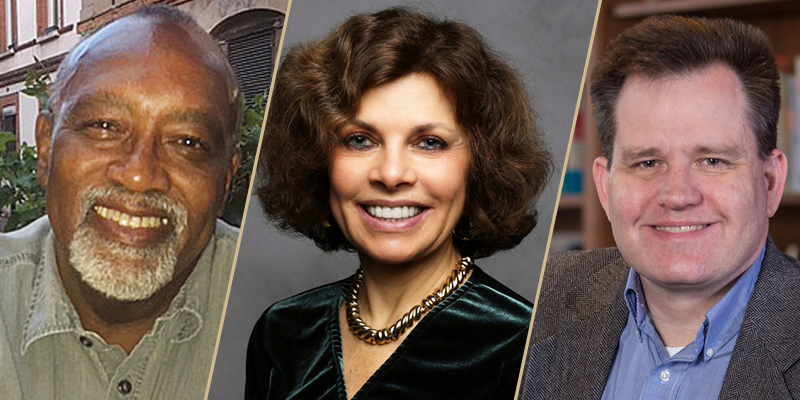
  • Glenn C. Loury is the Merton P. Stoltz Professor of Economics at Brown University. He holds a bachelor’s degree in mathematics from Northwestern University and a PhD in economics from Massachusetts Institute of Technology. As an economic theorist, he has published widely and lectured throughout the world on his research. He also is among America’s leading critics on racial inequality. He has been elected as a distinguished fellow of the American Economics Association, as a member of the American Philosophical Society and the U.S. Council on Foreign Relations, and as a fellow of the Econometric Society and the American Academy of Arts and Sciences. His 1995 book “One by One, From the Inside Out: Essays and Reviews on Race and Responsibility in America,” won the American Book Award and the Christianity Today Book Award.
  • Nadine Strossen is the John Marshall Harlan II Professor of Law, Emerita at the New York Law School and former president of the American Civil Liberties Union (1991-2008), who spoke at Purdue in February 2016. She is a senior fellow with the Foundation for Individual Rights and Expression (FIRE ) and a leading expert and frequent speaker and commentator on constitutional law and civil liberties who has testified before Congress. She serves on the advisory boards of the ACLU, Academic Freedom Alliance, Heterodox Academy and the National Coalition Against Censorship. The National Law Journal has named Strossen one of America’s “100 Most Influential Lawyers.” Her 2018 book “HATE: Why We Should Resist It With Free Speech, Not Censorship” has been selected as the common read by Washington University in St. Louis in 2019 and Washburn University in 2022.
  • Keith E. Whittington is the William Nelson Cromwell Professor of Politics at Princeton University, chair of the Academic Freedom Alliance and a visiting fellow at the Hoover Institution. He works on U.S. constitutional history, politics and law, and on American political thought. Whittington is the author of “Repugnant Laws: Judicial Review of Acts of Congress From the Founding to the Present” and “Speak Freely: Why Universities Must Defend Free Speech,” among other works. He has been a visiting professor at Harvard Law School, Georgetown University Law Center and the University of Texas School of Law, and he is a member of the American Academy of Arts and Sciences. He served on the Presidential Commission on the U.S. Supreme Court. He completed his undergraduate work at the University of Texas at Austin and PhD in political science at Yale University.

Purdue placed an emphasis on free speech in 2015, when it became the first public university to adopt the Chicago Principles, a landmark declaration of the importance of freedom of expression in any university community. Purdue reinforced its commitment in 2016 by incorporating a dedicated module on freedom of expression during Boiler Gold Rush, its weeklong student orientation program.

Purdue’s pledge continues to gain national attention. The latest recognition: a No. 3 ranking in 2022 for campus free speech from the College Pulse/FIRE survey. Purdue climbed three spots from 2021 and highlights its ongoing emphasis on the importance of the topic as vital to its mission as a land-grant institution. In the latest College Pulse/FIRE ranking, Purdue trailed only the University of Chicago, which developed the Chicago Principles, and Kansas State University. Mississippi State and Oklahoma State universities rounded out the top five.

Moreover, Purdue and the University of Chicago are the only Association of American Universities members in the top 10. Purdue remains the highest-ranking member of the Big Ten (next is the University of Maryland at No. 20) and leads all Indiana-based schools (the University of Notre Dame is next at No. 31 on the overall listing).

As Purdue’s chief legal officer, Schultz advises the board of trustees, the president and senior administrators on issues of law, governance and risk management and oversees representation of the university in all legal matters. In addition to developing and leading its internal legal operation since joining Purdue in 2013, Schultz was one of the architects of the Boiler Gold Rush free speech orientation module, which he still moderates each year.

Before coming to Purdue, he practiced as a corporate attorney and served as general counsel for several firms in the private sector. Schultz was chief counsel for Daniels when he was governor of Indiana. An Indianapolis native, Schultz received an undergraduate degree in history and political science from Butler University and law degrees from Yale and Cambridge (Trinity Hall) universities.

About Purdue University

Purdue University is a top public research institution developing practical solutions to today’s toughest challenges. Ranked in each of the last five years as one of the 10 Most Innovative universities in the United States by U.S. News & World Report, Purdue delivers world-changing research and out-of-this-world discovery. Committed to hands-on and online, real-world learning, Purdue offers a transformative education to all. Committed to affordability and accessibility, Purdue has frozen tuition and most fees at 2012-13 levels, enabling more students than ever to graduate debt-free. See how Purdue never stops in the persistent pursuit of the next giant leap at https://purdue.edu/.

Writer and Media Contact: Phillip Fiorini, pfiorini@purdue.edu, 765-430-6189

Adblock test (Why?)


"discourse" - Google News
November 18, 2022 at 02:11AM
https://ift.tt/j7dNoBM

Purdue symposium during 'MitchFest' will focus on free speech for advancing healthy civil discourse on university campuses - Purdue University
"discourse" - Google News
https://ift.tt/wpoMPYr
https://ift.tt/yG7kSHA

Our opinion: A sign of some state listening - timesobserver.com

“We hear their voice.”

State Rep. Joe Hamm, R-Hepburn Township, emphasized that as an incumbent lawmaker — even one running uncontested in this month’s election — he understands the importance of staying connected to his constituents.

It’s an important reminder of the role of our state lawmakers, and it’s clear that Hamm understands his role.

We also were heartened to hear Hamm and state Rep.-elect Jamie Flick address their priorities in the next session, which we feel are exactly what our state government’s priorities should be.

Hamm mentioned inflation and economic worries felt by our region — the price increases at “the gas pumps … the grocery store and when you heat your home in the winter.”

He mentioned the burden of 153,000 regulations on Pennsylvania’s small businesses and other employers, and specifically cited a Pittsburgh-area steel mill lost to a relocation to West Virginia after applying for permits in Pennsylvania needlessly dragged on.

Flick also mentioned the pain of energy prices and said a return to energy independence and revitalization of Pennsylvania’s natural gas industry are priorities.

“We have enough natural gas to supply the entire state for decades,” he noted.

Flick included mental health services in schools and shortages of substitute teachers as pressing matters he wants to see the state address.

Perhaps most importantly, he said he intends to listen to constituents from all political perspectives and intends to work across the aisle.

We are optimistic about our state representatives in the next state Legislature and we hope to see them succeed in listening to and working with both sides in our frequently too-divisive political climate.

It’s what our state — and our country — needs.

Today's breaking news and more in your inbox

Adblock test (Why?)


"Opinion" - Google News
November 17, 2022 at 12:03PM
https://ift.tt/xp1T9VN

Our opinion: A sign of some state listening - timesobserver.com
"Opinion" - Google News
https://ift.tt/dKig4SF
Shoes Man Tutorial
Pos News Update
Meme Update
Korean Entertainment News
Japan News Update

Tuesday, November 15, 2022

Opinion: Airlines have gotten away with this long enough - CNN

Editor’s Note: Jill Filipovic is a journalist based in New York and author of the book “OK Boomer, Let’s Talk: How My Generation Got Left Behind.” Follow her on Twitter. The opinions expressed in this commentary are solely her own. View more opinion on CNN.

CNN  — 

In my line of work – and probably yours, too – I cannot collect payment for a service, refuse to perform it, refuse to issue a refund and expect to remain legally and reputationally in the clear. If I did that, and especially if I did it over and over again, I would expect to be sued, shunned and eventually out of a job.

Jill Filipovic

But I’m not an airline.

This week, the Department of Transportation (DOT) announced that six airlines have been forced to issue $600 million in refunds. The DOT is also fining the airlines $7.25 million for flights that were canceled during Covid and not refunded. Those facing fines include Frontier, Air India, TAP Portugal, Aeromexico, El Al and Avianca.

It’s about time this industry saw some consequences. The airline industry posted record profits this past summer, while also canceling and delaying a huge number of flights. When an industry is failing at doing its one job properly and yet is still making money hand over fist, there’s a big problem – and it’s one being borne by consumers.

I’m one of them. I was booked on a TAP Portugal flight to Lisbon in the spring of 2020, which obviously didn’t happen because of Covid. That’s understandable – I didn’t expect to board a flight during a global pandemic. But given that the flight didn’t fly, I did expect my money back. For more than a year and a half, I didn’t get it, despite messages and calls to both TAP and Expedia. Eventually, in December 2021, I received a partial refund, though still far below the full cost of the ticket.

A similar thing happened last Christmas: I flew to Kenya for the holidays on a ticket booked with Chase credit card points, and on Dec. 23, I received an email that Emirates had canceled my return flights – and had, as it turned out, also canceled all of its flights out of Nairobi, stranding my husband and me. We had to book a last-minute one-way flight home on a different airline, during one of the busiest travel periods of the year.

After weeks of back and forth with Emirates and Chase, and in that particular purgatory one is thrust into when trying to recoup one’s losses from two major companies, neither of which wants to take financial responsibility, we were never reimbursed by either – although I do have an expired Emirates credit sitting in my Chase account, a now-invalid offer to fly an airline I hope to never set foot on.

Virtually no other industry is permitted to operate this way. And it is mind-boggling that airlines can sell you a ticket to get from Point A to Point B, not fly the plane from Point A to Point B and then keep your money – or issue you a credit they know you’re unlikely to use, so you can do the same thing all over again.

Covid has, of course, complicated things. Some cancellations are due to lack of staffing. But it’s hard to feel sorry for an industry that accepted massive government bailouts, culled its staff anyway and then says it simply doesn’t have the personnel to operate the flights it scheduled with the full knowledge of its own limitations – especially when that industry has been charging more and raking in record revenue.

Get our free weekly newsletter

According to Transportation Secretary Pete Buttigieg, the DOT will be “ratcheting up the penalty side” until airlines change their behavior. And this is frankly the least they can do. Over and over, airlines exploit the fact that their customer base is a captive one, often desperate to get to where they were going and with little alternative. And so passengers muddle through all kinds of insults and indignities, from major ones like cancelations to more mundane and minor offenses, like seats far too small for the average human and being nickel-and-dimed for expecting to carry on a bag.

At the very least, if airlines do not provide the service they sold – flying an airplane on the day and time scheduled – they should pay up. If they delay flights significantly, they should pay up, or provide passengers with a place to stay and something to eat – without making them stand in hours-long lines to collect measly, limited little vouchers. They should issue reimbursements automatically and swiftly, without requiring passengers to spend hours hounding them for refunds. And if they don’t, they should expect to see exactly what’s happening now, thanks to the Buttigieg DOT: paying far more than if they had just done the right thing in the first place.

Adblock test (Why?)


"Opinion" - Google News
November 16, 2022 at 04:56AM
https://ift.tt/C7zpygQ

Opinion: Airlines have gotten away with this long enough - CNN
"Opinion" - Google News
https://ift.tt/lDTZoYM
Shoes Man Tutorial
Pos News Update
Meme Update
Korean Entertainment News
Japan News Update
Our opinion: GOP must change or risk irrelevancy - timesobserver.com

The red wave that was supposed to flood the country on Election Day was more like a red ripple — except for Pennsylvania, where a blue wave should have the state’s Republicans thinking about making some changes.

Democrats have thus far gained nine seats on the state House of Representatives, threatening a majority Republicans have held in the chamber since 2010. There are still eight races too close to call. And, while Republicans are poised to keep control of the Senate, Democrats closed the gap in the 40-member chamber.

Many have said Democrats’ election gains are the result of new legislative lines drawn this year. While the new district lines may indeed have helped give Democrats a legitimate shot in some districts, Republicans likely shot themsleves in the foot as well.

It’s difficult to talk about stolen elections and then expect people to get out and vote. Democrats embraced mail-in voting while Republicans largely shunned the newer practice — and it likely hurt the party last week. According to pennlive.com, Republicans in statewide races also struggled in the Philadelphia and Pittsburgh suburbs, which indicates voters in those areas weren’t buying what Republicans were selling.

One thing is obvious following last week’s lackluster showing by Republicans in Pennsylvania — it’s time to change. If the GOP doesn’t, it needs look no further than New York to see how irrelevant the party can be in state politics.

Today's breaking news and more in your inbox

Adblock test (Why?)


"Opinion" - Google News
November 15, 2022 at 12:22PM
https://ift.tt/ptCanQo

Our opinion: GOP must change or risk irrelevancy - timesobserver.com
"Opinion" - Google News
https://ift.tt/3lDpUCH
Shoes Man Tutorial
Pos News Update
Meme Update
Korean Entertainment News
Japan News Update

Search

Featured Post

I just paid $9.99 for a carton of 18 eggs. Will prices ever drop? | Opinion - Sacramento Bee

[unable to retrieve full-text content] I just paid $9.99 for a carton of 18 eggs. Will prices ever drop? | Opinion    Sacramento Bee ...

Postingan Populer