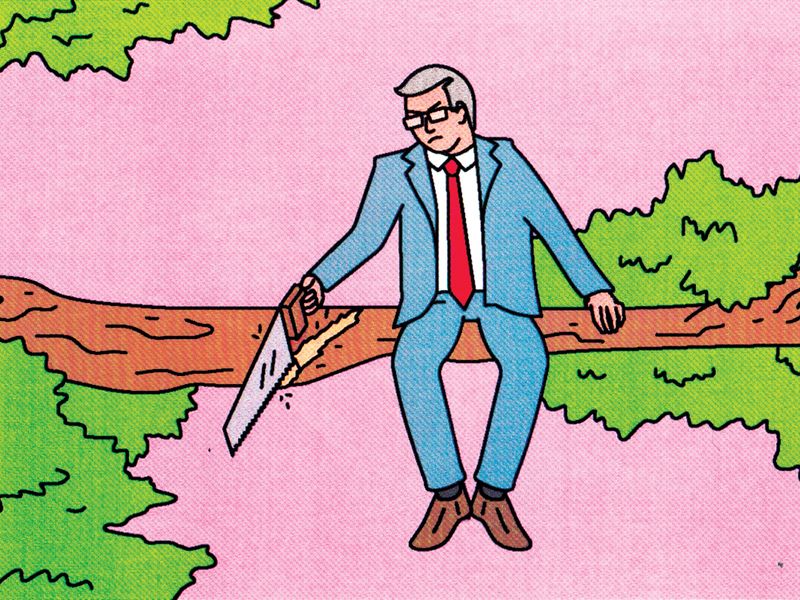
January is the month when bills for all that holiday shopping start arriving to remind you the economy is still uncertain and everything costs too damn much. So as we look back on auld lang syne—which literally means days gone by—marketers everywhere should consider the costs of fateful decisions we made in years past.
Our industry is standing on quicksand, its foundations undermined and fortunes eroded—not by disruptions in media habits or last year’s pandemic, but from years of rapacious cost-cutting by clients and holding companies desperate to convince Wall Street they have a viable business plan.
Which they don’t.
Clients don’t want to admit that procurement has cost more money than it’s saved, especially when you consider its effect on performance, relationships and agency tenure. Agencies once partnered with clients for decades, but now the average is barely three years, roughly the ephemeral lifespan of a modern CMO. Add the cost of an agency search, hiring a pitch consultant and starting from scratch with a new campaign every two years.
Try spending your way out of the inevitable drop in brand awareness, then ask if that 20% haircut you gave your marketing team (which got passed along to your agency) was really worth it. Or come to your senses and ask finance to try something new: measure the return on investment in long-term relationships.
Pre-holding company, most agencies invested in top talent and bench strength to think proactively. Today, big agencies have neither, so they use sleight of hand to distract clients from noticing that their most senior account person is half the client’s age and has never worked on an account like this ... but is incredibly excited to give it a try.
Hello, small agency founded by disaffected senior talent with actual experience? I’m wondering if you’d take a meeting.
The inflection point occurred years ago, when the big four—Ogilvy, Y&R, Grey and JWT—got assimilated, and a holding company achieved enough scale that Wall Street bought into the argument that talent could be commoditized, infrastructure could be optimized and inefficiencies could be banished.
Let’s save the original sin of unbundling media for another column, but bear in mind that none of the bureaucrats building the holding companies were practitioners of marketing. They weren’t clients, creatives, strategists or account people. They never made an ad, helped a business grow or marketed their way out of a paper bag, let alone a recession. Their entire approach to the bottom line was cost-based, not revenue-driven.
If they had marketing experience, they might have realized an agency’s infrastructure isn’t juicy enough to squeeze for cash. There are no factories, elaborate supply chains or fleets of trucks. Anyone with a credit card could rebuild the back end of most agencies with one trip to Best Buy or, if you’re talking about R/GA or Huge, a visit to the Apple Store. The people are the infrastructure, and so-called inefficiencies in the creative process are the messy moments that make it creative in the first place. If your business is art-as-commerce, don’t be surprised when some paint splatters across the floor.
Hello, overpriced consulting firm that delivers PowerPoint slides but no actual results? I’ll give you one more chance if you find a way to make money that doesn’t involve buying more companies and screwing up what made them successful in the first place. Yes, you can put me on hold.
Agencies can share their miser’s misery because clients made the same mistake. As budgets grew, marketing departments became matrixed muddles of mid-level managers responsible for the creative agency, the media agency, the digital agency, the design agency, the innovation firm, the brand consultants, the business consultants and the PR agency. Oh, and don’t forget the website. More people than you have fingers and toes to manage more agencies than any brand needs.
No wonder each slice of the pie gets thinner each year.
In a marketplace where 90% of all products and services are undifferentiated, your brand is the only unique selling proposition that matters, and talent and ideas are the only things that set clients and agencies apart.
It’s high time agencies and clients realize that size is often an impediment to creativity, not a winning formula for back-office consolidation. The only thing you need to grow is your ambition, and a big idea is always more efficient and effective than mediocrity at scale.
(You don’t need a consultant to tell you that, it’s something you already knew but were afraid to say during your last finance meeting.)
The new year will bring an accounting for the true costs of decisions that seemingly made sense in the midst of a global pandemic. Lockdowns, school closures, the list goes on and on. By comparison, the challenges facing the marketing industry seem inconsequential, so the least we can do is look them in the eye. And if we see a reflection of our own venal nature, let’s do something about it. Invest in better ideas and the people behind them.
The only cost you should be worried about is the cost of failure, because the last thing anyone needs is another brand in their life. So this year, make yours count for something.
"Opinion" - Google News
January 14, 2021 at 02:49AM
https://ift.tt/39tCk0O
Opinion: The real cost of cost-cutting - AdAge.com
"Opinion" - Google News
https://ift.tt/2FkSo6m
Shoes Man Tutorial
Pos News Update
Meme Update
Korean Entertainment News
Japan News Update


No comments:
Post a Comment